


Introduction: The Light of the Dhamma
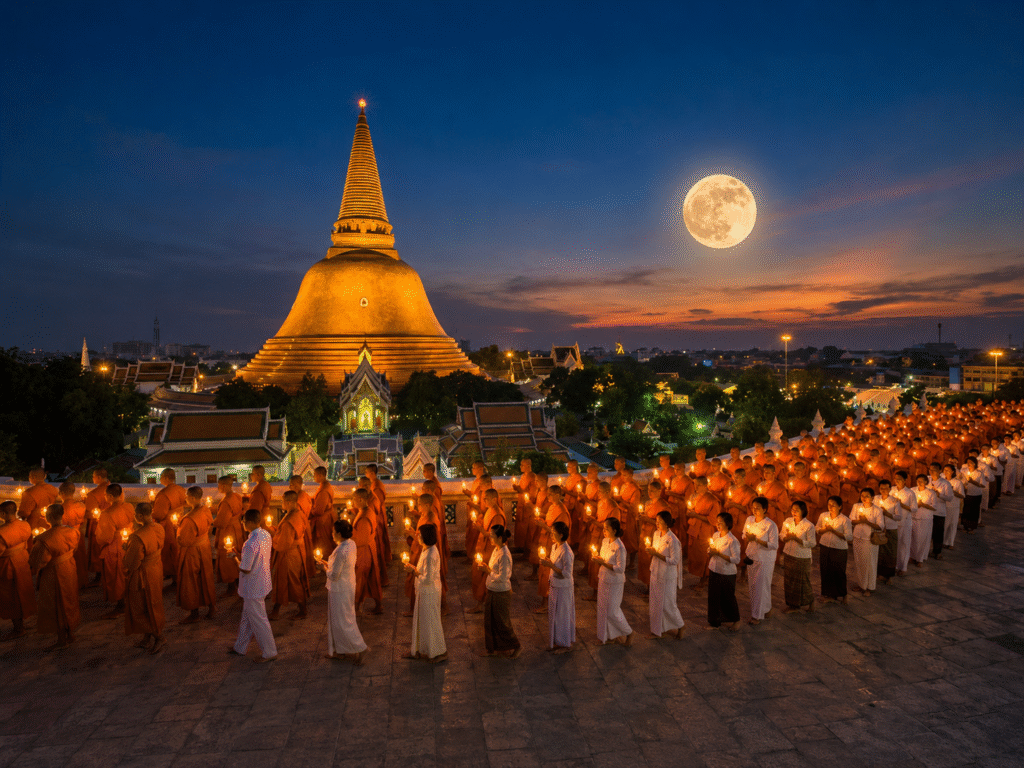
Every year, typically occurring in July or August on the 15th day of the waxing moon in the eighth lunar month of Āsādha, a remarkable spiritual phenomenon unfolds in many parts of the globe. Millions of Theravada Buddhists gather in serene devotion. As the sun sets, the darkness is gently pushed back by a growing ocean of warm, flickering light. Devotees emerge into the evening breeze, holding lit candles, glowing incense, and fresh lotus flowers, walking mindfully in a tranquil procession around sacred stupas and temple grounds.
This visually stunning ritual is the profound celebration of Asalha Puja, widely recognized globally as “Dhamma Day”. It commemorates the exact moment when the Buddha’s supreme wisdom was first shared with the world, setting the ultimate truth into motion. Over the years, I have extensively explored the profound depths of this sacred occasion and its contemporary relevance in three previous articles published on Thailandfoundation.or.th:
• Asalha Puja Day: Dhamma Day (July 8, 2022)
• Insights into the Buddha’s First Sermon (Asalha Puja Day) and its Relevance for Modern Life (July 3, 2023)
• Unfolding the Buddha’s Map of Suffering and Liberation on Asalha Puja (July 9, 2025)
Building upon those reflections, this article respectfully reimagines the genesis of the Dhamma. Just as an earthly emperor beats the war drum to expand his territory, the Buddha, as the Dhamma Raja (King of Dhamma), sounded the drum of truth on this day to establish an eternal empire of peace and liberation.
The Unique Thai Observance
The observance of Asalha Puja carries immense cultural and spiritual weight. However, its formal celebration as a major national holiday possesses a uniquely Thai character. In Thailand, the formal ceremonies and public recognitions for Asalha Puja were officially established by the Supreme Sangha Council in 1958, granting the day observances equivalent in grandeur to those of Visakha Puja. Other Theravada Buddhist countries have not traditionally accorded this specific day the exact same level of national holiday status.
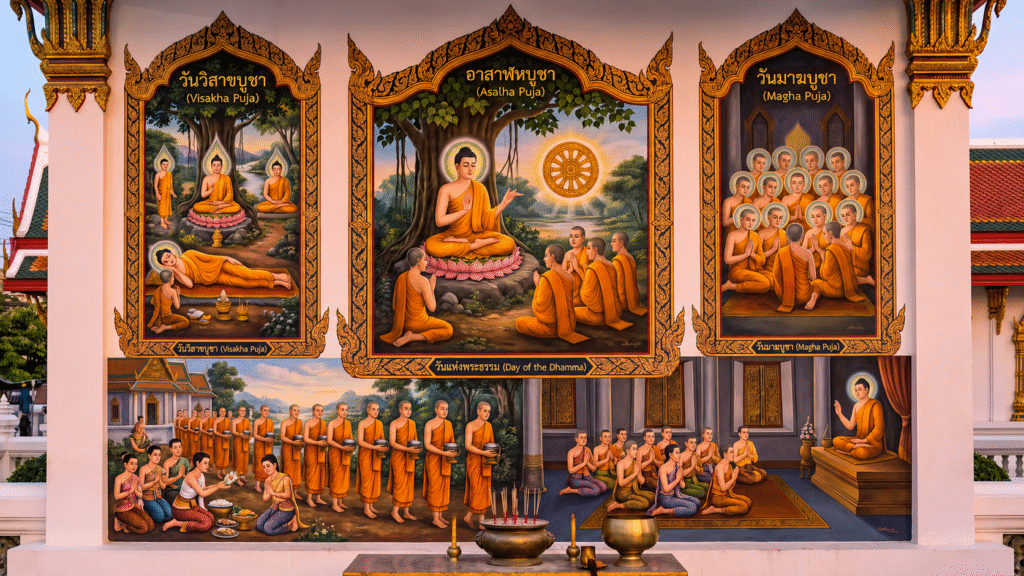
More importantly, Thai Buddhists hold a highly distinct, tripartite categorization of their sacred holidays. Guided by historical and spiritual milestones, Thai Buddhists distinctly revere Visakha Puja as the “Day of the Buddha,” Magha Puja as the “Day of the Sangha” (honoring the miraculous assembly of enlightened monks), and Asalha Puja as the “Day of the Dhamma” (honoring the Buddha’s first sermon, the Dhammacakkappavattanasutta). This specific framework is a unique hallmark of Thai Buddhist understanding.
Traditional observances throughout the day in Thailand include heartfelt merit-making activities, offering alms to monks, maintaining ethical precepts, and listening to profound teachings. The spiritual climax occurs in the evening with the Wien Thian circumambulation, where devotees walk clockwise around sacred temple ordination halls three times, deeply honoring the Triple Gem.
The Middle Way: Escaping the Extremes
To truly appreciate the magnitude of Asalha Puja, one must understand the ancient world into which the Dhamma was introduced. Over 2,600 years ago, society was trapped between two completely extreme and unfulfilling lifestyles. On one end of the spectrum, the affluent immersed themselves in materialism and sensual indulgence, clinging tightly to wealth and physical pleasures. On the other end, resolute ascetics sought spiritual purity through extreme, punishing methods, starving and torturing their bodies.
Seeking ultimate spiritual liberation, Siddhartha Gautama tested both extremes. Having found them utterly incapable of ending human suffering, he abandoned them and formulated a radically new approach based on objective observation and the cultivation of wisdom. Following his supreme awakening under the Bodhi tree, the Buddha journeyed for two months to the Deer Park in Isipatana (modern-day Sarnath) to find his five former ascetic companions.
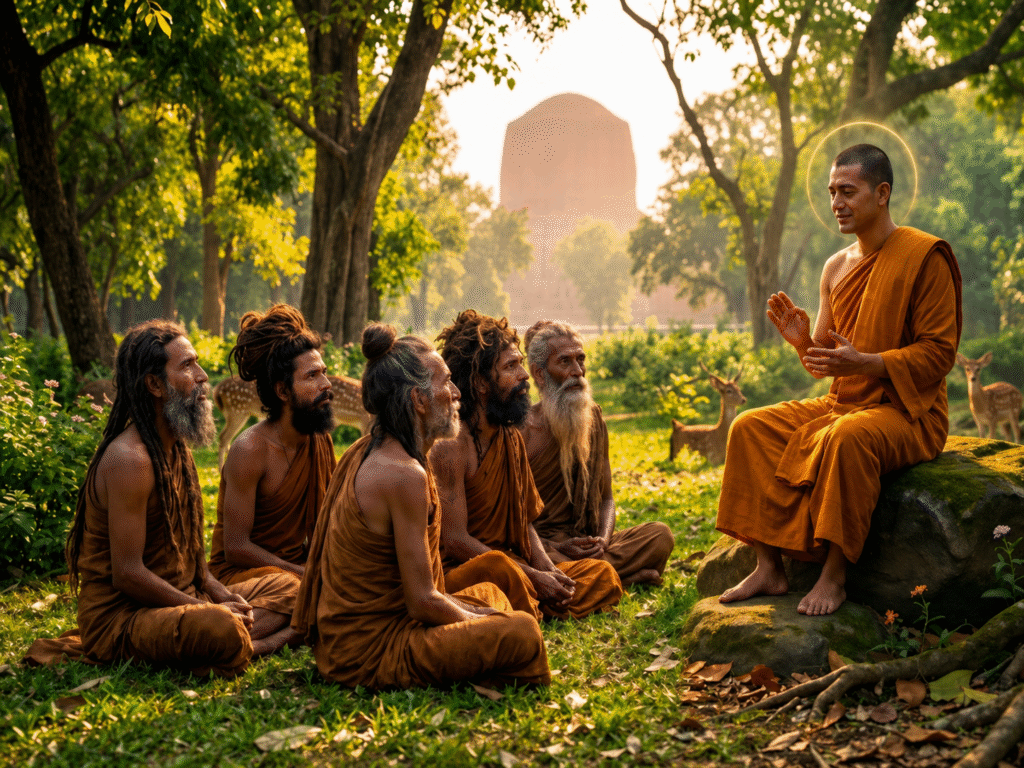
Upon reuniting with them, the Buddha delivered his inaugural discourse: the Dhammacakkappavattanasutta, or the “Setting in Motion of the Wheel of the Dhamma”. He boldly urged his companions to completely abandon the two extreme dead ends of sensual indulgence and self-mortification. Instead, he revealed the “Middle Way” (Majjhima Patipada)—a perfectly balanced lifestyle rooted in profound wisdom that leads directly to absolute peace, direct knowledge, enlightenment, and ultimately, Nibbāna.
A Diagnostic Operating System: The Four Noble Truths
The brilliance of the Buddha’s first sermon lies in its radical clarity. He did not introduce an abstract philosophy or demand blind obedience to unseen deities; instead, he presented a practical, scientific diagnostic operating system known as the Four Noble Truths.
First, he diagnosed the objective reality of the symptom: The Noble Truth of Suffering (Dukkha). He explained that birth, aging, illness, and death are suffering. Second, he identified the root cause: The Noble Truth of the Origin of Suffering (Samudaya). He revealed that suffering is driven by craving (Tanha)—the relentless thirst for sensual pleasures and existence. Third, he envisioned the prognosis and the cure: The Noble Truth of the Cessation of Suffering (Nirodha).
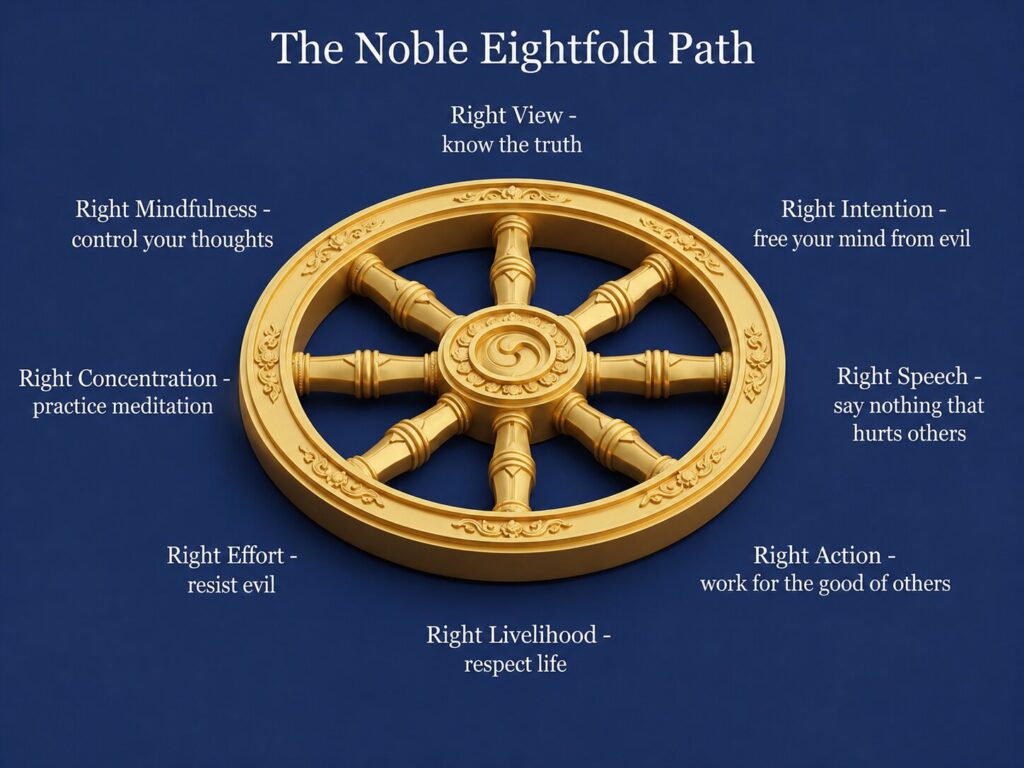
He declared that suffering ends with the remainderless fading away and cessation of that exact same craving, offering hope for a completely liberated mind. Finally, he prescribed the treatment plan: The Noble Truth of the Way Leading to the Cessation of Suffering (Magga). This is the Noble Eightfold Path, a comprehensive system of ethical conduct, mental discipline, and wisdom.
The Awakening and the Completion of the Triple Gem
As the Buddha meticulously unfolded these truths, a profound spiritual transformation occurred. Venerable Koṇḍañña, one of the five ascetics, listened intently and developed such deep insight that he attained the brilliant “Eye of Dhamma”. There arose in him the dust-free vision of the truth: “Whatever is subject to origination is all subject to cessation”.
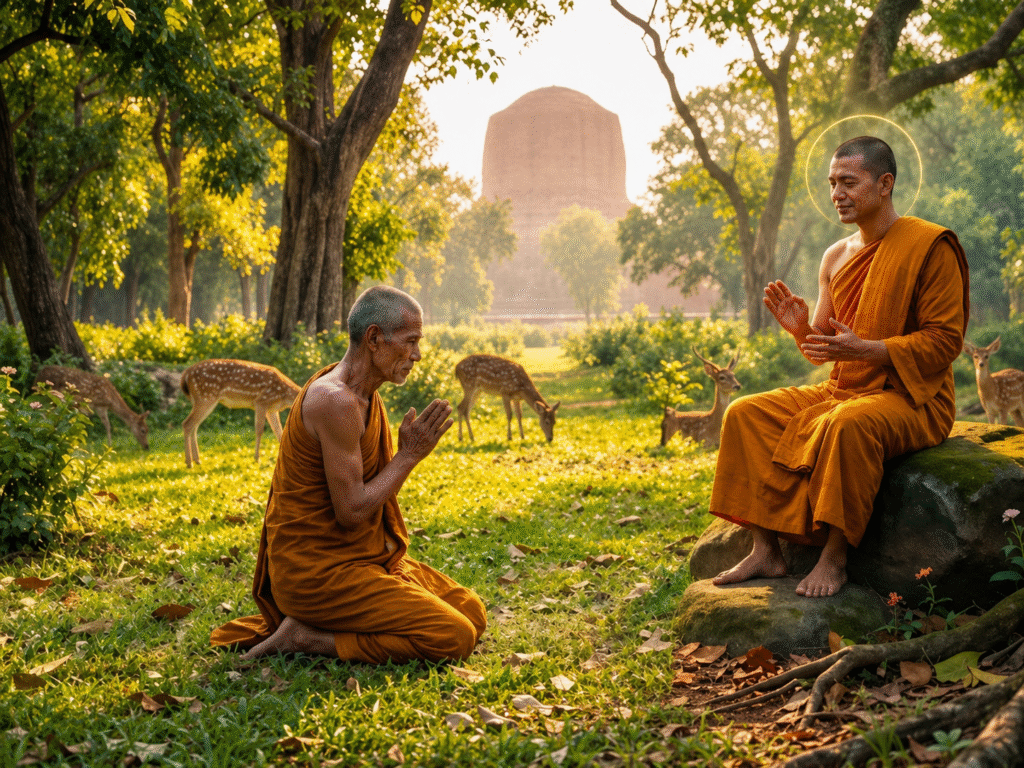
Sensing this monumental breakthrough, the Buddha uttered: “Koṇḍañña has indeed understood!”. He was instantly ordained as the world’s very first Buddhist monk by the Buddha. On this mid-July day, the spiritual foundation of Buddhism was solidified. The Triple Gem—the Buddha, the Dhamma, and the Sangha—was flawlessly completed and unbroken for the first time in history. Yet, in the unique spiritual lens of Thai Buddhists, the absolute core of this day remains the glorious celebration of the Dhamma being shared with humanity. Days later, he would teach the Anattalakkhaṇasutta (The Characteristic of Nonself), completely freeing the minds of all five monks and giving birth to the world’s first Arahants.
The Living Legacy and the Rains Retreat (Vassa)
Aesthetically and structurally, the observance of Asalha Puja acts as a critical spiritual doorway. The day immediately following Asalha Puja is known in Thailand as Wan Khao Phansa; it marks the official beginning of Vassa, the Theravada Rains Retreat. Monks begin this sacred retreat to strictly practice and teach the Dhamma.
This timeless wisdom then naturally flows to laypeople, opening a dedicated season for practical spiritual renewal. Guided by the Buddha’s teaching in the Ittha Sutta, practitioners realize that mere prayers or wishes fail to bring true results; only actual, mindful action succeeds. Taking true action, many individuals resolve to abandon harmful habits—such as abstaining from alcohol—and cultivate deep mindfulness to navigate modern challenges.
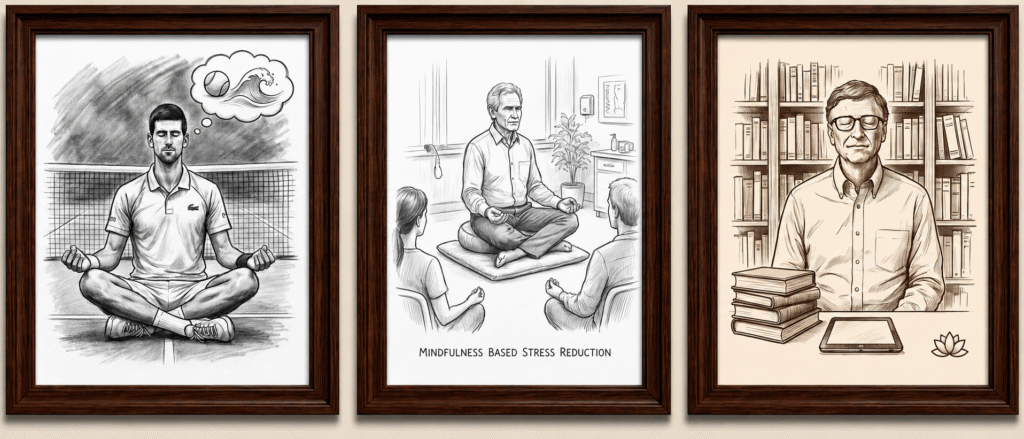
Today, this incredible living legacy extends far beyond traditional religious boundaries, serving as a practical tool for humanity in the modern era. Beyond everyday societal challenges, the Buddha’s profound teachings on mental clarity are actively utilized by global leaders across various demanding fields. Elite athletes like Novak Djokovic utilize mindfulness to conquer immense competitive pressure and maintain inner focus on the world stage. In modern medicine, visionary Dr. Jon Kabat-Zinn successfully applies these exact meditative practices to heal human stress and anxiety in clinical settings. Even technology pioneer Bill Gates relies on deep meditation to achieve ultimate mental clarity and process complex information. Ultimately, truly living the Buddha’s teachings creates expanding ripples of profound and lasting inner peace.
Conclusion: The Unstoppable Wheel
When the Buddha set the Wheel of the Dhamma into motion at the Deer Park in Isipatana, it marked a monumental pivot in human history. For the first time, liberation from psychological suffering was presented not as a divine favor or a mystical secret, but as an accessible, universal truth based on the laws of nature and human consciousness. Ancient records describe this breakthrough as an “unstoppable wheel”—a metaphor symbolizing that once the fundamental truths of mental clarity, cause and effect, and inner peace are brought to light, they cannot be unlearned or suppressed by any dogma or power in the world.
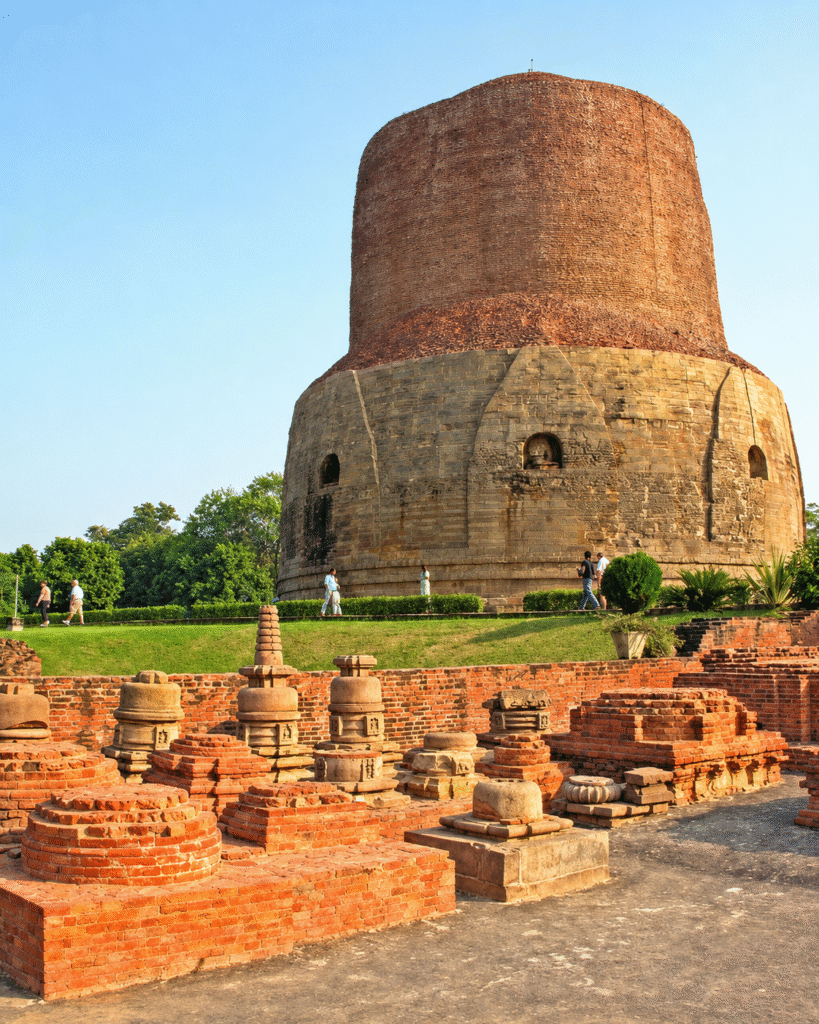
Today, Asalha Puja beautifully bridges the ancient and the modern, uniting global communities from the historic Dhamek Stupa in India and the majestic Borobudur in Indonesia to the glowing, candlelit temples of Thailand. As a sea of candlelight gently pushes back the darkness every year, it serves as a powerful visual reminder of a core reality: supreme freedom from stress and suffering is not a myth of the ancient past, nor is it reserved for the cloistered ascetic.
Instead, the Dhamma remains a living, transformative force—an active possibility unfolding in every moment of mindfulness, every act of compassion, and every step taken with intention and cognitive clarity. Over 2,600 years later, this wheel of wisdom is still turning, offering a profound, practical path to peace for anyone, regardless of culture or creed, willing to walk it.
References
• Bodhi, Bhikkhu (Trans.). (2000). SN 22.59: Anattalakkhaṇasutta (The Characteristic of Nonself). The Connected Discourses of the Buddha. Wisdom Publications / SuttaCentral.
• Bodhi, Bhikkhu (Trans.). (2000). SN 56.11: Dhammacakkappavattanasutta (Setting in Motion the Wheel of the Dhamma). The Connected Discourses of the Buddha. Wisdom Publications / SuttaCentral.
• Gates, Bill. (2018). “Why I’m into meditation.” GatesNotes (The Blog of Bill Gates).
• Jandamit, Komsan. (2025). “Asalha Puja Day: What is this mid-July Buddhist holiday?” Bangkok Post.
• Kabat-Zinn, Jon. (1990). Full Catastrophe Living: Using the Wisdom of Your Body and Mind to Face Stress, Pain, and Illness. Delta Trade Paperbacks.
• Payutto, P. A. (Somdet Phra Buddhaghosacariya). (2017). BuddhaDhamma: The Laws of Nature and Their Benefits to Life. Translated by Robin P. Moore. Buddhadhamma Foundation.
• Songkaeo, Paitoon. (2022–2025). Articles on Asalha Puja. Thailand Foundation.
• Stowers, Chris. (2016). “Novak Djokovic’s Secret Weapon: Mindfulness.” The New York Times / Various Sports Interviews. (Reference to Djokovic’s practice of Mindfulness Meditation).
• Wikipedia, The Free Encyclopedia. “Asalha Puja.”
About the Author
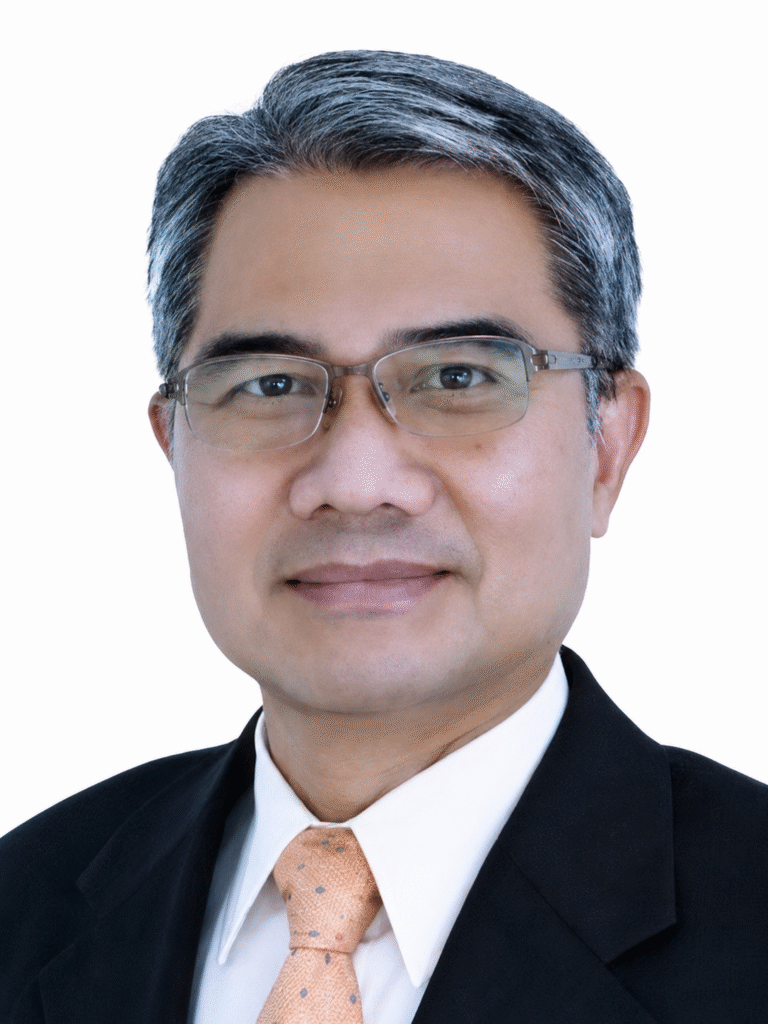
Dr. Paitoon Songkaeo is the Administrative Director of the Thailand Foundation. Before entering public service, he spent 16 years as an ordained Theravāda Buddhist monk, undertaking extensive study of the Pali Canon and the philosophical foundations of Buddhism within Thailand’s monastic scholarly tradition. Following his monastic life, he joined the Ministry of Foreign Affairs of Thailand, serving in a variety of diplomatic and international assignments, including as Consul-General in Kota Bharu, Malaysia, until his retirement in 2017.
He is now a regular contributor to the Thailand Foundation’s Spiritual Values & Meditation section, where he seeks to translate timeless Buddhist wisdom into practical and accessible approaches for addressing the psychological, social, and ethical challenges of contemporary life. For correspondence, he may be reached at: [email protected]