


เนื้อหาในรูปแบบวิดีโอ
สำหรับท่านที่ต้องการรับชมและรับฟัง บทความนี้มีการนำเสนอในรูปแบบวิดีโอด้วยเช่นกัน
วิดีโอนี้จัดทำขึ้นทั้ง ภาษาไทย และ ภาษาอังกฤษโดยนำเสนอสาระสำคัญเดียวกันผ่านการถ่ายทอดเชิงสะท้อนความคิดและการอธิบายอย่างเป็นลำดับขั้นตอน
1. บทนำ
Each year on September 21st, the United Nations observes the “International Day of Peace” to encourage humanity to reflect on the importance of peaceful coexistence. Often, the concept of “peace” immediately evokes the cessation of armed conflict. In reality, the challenges that undermine global harmony exist on two distinct levels.
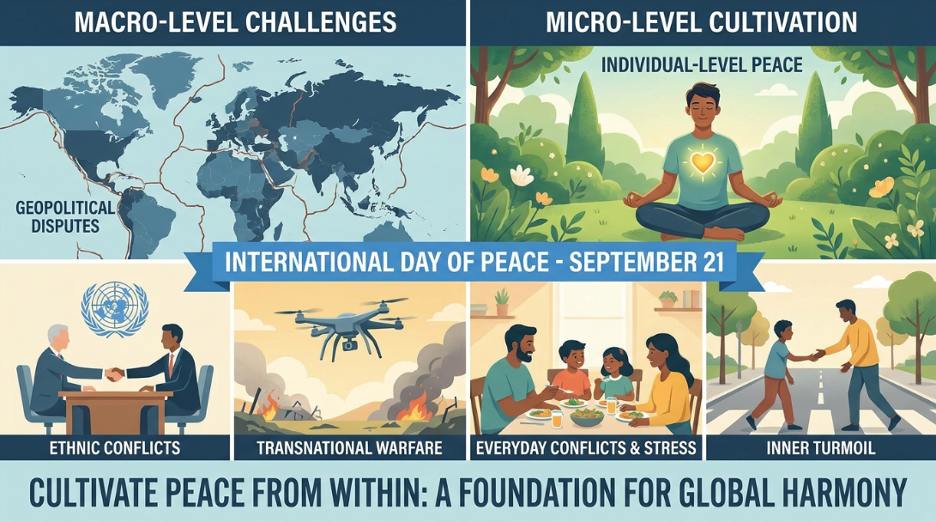
The first involves macro-level and structural issues, such as geopolitical disputes, ethnic conflicts, and transnational warfare. These complexities undoubtedly require international mechanisms, diplomacy, and global cooperation to be resolved. The second, however, involves micro-level, individual challenges—the everyday conflicts, stress, and inner turmoil experienced by people worldwide. While global crises may seem insurmountable for ordinary citizens to tackle directly, individual-level peace is entirely within our sphere of influence. It is a foundation that every human being can cultivate from within.
2. The Problem and Its Root Causes
While the international community strives to resolve geopolitical conflicts, the modern lifestyle inadvertently breeds an “internal war” within many individuals. The hyper-connected, fast-paced nature of contemporary life, coupled with intense competition and information overload, frequently leads to chronic stress, anxiety, and severe ideological polarization.
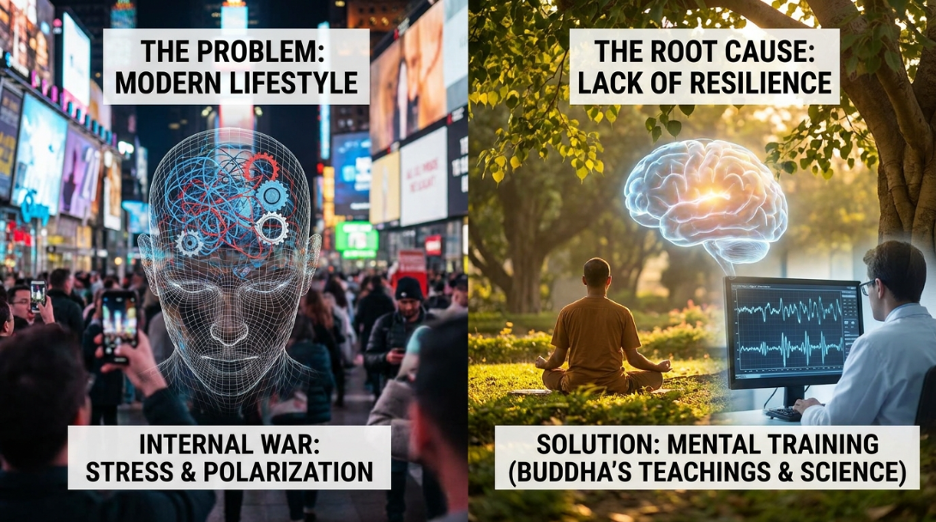
The root cause of this individual turmoil lies in a mind that lacks resilience and is easily hijacked by negative emotions. When the mind is dominated by anger, fear, or dissatisfaction, our reactions to external circumstances often manifest as aggression and friction. If left unchecked, these personal grievances accumulate, gradually escalating into broader societal divides.
Fortunately, there are practical solutions applicable to daily life. Recognizing that external turmoil often originates in the mind, the most effective intervention must begin with managing our own mental mechanisms. Here, the Buddha’s teachings serve as a profoundly effective tool—not as an imposition of religious belief, but as a systematic method of mental training supported by reason and modern scientific evidence.
3. Solutions through the Buddha’s Teachings and Corresponding Research
The individual struggles mentioned above can be significantly alleviated through “mental training,” a framework the Buddha established over two millennia ago. Today, modern science has conducted rigorous research that corroborates these ancient practices, proving their tangible impact on brain structure and human behavior.
Mitigating Anger through the Four Foundations of Mindfulness (Satipatthana): Conflict frequently originates from anger (Dosa) and ego attachment. The Buddha taught the Four Foundations of Mindfulness, particularly “Mindfulness of Mind” (Cittanupassana) and “Mindfulness of Mental Objects” (Dhammanupassana). These practices train us to observe emerging anger objectively, preventing it from dictating our actions.
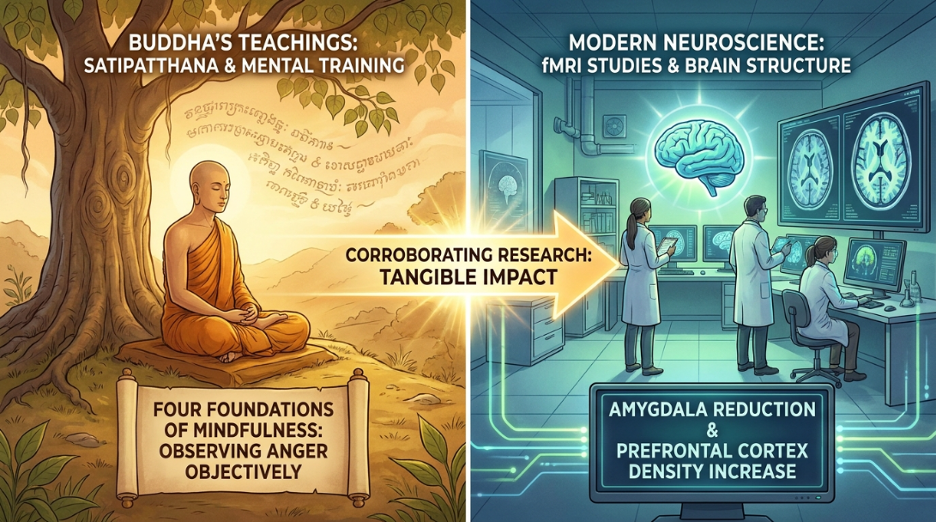
- Corresponding Research: In the field of neuroscience, fMRI studies have demonstrated that regular mindfulness and meditation practice physically reduces the size and reactivity of the amygdala—the brain’s center for processing fear and anger. Simultaneously, it increases the density of the prefrontal cortex, which governs rational decision-making. With these neural pathways strengthened, individuals can respond to provocative situations with clarity and composure, significantly reducing interpersonal aggression.
Bridging Divides through the Four Sublime States (Brahmavihara): Societal friction is often fueled by a polarized “us versus them” mentality. To counter this, the Buddha emphasized the Four Sublime States, particularly Loving-kindness (Metta) and Compassion (Karuna), as the bedrock for social harmony.
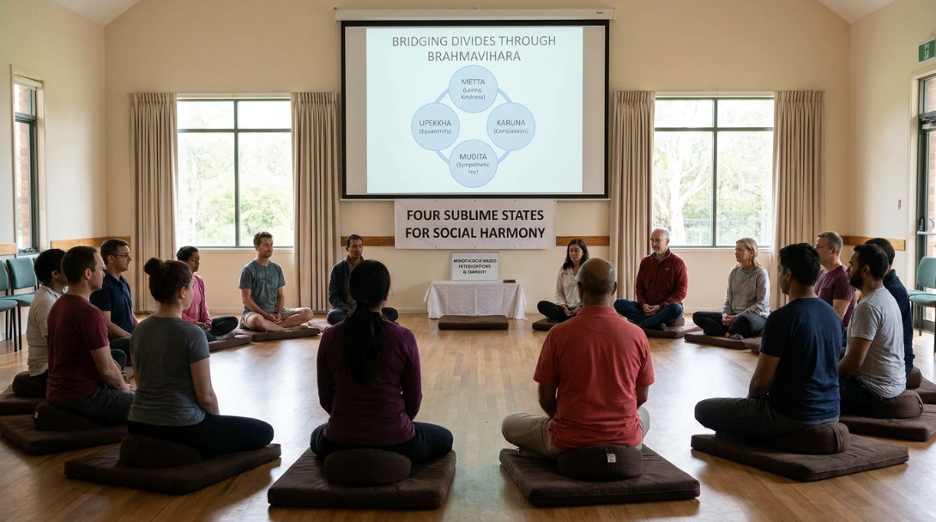
- Corresponding Research: Meta-analytic psychological studies confirm that mindfulness-based interventions substantially elevate empathy and prosocial behaviors. Practicing Loving-kindness meditation is not merely an idealistic recitation; it is a process of deep cognitive reframing. It conditions the mind to recognize the shared humanity in others, which is an essential prerequisite for resolving structural conflicts.
A Practical Guide for Modern Life
A common misconception is that meditation requires hours of absolute silence in seclusion. In truth, it is a highly adaptable practice that seamlessly fits into the demands of modern living.
Appropriate Duration and Frequency: Neuroscientific research indicates that the key to effective meditation is consistency, rather than duration. For beginners, dedicating just 10 to 15 minutes a day—consistently over 4 to 8 weeks—is sufficient to induce positive neuroplasticity and enhance emotional regulation.
Meditation Postures: Mindfulness can be cultivated in any posture. Modern practitioners can adopt the method that best aligns with their daily routine:
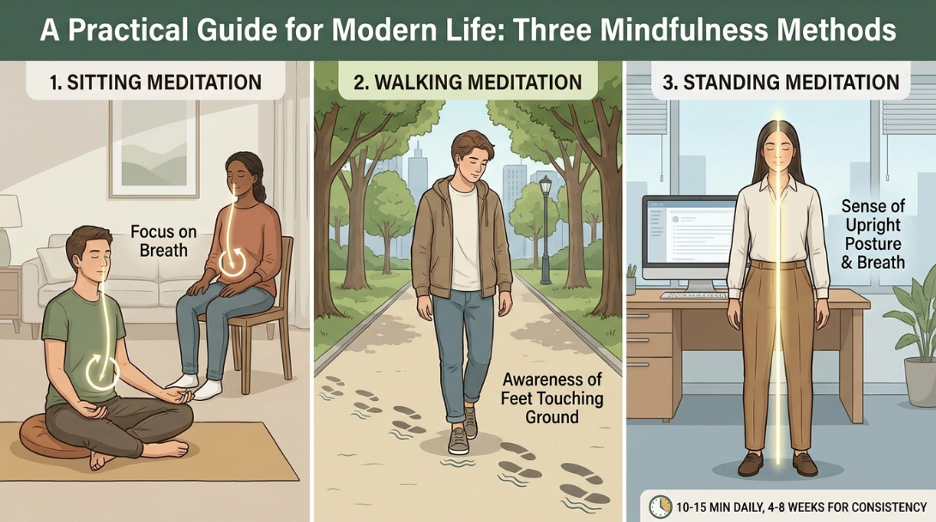
- Sitting Meditation: Sit cross-legged on the floor or on a chair with feet flat on the ground. Maintain a straight but relaxed back. With eyes closed or half-open, anchor your attention to the natural rhythm of your breath (Anapanasati). When the mind inevitably wanders, simply acknowledge the thought and gently return your focus to the breath.
- Walking Meditation: Ideal for breaking up long periods of sitting. Walk slowly over a short distance, anchoring your awareness to the soles of your feet as they make contact with the ground. This practice can be easily integrated into a commute or a stroll through a park.
- Standing Meditation: Stand with feet shoulder-width apart, arms relaxed by your sides. Focus on the sensation of your body standing upright, or on your breath. This is an excellent technique for short mental breaks away from the computer screen or while waiting in line.
4. Conclusion
On this International Day of Peace, as we advocate for state-level diplomacy and global cooperation, we must not overlook the most fundamental starting point: inner peace. As the Buddhist proverb wisely states, “Natthi Santi Param Sukham” (There is no higher bliss than peace). In this context, peace is not a void or an abstract concept; it is a mature, stable state of mind, untethered from destructive emotions.
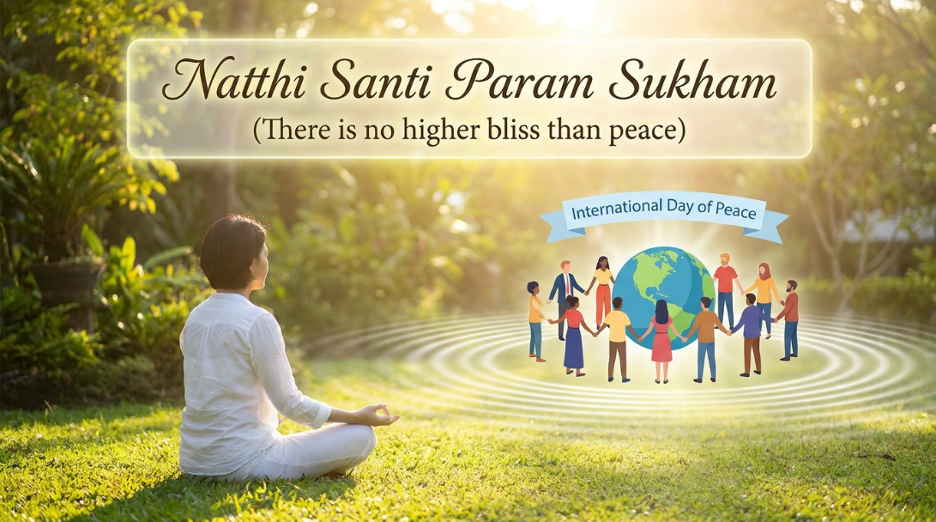
We may not possess the individual power to unilaterally end global conflicts. However, if each of us commits to using mindfulness as a tool to end the wars within our own minds, true and sustainable peace will naturally ripple outward—transforming ourselves, our families, our societies, and ultimately, our world.
5. References
- The Pali Canon: Principles of Satipatthana (Four Foundations of Mindfulness) and Brahmavihara (Four Sublime States).
- DeSteno, D., et al. (2018). Mindfulness Meditation Reduces Interpersonal Aggression. Northeastern University.
- Lazar, S. W., et al. (2005). Meditation experience is associated with increased cortical thickness. Neuroreport.
- Luberto, C. M., et al. (2018). A Systematic Review and Meta-analysis of the Effects of Meditation on Empathy, Compassion, and Prosocial Behaviors. National Institutes of Health (NIH).
6. About the Author
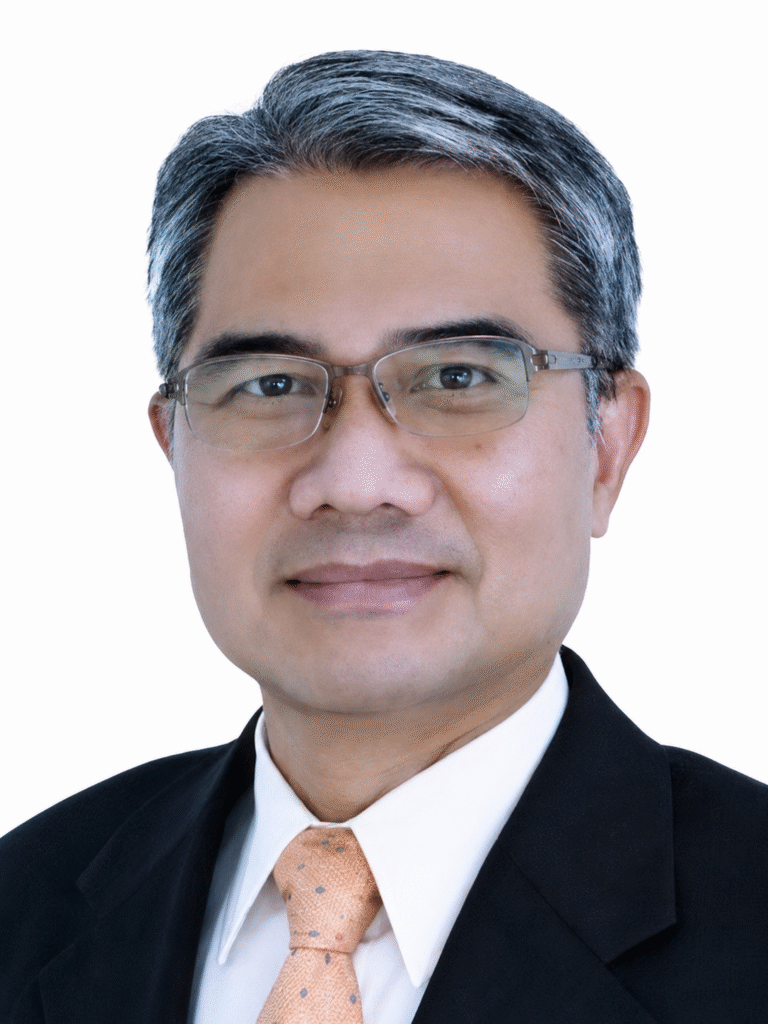
Dr. Paitoon Songkaeo is the Administrative Director of the Thailand Foundation. Before entering public service, he spent 16 years as an ordained Theravada Buddhist monk, extensively studying the Pali Canon and the philosophical foundations of Buddhism within the Thai monastic scholarly tradition. After leaving the monkhood, he joined the Ministry of Foreign Affairs of Thailand, serving in various diplomatic and international roles, including as Consul-General in Kota Bharu, Malaysia, until his retirement in 2017.
Currently, he is a regular contributor to the Spiritual Values & Meditation section of the Thailand Foundation, where he seeks to translate timeless Buddhist wisdom into accessible and practical approaches for addressing the psychological, social, and ethical challenges of contemporary life. For correspondence, he can be reached at: [email protected]