


Buddhist Pavāranā, Universal Wisdom, and the Modern Science of Forgiveness
สำหรับท่านที่ต้องการรับชมและรับฟัง บทความนี้มีการนำเสนอในรูปแบบวิดีโอด้วยเช่นกัน
วิดีโอนี้จัดทำขึ้นทั้ง ภาษาไทย และ ภาษาอังกฤษโดยนำเสนอสาระสำคัญเดียวกันผ่านการถ่ายทอดเชิงสะท้อนความคิดและการอธิบายอย่างเป็นลำดับขั้นตอน

Author’s Note:
This article is written not merely as a theological exploration, but as a source of inspirational reflection and motivational encouragement for our daily lives. While anchored in the Buddhist practice of Pavāraṇā, the courage to seek forgiveness, make amends, and begin anew is a universal virtue shared across the world’s major spiritual and philosophical traditions. My hope is to offer readers a grounding spiritual perspective that transcends cultural boundaries, inspiring us to disarm personal defensiveness, heal fractured relationships, and cultivate genuine peace within ourselves and our communities.
1. บทนำ
Repentance, atonement and forgiveness remain the most enduring moral inquiries across religious traditions, philosophical systems, and contemporary psychology. Human relationships, by their very nature, are vulnerable to misunderstanding, neglect, harsh speech, and lapses in judgment. When left unresolved, these injuries breed guilt, resentment, estrangement, and a chronic erosion of mutual trust. Yet genuine forgiveness is neither a dismissal of wrongdoing nor an evasion of personal responsibility. Rather, it represents a disciplined, transformative process through which individuals and communities confront harm candidly, pursue meaningful restitution, and intentionally relinquish the corrosive grip of vindictiveness.
Within Theravada Buddhism, the monastic ceremony of Pavāraṇā offers an extraordinary paradigm of this transformative dynamic {I wrote an article on Pavarana titled Kindly Admonish Me: When I Recognize MY Faulth, I Will Make Amends (Pavarana Practice at the End of Buddhist Lent), on Oct. 15, 2004}. Observed at the close of the three-month annual Rains Retreat (Vassa), Pavāraṇā invites monastics to proactively solicit moral correction from their peers in the Sangha. Each monk formally requests others to point out any lapses they may have seen, heard, or reasonably suspected. This ancient rite reframes ethical correction: rather than an adversarial confrontation or an instrument of shame, it becomes an act of mutual care and shared accountability.
Examining Pavāraṇā alongside Hindu, Jain, Confucian, Jewish, Christian, and Islamic traditions reveals a profound global consensus. Despite distinctive theological frameworks, these diverse traditions converge upon a singular truth: authentic reconciliation demands rigorous self-examination, honest acknowledgment of harm, a resolute commitment to moral transformation, and the restoration of communal harmony.
2. Buddhist Pavarana: Humility and Communal Accountability
อริยสัจ 4 (Four Noble Truths) Vassa retreat has long formed the cornerstone of Theravada monastic discipline. For three lunar months during the monsoon season, monastics dwell together in a single residence to immerse themselves in scriptural study, meditation, and communal training. While prolonged proximity deepens solidarity, it inevitably surfaces personal shortcomings, friction, and misunderstandings. Pavāraṇā—which literally translates to “inviting admonition”—provides an intentional, structured forum to address these simmering tensions before they harden into enduring discord.

Grounded in the Vinaya (the monastic code of discipline), the ceremony requires each monk to step forward and invite admonition regarding any transgression that was “seen, heard, or suspected” (diṭṭha, suta, parisaṅkitāya). The profundity of this invitation lies in its intentional suspension of ego-defense. Rather than guarding reputations or concealing inadequacies, the practitioner openly concedes that self-awareness is inherently imperfect and that peers often perceive blind spots one has overlooked.
Crucially, Pavāraṇā is not designed to punish or humiliate. Its sole purpose is preserving communal harmony within the Sangha and fostering spiritual awakening among its members. Admonition must be offered with compassion, factual accuracy, and restraint; it must be received with humility and an earnest desire for growth. In this light, personal ethical cultivation is not merely an isolated, individual achievement, but a shared communal responsibility.
This practice directly targets the unwholesome roots (akusala-mūla) of greed, hatred, and delusion. Unchecked anger (dosa) severely constricts moral vision and perpetuates cycles of reciprocal harm. While Buddhism affirms that intentional actions bear inescapable karmic fruits, cultivating forgiveness ensures that past injuries do not dictate present conduct. Here, the concept of abhaya-dāna—the gift of fearlessness—becomes paramount. By renouncing hostility and retaliation, one offers others freedom from fear. Far from passive resignation, Buddhist forgiveness is an active commitment to non-harm, moral clarity, and psychological liberation.
3. Forgiveness in Eastern Traditions
The principles underpinning Pavāraṇā resonate deeply across broader Asian philosophical traditions, where introspection and harmony are viewed as interdependent virtues.
In Hindu thought, kṣamā denotes patience, forbearance, and forgiveness. Rather than an admission of weakness, it is regarded as a supreme virtue reflecting profound spiritual strength. Simultaneously, Hindu ethics balances kṣamā with prāyaścitta (acts of voluntary penance). When a transgression disrupts moral equilibrium, an individual undertakes restorative disciplines—such as prayer, fasting, or charitable deeds—to purify karmic residue and restore cosmic order. Forgiveness is thus inextricably linked to accountability: genuine remorse must culminate in ethical reform.

Confucianism approaches reconciliation through social propriety and virtue cultivation. The core ideal of hé (harmony) denotes an organic balance born not of blind conformity, but of relationships governed by mutual respect and moral duty. Within this framework, self-examination is indispensable. Daily practices such as nèixǐng (inward reflection) and shèndú (vigilance over one’s conduct while alone) compel individuals to rectify their faults before domestic or societal peace is damaged. Forgiveness fosters social cohesion precisely when it is paired with diligent self-correction.
Like Pavāraṇā, these Eastern traditions affirm that social harmony cannot survive by suppressing discord. True harmony requires structured, safe spaces where hard truths can be spoken, responsibilities acknowledged, and ethical commitments renewed.
4. Forgiveness in the Abrahamic Traditions
In Judaism, Christianity, and Islam, forgiveness and atonement operate within a covenantal relationship uniting humanity, moral law, and the Divine. Across these faiths, repentance is never reduced to mere emotional regret; it demands a decisive departure from wrongdoing and a return to righteousness.
In Judaism, this process is encapsulated in teshuvah (“return”). As codified by Maimonides, authentic repentance requires recognizing the transgression, experiencing sincere remorse, confessing verbally, abandoning the harmful behavior, and resolving never to repeat it. Crucially, Jewish jurisprudence draws a sharp distinction between offenses against God and offenses against one’s neighbor. For interpersonal transgressions (aveirot shebein adam l’chaveiro), divine expiation cannot be granted until the wrongdoer directly approaches the victim, seeks forgiveness, and offers restitution.
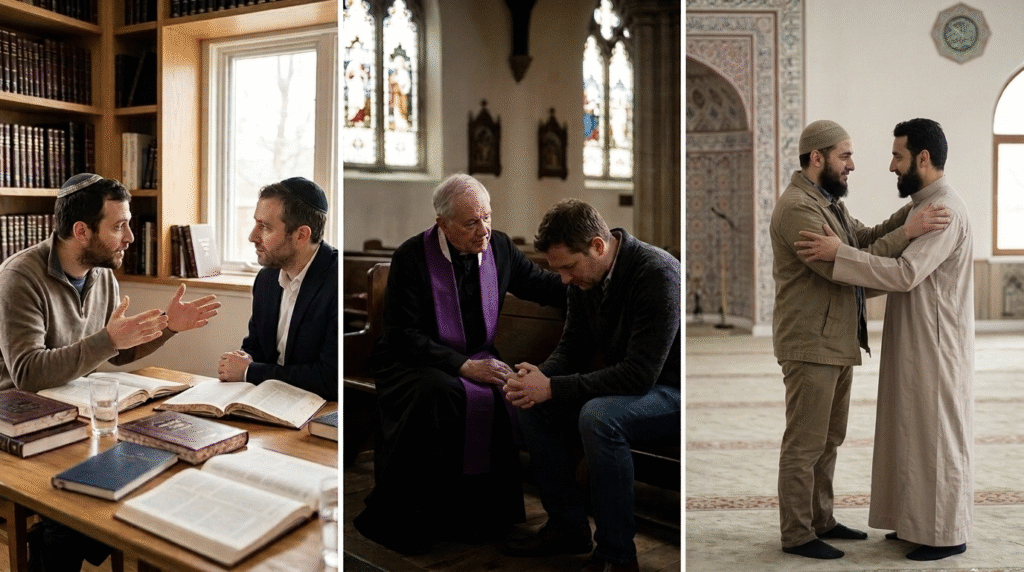
Christianity positions forgiveness at the very heart of spiritual life. The teachings of Jesus consistently fuse forgiveness with mercy, reconciliation, and selfless love of neighbor. During the liturgical season of Lent, believers enter a 40-day period of fasting and self-examination to prepare for spiritual renewal. Whether practiced communally, personally, or sacramentally through confession, this tradition establishes an environment where individuals confront moral failures, receive pastoral guidance, and commit to personal change. Christian forgiveness refuses to minimize the reality of sin, affirming instead that moral failure need not be the definitive word in any human life.
In Islam, tawbah likewise signifies a “return” to God. Classical Islamic theologians, notably Al-Ghazali, structure sincere repentance around three essential pillars: intellectual awareness of the harm, deep emotional contrition, and immediate behavioral cessation accompanied by restitution. Divine mercy is boundless, yet when another person’s rights (huquq al-ibad) have been violated, repentance remains deficient until the wronged party is consulted, compensated, or reconciled.
These Abrahamic doctrines parallel Pavāraṇā in a vital respect: reconciliation requires active moral confrontation, accountability, and demonstrable transformation.
5. Psychological and Social Significance
What spiritual traditions have understood intuitively for centuries, contemporary science now corroborates empirically. Compelling evidence demonstrates that forgiveness-based interventions substantially down-regulate chronic stress, significantly reducing clinical symptoms of anxiety, depression, and anger. Conversely, chronic unforgiveness—manifesting as rumination, hostility, and revenge fantasies—operates as a potent physiological stressor. Its sustained activation of the sympathetic nervous system elevates blood pressure, increases cortisol, and impairs both cardiovascular and immune function.

Importantly, clinical psychology distinguishes genuine forgiveness from condonation, denial, or remaining in abusive circumstances. Forgiveness does not compromise legal remedies, safety protocols, or personal boundaries. Nor should it ever be coerced from victims as an obligatory badge of virtue. Rather, properly understood, forgiveness is an internal cognitive and emotional realignment. It frees the injured person from obsessively reliving trauma, restoring cognitive agency and psychological peace.
Sociologically, forgiveness serves as an indispensable mechanism for communal resilience. Human institutions—families, workplaces, and civic bodies—cannot survive if every failure precipitates permanent exile. Sustainable communities require institutionalized processes that protect the vulnerable, enforce ethical accountability, and create clear pathways for restorative reintegration.
6. บทสรุป
The human quest for forgiveness is universal because moral injury is an inescapable facet of the human condition. Whether expressed through Buddhist Pavāraṇā, Jain Kshamavani, Jewish teshuvah, Christian confession, or Islamic tawbah, world traditions universally affirm that healing cannot be achieved through silence or avoidance. It demands moral courage, radical truthfulness, and an unyielding commitment to begin anew.
Pavāraṇā remains uniquely instructive because it transforms moral correction into an instrument of communal solidarity. By actively inviting constructive critique, the practitioner disarms the fragile ego, dissolves interpersonal suspicion, and reaffirms mutual trust. It reminds us that forgiveness is not merely a passive gift granted by another, but an active, disciplined habit of the heart—requiring the humility to seek it and the wisdom to grant it.

In our contemporary world—too often fractured by ideological polarization, rapid condemnation, and institutional defensiveness—the wisdom of Pavāraṇā shines with renewed urgency. Forgiveness does not rewrite history, nor does it dissolve the necessity of justice. But through compassionate accountability and an open heart, it liberates our minds, restores our communities, and ensures that we are never permanently held hostage by the past.
7. เอกสารอ้างอิงตามต้นฉบับภาษาอังกฤษ
- Al-Ghazali. (2015). Al-Ghazali on repentance: Book XXXI of the revival of the religious sciences (M. A. Quasem, Trans.). Islamic Texts Society. (Original work published 1980). https://its.org.uk/catalogue/al-ghazali-on-repentance-book-xxxi-of-the-revival-of-the-religious-sciences/
- Barton, R. H. (2010, March 1). Practicing Lent: True confessions. Transforming Center. https://transformingcenter.org/2010/03/practicing-lent-true-confessions/
- Bhagavad Gita: Chapter 16, verse 1–3. (n.d.). Holy Bhagavad Gita. https://www.holy-bhagavad-gita.org/chapter/16/verse/1-3/
- Iriyāvahiyā Sutra. (n.d.). Jain Treasures. https://jaintreasures.org.uk/iriyavahiya-sutra/
- Legge, J. (Trans.). (1893). The four books: Confucian analects, the great learning, the doctrine of the mean, and the works of Mencius. Chinese Materials Center. https://archive.org/details/fourbooksconfuci00leggiala
- Maimonides, M. (1981). Mishneh Torah: Hilchot teshuvah—The laws of repentance (E. I. Groner, Trans.). Moznaim Publishing. https://www.chabad.org/library/article_cdo/aid/911887/jewish/Teshuvah.htm
- Pavāraṇā. (n.d.). In Wikipedia. https://en.wikipedia.org/wiki/Pavāraṇā
- Rasmussen, K. R., Stackhouse, M., Boon, S. D., Comstock, K., & Ross, R. (2019). Meta-analytic connections between forgiveness and health: The moderating effects of forgiveness-related distinctions. Psychology & Health, 34(5), 515–534. https://doi.org/10.1080/08870446.2018.1545906
- Worthington, E. L., Jr., & Scherer, M. (2004). Forgiveness is an emotion-focused coping strategy that can reduce health risks and promote health resilience: Theory, review, and hypotheses. Psychology & Health, 19(3), 385–405. https://doi.org/10.1080/0887044042000196674
8. About the Author

Dr. Paitoon Songkaeo is the Administrative Director of the Thailand Foundation. Before entering public service, he spent 16 years as an ordained Theravada Buddhist monk, extensively studying the Pali Canon and the philosophical foundations of Buddhism within the Thai monastic scholarly tradition. After leaving the monkhood, he joined the Ministry of Foreign Affairs of Thailand, serving in various diplomatic and international roles, including as Consul-General in Kota Bharu, Malaysia, until his retirement in 2017.
Currently, he is a regular contributor to the Spiritual Values & Meditation section of the Thailand Foundation, where he seeks to translate timeless Buddhist wisdom into accessible and practical approaches for addressing the psychological, social, and ethical challenges of contemporary life. For correspondence, he can be reached at: [email protected]

