


By Paitoon Songkaeo, Ph.D.

| Author’s Note & Disclaimer This article is conceived as an inspirational, motivational, and spiritual reflection rather than a clinical manual. Drawing upon Buddhist teachings, comparative world philosophies, and contemporary psychological research, it seeks to offer a grounding perspective and gentle encouragement for navigating the universal human experience of loss. |
1. บทนำ
Loss is an inescapable thread woven into the very fabric of human existence. Whether through the passing of a loved one, the collapse of a career, or an unforeseen life transition, grief remains a universal experience that transcends cultural, temporal, and geographical boundaries. Yet, despite its inevitability, modern society struggles profoundly to navigate the turbulent waters of bereavement. Paralyzed by sorrow, we frequently find ourselves uncertain of how to heal our own wounds—or how to console those suffering around us.
Over 2,500 years ago, the Buddha articulated a penetrating, practical framework for understanding and transforming the suffering born of loss. Nor does this insight stand in isolation: across centuries, humanity’s great Indic, Chinese, and Abrahamic traditions have likewise cultivated sacred rituals and philosophical frameworks to hold the weight of mourning. Remarkably, as contemporary psychology advances, empirical research consistently converges upon the very conclusions ancient masters reached millennia ago. By examining the Buddha’s teachings alongside world wisdom traditions and modern scientific findings, we uncover a sustainable, compassionate roadmap for navigating grief and cultivating peace amidst sorrow.
2. The Problem and Its Root Causes
In contemporary society, our relationship with grief is fundamentally fractured. Driven by a culture of relentless speed and productivity, we often treat mourning as a temporary malfunction—an inconvenience to be “fixed,” “gotten over,” or quietly suppressed so that we may swiftly resume our efficient routines. Similarly, when a friend or colleague suffers a tragic loss, those around them frequently withdraw. Fearful of saying the wrong thing, intruding upon personal privacy, or awkwardly reopening an emotional wound, well-meaning individuals often choose silence or distance, inadvertently abandoning the bereaved to profound isolation.

From a Buddhist perspective, the root of this acute torment lies not in loss itself, but in Avijjā (primordial ignorance of reality’s impermanent nature) and Upādāna (clinging to that which is inherently transient). Insulated from mortality in our daily routines, we suffer because we cling to the illusion that relationships are permanent and that we exercise control over the uncontrollable.
When the reality of impermanence inevitably strikes, this lack of inner preparation triggers fierce psychological resistance. By denying our pain, blaming ourselves, and erecting walls around our hearts, we fire what the Buddha termed the “second arrow” directly into our own wounds—compounding the natural pain of loss with the self-inflicted suffering of resistance, guilt, and fear.
3. The Problem Can Be Solved
True healing requires neither blind faith nor emotional detachment; rather, it calls for practical insight and compassionate integration, illuminated precisely where Buddhist wisdom, global spiritual traditions, and modern psychology converge.
3.1 The Buddha’s Teachings: Refusing to Shoot the Second Arrow into the Same Wound
The Buddha approached bereavement like a skilled physician, diagnosing why grief turns destructive and prescribing an experiential path toward peace.
- Embracing Pain and Impermanence: In the Salla Sutta (The Discourse on the Arrow), the Buddha compared unavoidable losses, such as illness, aging, or bereavement, to being struck by a physical arrow. When an untrained mind reacts with lamentation and resistance, it shoots a “second arrow” of mental anguish into itself. To end this secondary torment, the Buddha taught Pariññā (full comprehension of suffering): turning mindfully toward the first arrow without judgment while recognizing Anicca (impermanence) and Anattā (non-self, or lack of control). Because emotions naturally arise and pass away, grieving cannot be forced onto a rigid timeline.
- Dissolving Guilt through Conditionality: Much of the second arrow manifests as survivor guilt: the agonizing thought, “I should have done more,” or “This is my fault.” The Buddha dismantled this egocentric blame through Idappaccayatā (specific conditionality), explaining that every event arises from a vast, interwoven web of causes beyond any single individual’s control. Seeing this reality dissolves the illusion that we could single-handedly rewrite destiny. To heal self-blame, the Buddha prescribed เมตตา (loving-kindness) and กรุณา (compassion), emphasizing that genuine warmth and forgiveness must first be directed inward.
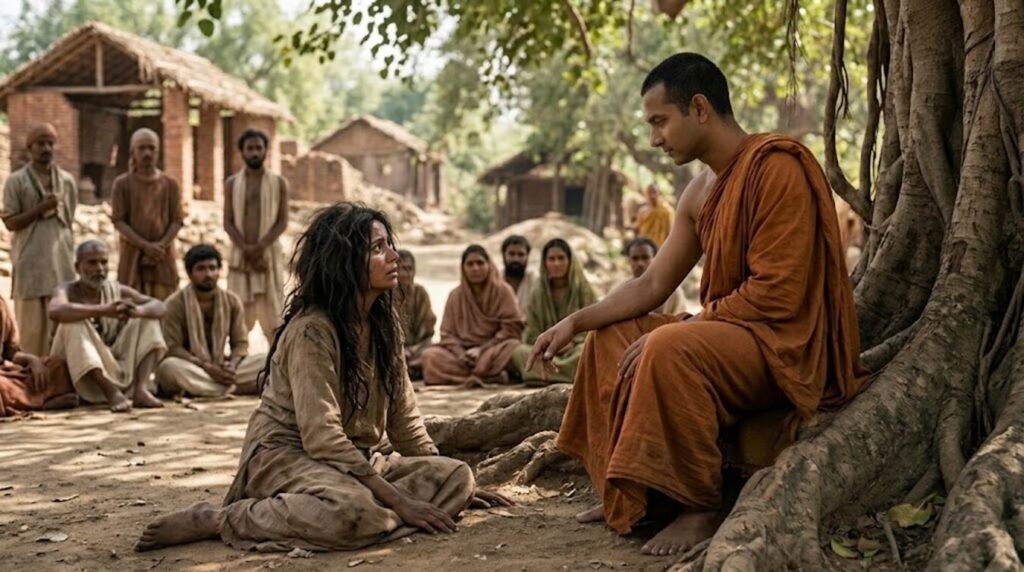
- The Power of Noble Presence: In supporting others, the Buddha exemplified Kalyāṇamitta (noble, spiritual friendship), vividly illustrated in the account of Paṭācārā. Having tragically lost her husband, two young sons, parents, and brother within a matter of days, Paṭācārā wandered the streets unclothed and shattered by grief. When she stumbled before the Buddha at Jetavana Monastery, he offered neither lofty philosophical abstractions nor hollow platitudes to “move on.” Instead, radiating calm, non-judgmental compassion, he gently spoke: “Sister, recover your presence of mind.” Only after his grounding presence restored her psychological safety did he guide her to contemplate the universal law of impermanence—demonstrating that compassionate presence must always precede philosophical instruction.
3.2 Universal Echoes: Indic, Chinese, and Abrahamic Perspectives
Across civilizations, humanity’s major philosophical and spiritual traditions have cultivated complementary frameworks that harmonize inner acceptance with communal ritual and cosmic order.
- The Indic Perspective: Rooted in Vedic and Vedantic thought, Hindu philosophy frames bereavement through the lens of Saṃsāra (the cycle of rebirth) and the eternal Ātman (the true self). In the Bhagavad Gītā, when Arjuna is paralyzed by grief on the battlefield, Krishna reminds him that the innermost self is neither born nor dies, casting off mortal bodies much like worn garments. On a practical level, mourning rites such as Antyeṣṭi (funeral rites) and the twelve-to-thirteen-day observance of Śrāddha provide a structured communal vessel—channeling raw emotion into sacred tribute while anchoring physical separation within an infinite spiritual continuum.
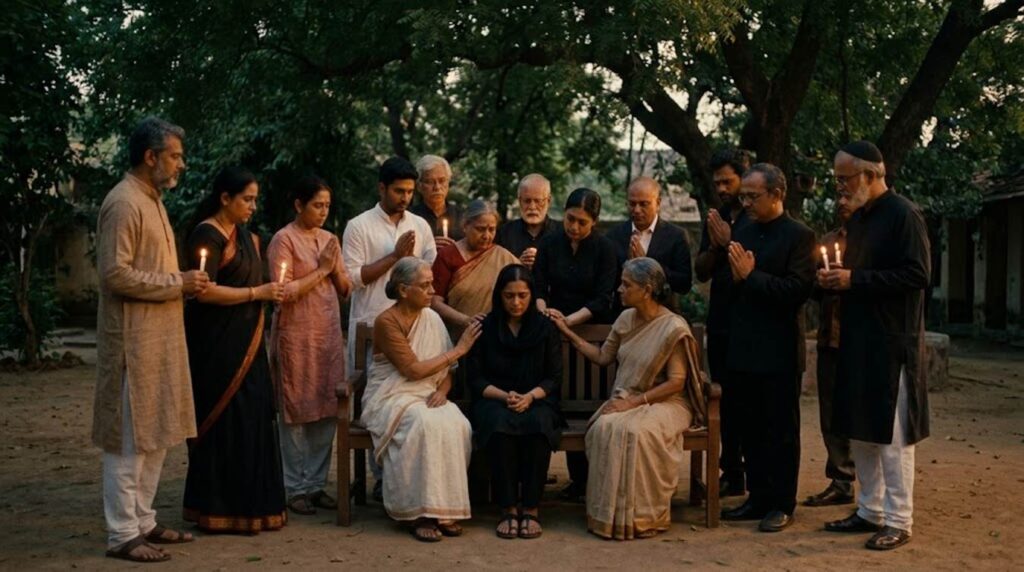
Image 4: The healing power of communal holding — Ancient traditions worldwide, from Shiva to ancestral rites, provide a collective, sacred container of ritual and supportive touch to carry those in mourning.
- The Chinese Perspective: Classical Chinese wisdom balances relational duty with the spontaneous flow of nature. Confucianism honors mourning rites (Sānglǐ) as a supreme expression of Rén (humaneness) and Xiào (filial piety); Confucius himself wept unreservedly upon the death of his beloved disciple Yan Hui, and ancestral rituals ensure that society formally respects a family’s bereavement. Daoism, conversely, counsels non-resistance to natural transformation (Zìrán). In the Zhuangzi, after initially weeping for his late wife, the sage Zhuangzi was found sitting, drumming on a basin, and singing—having realized that her passing was part of nature’s grand seasonal succession, which it would be futile to resist.
- The Abrahamic Perspective: Judaism, Christianity, and Islam hold grief within the embrace of communal solidarity and covenant with the Divine. Judaism establishes Shiva, a seven-day sanctuary during which mourners remain at home while neighbors bring meals and sit in supportive silence until the bereaved choose to speak—echoing the wisdom of Ecclesiastes that there is “a time to weep, and a time to mourn.” Christianity sanctifies sorrow through divine empathy, poignantly captured in the verse “Jesus wept” (John 11:35) at the tomb of his friend Lazarus, while cradling human pain in the hope of resurrection. Islam unites Ṣabr (patient endurance) with tender emotional release; weeping for his infant son Ibrahim, the Prophet Muhammad affirmed that tears are a manifestation of divine mercy, while the invocation “Inna lillahi wa inna ilayhi raji’un” (Indeed, to God we belong and to Him we return) gently dissolves the illusion of personal ownership.
Across Indic, Chinese, and Abrahamic traditions alike, a singular truth resonates: healthy mourning requires honest emotion, a supportive community, and humble surrender to a larger order.
3.3 Modern Research: Psychological Validation of Ancient Insights
Today, contemporary clinical psychology and bereavement science offer striking empirical validation of these ancient contemplative and cultural practices.

Facing Pain and Nonlinear Grief: Clinical psychology confirms the destructive toll of emotional avoidance. Dr. Lesel Dawson, Associate Professor at the University of Bristol and Co-Director of the Good Grief Festival, warns against suppressing sorrow: “Being able to turn toward the pain of the experience is the only way we process what’s happened.” Furthermore, contemporary bereavement studies have largely debunked the popular misconception that grief unfolds in five neat, linear stages (the Kübler-Ross model). Echoing the Buddhist insights of Anicca และ Pariññā, Dr. Dawson observes that grief is “messy, unpredictable, and deeply individual”—a fluctuating reality we must meet with open awareness rather than rigid control.
Healing Guilt through Self-Compassion: Dr. Dawson’s work likewise illuminates how self-blame paralyzes emotional recovery. Her own mother carried silent guilt for decades following a stillbirth, finding release only when Dr. Dawson—having experienced medical complications with her own premature son—gently asked her, “Why can you not show the same compassion to yourself and your own loss?” Broader empirical science concurs: pioneering research by Dr. Kristin Neff at the University of Texas at Austin demonstrates that self-compassion fosters significantly greater trauma resilience than either self-esteem or self-criticism, directly validating the Buddhist practice of inward-facing เมตตา และ กรุณา.
The Science of Compassionate Presence: Mirroring both the Buddha’s encounter with Paṭācārā and the Jewish practice of Shiva, empirical evidence confirms that quiet solidarity heals where avoidance wounds. Research commissioned by the UK charity Marie Curie revealed that while roughly 70% of people feel comfortable discussing death in theory, remarkably few reach out to grieving friends for fear of misspeaking. Dr. Dawson emphasizes that withdrawing is the gravest mistake: “The most important thing when helping someone dealing with grief isn’t what you say, but that you don’t turn away.” Simple, authentic words such as “I’m so sorry, and I’m here,” paired with allowing the bereaved to lead the conversation, create an indispensable sanctuary for recovery.
4. Conclusion
The convergence of the Buddha’s teachings, world spiritual traditions, and modern psychology offers a luminous, humane compass for navigating life’s darkest chapters. Grief is neither a clinical malfunction to be cured nor an intellectual puzzle to be solved; rather, it is the natural echo of love—an experience meant to be honored, lived through, and gently integrated.

Whenever we resist the law of impermanence or retreat from another’s sorrow, we inflict the “second arrow” of unnecessary suffering upon ourselves and those around us. Yet when we meet pain with mindful acceptance, dissolve self-blame through conditionality and self-compassion, draw solace from communal rituals, and offer steadfast presence to the heartbroken, raw anguish gradually matures into wisdom. Ultimately, the Dhamma—echoed across human civilizations and verified by contemporary science—stands not as a matter of abstract dogma, but as a living art. It empowers us not to erase sorrow, but to expand our hearts until they are vast enough to hold loss in enduring peace.
5. References
- Al-Bukhari, M. (1997). Sahih al-Bukhari (M. M. Khan, Trans.; Vol. 2, Book 23, Hadith 1303). Darussalam.
- Bodhi, B. (Trans.). (2000). Salla Sutta: The dart (Saṃyutta Nikāya 36.6). In The connected discourses of the Buddha (pp. 1263–1265). Wisdom Publications.
- Burlingame, E. W. (Trans.). (1921). The story of Paṭācārā (Dhammapada Commentary, Verse 113). In Buddhist legends (Part 2, pp. 250–257). Harvard University Press.
- Confucius. (1979). The analects (D. C. Lau, Trans.). Penguin Classics.
- Davage, M., Harcombe, C., & Darvall, J. (2026, October 15). Professor shares “most important thing to do” when someone is grieving [Featuring Dr. Lesel Dawson]. BBC News.
- Easwaran, E. (Trans.). (2007). The Bhagavad Gita (2nd ed.). Nilgiri Press.
- Marie Curie. (2024). Public attitudes to death and dying in the UK. Marie Curie Research Centre, Cardiff University.
- Neff, K. D. (2003). Self-compassion: An alternative conceptualization of a healthy attitude toward oneself. Self and Identity, 2(2), 85–101. https://doi.org/10.1080/15298860309032
- Wolfson, R. (1996). A time to mourn, a time to comfort: A guide to Jewish bereavement and comfort. Jewish Lights Publishing.
- Zhuangzi. (2009). Zhuangzi: The essential writings (B. Ziporyn, Trans.). Hackett Publishing.
6. About the Author

Dr. Paitoon Songkaeo is the Administrative Director of the Thailand Foundation. Before entering public service, he spent 16 years as a novice and an ordained Theravada Buddhist monk, extensively studying the Pali Canon and the philosophical foundations of Buddhism within the Thai monastic scholarly tradition. After leaving the monkhood, he joined the Ministry of Foreign Affairs of Thailand, serving in various diplomatic and international roles, including as Consul-General in Kota Bharu, Malaysia, until his retirement in 2017.
Currently, he is a regular contributor to the สิ่งยึดเหนี่ยวทางจิตใจและการทำสมาธิ section of the Thailand Foundation, where he translates timeless Buddhist wisdom into accessible, practical approaches for addressing the psychological, social, and ethical challenges of contemporary life. For correspondence, he can be reached at: [email protected]