

As Buddhism is deeply ingrained in Thai culture, it comes as no surprise that one common sight for visitors to the Land of Smiles is the Thai Buddhist merit-making practice in which meals are offered to monks in their alms bowls as nourishment, especially at the very start of the day. The practice is said to have existed since the time of Gautama Buddha and has been deeply ingrained in Thai culture since Buddhism arrived in the region. The practice is believed by worshipers to bring good fortune and blessings in line with the belief in karma. In addition to the quotidian merit-making every morning, on special occasions – such as religious holidays, at the beginning or the end of the Buddhist Lent, or during ceremonies, both religious and secular – Thais may prepare a special big meal to offer monks at a temple or on the ceremonial ground. One such unique variation of this is the annual ceremonial practice of offering honey to monks, known as tak bat nam phueng (ตักบาตรน้ำผึ้ง), which is practiced among the Mon ethnic group in Thailand.
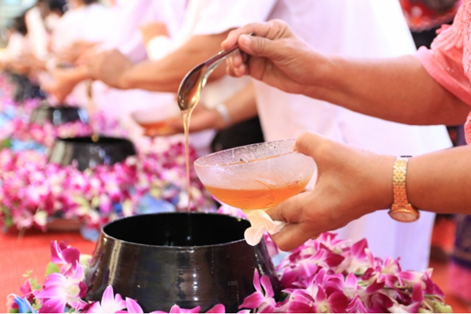
Photo Credit : thailandfestival.org
What is Tak Bat Nam Phueng?
As its Thai name suggests, with nam phueng meaning honey and tak bat denoting the Buddhist custom of offering alms to monks, the practice literally involves placing honey into monks’ alms bowls as an offering. The custom is observed annually on the 15th day of the 10th waxing moon according to the lunar calendar (around September) by the Mon communities throughout central Thailand, in provinces such as Nonthaburi, Samut Prakan, and Samut Songkhram. The Mons originally migrated from the region that is now Southern Myanmar into the area that is now Thailand around the 10th to 11th century CE onward, bringing with them their traditions and beliefs, including this unique practice.
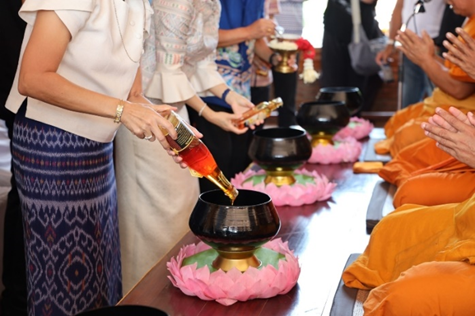
Photo Credit : thailandplus.tv
The custom stemmed from the Mons’ belief in two legends from Buddhism. In the first story, in one of his past lives, Sivali, a disciple under Gautama Buddha who was deemed to be bestowed with tremendous fortune, was born as a commoner who was very devoted to merit-making. Coincidentally, during the time, the residents of the nearby city would often compete with the king in merit-making, always trying to procure novel offerings. One day, the residents decided to make merit with honey and cheese, as these had not been used in their sacrificial rituals before. A lookout was, hence, posted at the city gate to monitor for the goods. At that time, young Sivali arrived at the city with cheese and a gigantic, deserted honeycomb he had just harvested on the way. The lookout, subsequently, offered to buy the goods for an exorbitant amount of money from Sivali, who, upon seeing how enthusiastic the lookout was, became inquisitive. Once Sivali learned of the reason why the lookout wanted to purchase the cheese and the honeycomb, he decided to gratuitously offer the goods in exchange for being allowed to participate in the merit-making with the residents.
In another legend, during the time before Gautama Buddha, there was a solitary Buddha (Pratyekabuddha) who was looking for honey to remedy his illness. At that time, a villager, wanting to make merit, offered the honey he had recently harvested to the Buddha. While decanting the sweet nectar into the alms bowl, the honey miraculously multiplied itself to the point that it began to overflow. At that moment, a weaver nearby, witnessing the scene and being worried that the honey would stain the Buddha, offered a piece of red cloth she had just woven to the Buddha to wipe away the excess liquid. These two acts of generosity led the villager and the weaver to be reincarnated as a mighty monarch and his wife. These two legends inspired the Mon to adopt the practice of making merit with honey with the hope of also being, one day, bestowed with great fortune, just like Sivali, as well as the villager and the weaver, resulting in the birth of the annual ceremony.
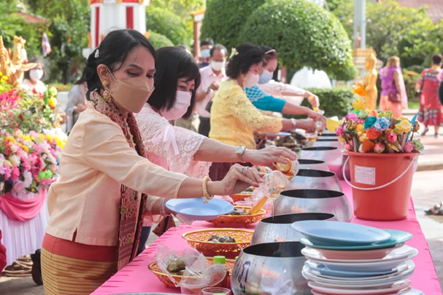
Photo Credit : komchadluek.net
On the day before the ritual, a variety of traditional coconut sticky rice desserts is prepared along with other dishes, depending on each family’s recipes. Here, among the most common variations of the aforementioned dessert are khao tom luk yon, khao tom kluk, และ khao tom mat, which all differ from each other only in minute details. While khao tom luk yon is usually wrapped with coconut or banana leaves in a triangular shape, leaving the tail end of the leaf as a long tip, khao tom mat is often wrapped with banana leaves in a rod shape, while also being tied off into different sections. On the other hand, khao tom kluk is not served wrapped, but rather cut into bite-sized pieces and tossed with shredded coconut.
On the day of the ritual, the participants will arrive at the temple with the prepared food and dessert, along with a bottle of pure honey, a pack of refined sugar, and some small red cloths. First, the prepared food and dessert are offered to the monks just like in any conventional Buddhist merit-making practice. Subsequently, the honey is carefully decanted into each of the 32 alms bowls, symbolizing the traditional belief in 32 components of the healthy human body, in a similar amount, while the sugar is, similarly, poured onto the lid of the bowls. Here, the sugar is supposed to serve as a stand-in for sugarcane juice, which is also believed in Buddhism to be another ingredient that can be used as a traditional remedy. Afterwards, the red cloth is placed behind each alms bowl, symbolizing the action of the weaver from the second legend. Importantly, only a specific kind of pure honey, known as the 5th Month honey – a type of honey harvested around April to May, considered to be of the highest quality due to the availability of diverse flower breeds the bees can harvest from, resulting in a highly concentrated and nutritious blend – is to be used in the offering, as adulterated honey can cause the honey in the bowl to degrade.
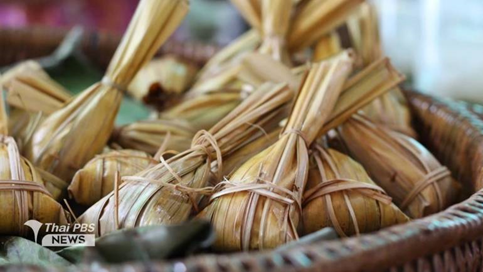
Photo Credit : thaipbs.or.th
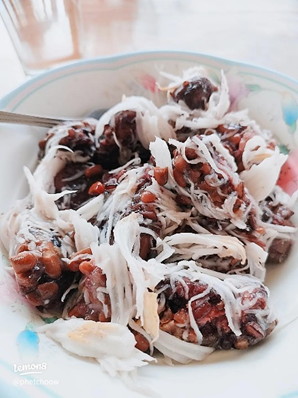
Photo Credit : wikiwand.com
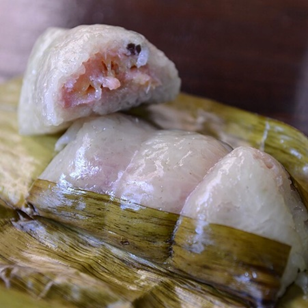
Photo Credit : wikiwand.com
The Symbolism and the Importance of Honey
Although the practice may be inspired by the legend of Sivali, the usage of honey as the offering may have stemmed from a more practical reason; namely, honey possesses medicinal properties. In the biography of Gautama Buddha, after he had stopped engaging in asceticism, but his body had not recovered from the malnourishment, he received rice pudding cooked with milk and honey as alms, which helped him to quickly convalesce. Furthermore, once during the rainy season, many monks under his tutelage became sick and emaciated. The Buddha thus allowed his disciples to consume honey and other remedies in the evening to help combat the illness. Apart from this, in many cultures around the world, honey has been used in traditional remedies to, for instance, cure wounds and bowel diseases. In modern times, honey has also been found to exhibit antimicrobial properties against some pathogenic microorganisms. Furthermore, it has been reported to contain a wide variety of antioxidants. Additionally, as a result of the inhibitory effects on certain microbes, honey was also widely used as a preserving agent in ancient times, such as by the Romans to preserve their fresh produce, or the Egyptians to embalm cadavers. As a result, the custom of merit-making with honey can be considered as a way to help promote monks’ health and to provide them with a long-lasting ingredient for remedies in case of ailments.
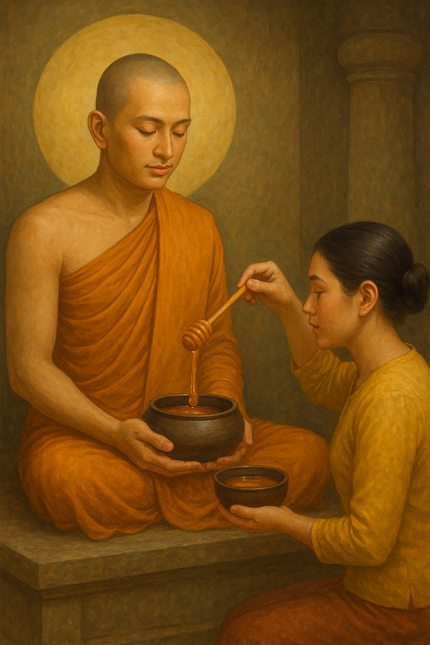
Photo Credit : This picture generated by ChatGPT AI
Apart from this, honey is also viewed in Thai Buddhist culture as a symbol of sweetness and preciousness. In Buddhist teaching, for instance, it is taught that one shall speak with words ‘as sweet as honey,’ reminding people to refrain from using curse words and inciting speech, which will help the person to be well-liked, as though they were offering sweet and pleasant honey to others. Furthermore, honey is believed in the Thai horoscope to be the representation of Venus, which is considered the planet of love, mercy, and pleasant charm. As a result, honey is often used in matrimonial ceremonies to emphasize the sweetness and preciousness of the love between the bride and the groom. Additionally, during the time of Gautama Buddha, honey was also used as a symbol of reverence, being given by younger monks to more senior monks whenever they received it as alms. The honey in the offering, thus, embodies the desire to give something most precious and pleasant to the monks as a gesture of great reverence and gratitude.
The Values behind the Celebration
Despite being celebrated by a minority in Thailand, tak bat nam phueng still reflects many different important values embodying Thai culture in the following aspects.
1. Religious and Moral Value
First and foremost, the practice encapsulates the significance of Buddhism as a foundation of Thai culture. In particular, the merit-making highlights the Thai people’s great reverence for the faith – culminating in the desire to help bolster the religion, in the hope of being able to access Buddha’s teaching through sermons, through which guidance for navigating life can be attained – and also their propensity for generosity and kindness in accordance with the Buddhist teaching. The practice of altruistically offering things to others, as in merit-making, serves as an exercise to diminish greed and to build up a habit to help others in need. Furthermore, in having to carefully decant the honey equally into each alms bowl as well as in participating in a sermon afterwards, the celebration also encourages mindfulness. The celebration, with this religious doctrine as its substratum, is thus a valuable representation of the moral compass of the culture.
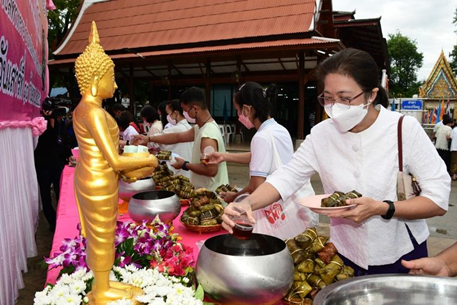
Photo Credit : sanook.com
2. Cultural Value
Secondly, the celebration is a demonstration of the unique cultural identity of a minority group within the beautiful and rich tapestry of Thai culture. This not only showcases the openness of Thai culture in harmoniously integrating cultural practices from other ethnicities, but also the dedication of the Thai society to preserving each unique local practice within the tapestry. In this way, the traditional way of life and wisdom of each subculture in the country are maintained, creating a high level of cultural diversity in the national landscape, enabling visitors to discover new hidden gems on each trip to Thailand, while locals can also turn to the various existing traditions to find inspiration in solving modern problems. In addition to this, the celebration also utilizes a lot of items from other facets of Thai culture, further helping to bolster and keep those alive and well, such as the practice of preparing traditional desserts or even the harvesting of luxurious, high-quality honey.
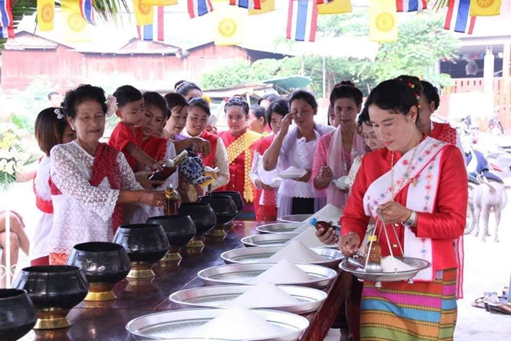
Photo Credit : mgronline.com
3. Social Value
Lastly, the annual celebration also strengthens the local sense of community. For one, the collective merit-making allows for more socialization of members within the community, bringing people closer together in their common dedication to maintaining and bolstering both the religion and their unique tradition. For instance, in certain Mon communities, people may come together to weave the cloth to be used in the ritual, or to prepare the meal and the desserts.
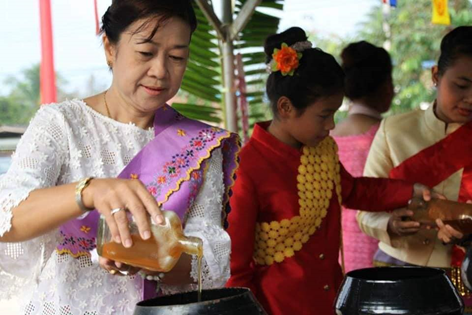
Photo Credit : komchadluek.net
Conclusion
As can be seen, tak bat nam phueng holds tremendous values. As such, the practice echoes many aspects of Thai society as a whole, from the importance of Buddhism as the substrate of the culture and morality, to the integration of different cultures to create a rich tradition, to the strengthened community spirit. On your next visit to the Land of Smiles, we would like to invite you to partake in this sweet ceremony yourself, taking a quick dive into the Mons’ tradition and way of life. For those interested, the next celebration will be held on 26 September 2026. Some of the most famous venues near Bangkok include Wat Bang Nam Phueng Nai in Samut Prakan, Wat Samoson in Nonthaburi, and Wat Sattha Thamin Samut Songkhram.
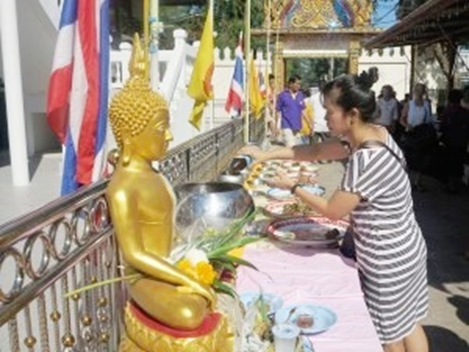
Photo Credit : nonthaburi.prd.go.th
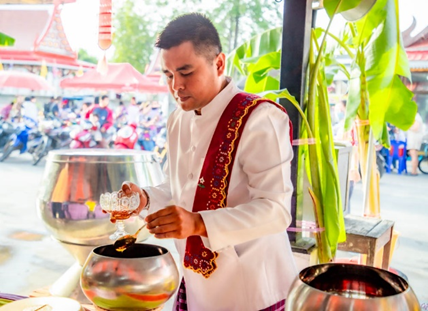
Photo Credit : samutsongkhram.prd.go.th
The story of Tak Bat Nam Phueng reflects a harmonious blend of Buddhist faith, Mon cultural heritage, and community spirit within Thai culture. The practice of offering honey not only symbolizes generosity, reverence, and the sweetness of life, but also highlights how Thai society embraces diversity, preserves traditions, and nurtures togetherness. Join us as we continue to explore more stories from across Thailand and discover the rich diversity that shapes Thainess.
Sources
Eteraf-Oskouei, T., & Najafi, M. (2013). Traditional and modern uses of natural honey in human diseases: a review. Iranian journal of basic medical sciences, 16(6), 731–742.
https://rituals.sac.or.th/detail.php?id=48
https://mgronline.com/travel/detail/9660000086871
https://www.sanook.com/horoscope/262595
https://www.naewna.com/local/235664
https://arit.kpru.ac.th/ap2/local/?nu=pages&page_id=2151&code_db=610008&code_type=01

Author : Yodsawin Uaychinda
Editor : Tayud Mongkolrat
Uploaded on 29 September 2025