


Introduction
In my previous exploration, The Quiet Burnout, I defined a silent epidemic of exhaustion where the human spirit is depleted behind a façade of high performance. While that article addressed the broad nature of modern work stress, we must now examine its most pervasive driver: the “Always-On” Reality. We live in a hyper-connected architecture where the boundary between “work” and “life” has not just blurred—it has vanished. We carry a “digital leash” that extends from our pockets into our dining rooms and even the deepest hours of our sleep. While this connectivity promised efficiency, it has inadvertently created a “digital prison.” This inspirational and spiritual article examines why we find it so difficult to switch off, how this state of constant alert serves as a catalyst for change, and the specific Buddhist and psychological remedies that can restore our mental sovereignty.

Table of Contents
1. The Digital Leash: The Seriousness of Cognitive Overload
The “Always-On” reality is characterized by a state of continuous partial attention. We are no longer present in one task; we are spread thin across multiple digital streams. This is not merely a social nuisance; it is a physiological crisis.The Physiological Cost: When we remain tethered to work emails and notifications during our “off” hours, our brains are kept in a state of High Beta frequency. This brainwave state is associated with high alertness and anxiety. From an evolutionary perspective, our ancestors only entered this state when facing a physical threat. Today, we inhabit it because of a “ping.” This constant “High Beta” state prevents the nervous system from entering the parasympathetic mode (rest and digest), leading directly to the somatic symptoms described in The Quiet Burnout, such as persistent muscle tension and digestive issues.
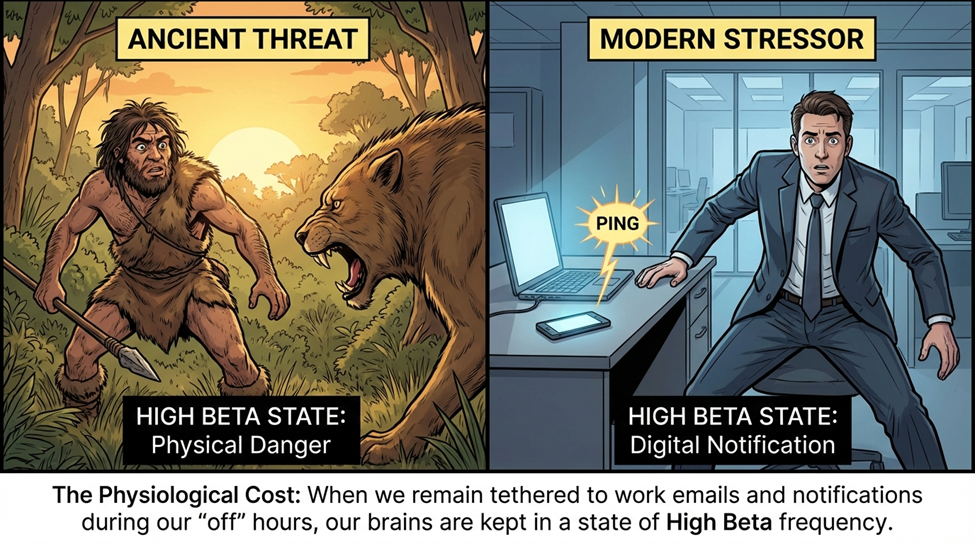
Attention Fragmentation: Modern research in Cognitive Load Theory suggests that every time we switch our attention from a personal moment to a work notification, we pay a ‘switching cost’. When our attention is derailed, it takes an average of 23 minutes to cycle back to what we were doing, and up to 15 minutes of uninterrupted time to rebuild our deep focus. In an ‘Always-On’ world, we are in a permanent state of cognitive debt. We are busy, but we are not productive; we are connected, but we are not present. This fragmentation erodes the executive function of the brain—the very part we need to regulate our emotions and realize we are burning out.
2. The Breaking Point as Catalyst: How “Always-On” Triggers the Remedy
In Buddhist thought, suffering (Dukkha) is the first Noble Truth, but it is also the first step toward a cure. The “Always-On” reality is unique because the suffering it causes is so relentless that it eventually acts as a catalyst for a remedy.The Mirror of Truth: As I noted in The Quiet Burnout, many of us are people-pleasers who suppress our symptoms. However, the “Always-On” lifestyle eventually pushes the mind to a point where suppression is no longer possible. The exhaustion becomes so profound that the individual is forced to stop. In this sense, the digital burnout is a “Mirror of Truth.” It reveals our craving(Tanha) for relevance, for being “needed,” and our fear of missing out.

When we hit this wall, the “Always-On” state stops being a lifestyle and starts being a teacher. It forces us to ask: “Who am I when the screen is dark?” This existential crisis is the beginning of the “remedy.” By experiencing the pain of being constantly tethered, the mind finally becomes willing to practice the discipline required to disconnect.
3. Buddhist Remedies: Right Mindfulness and the “Internal Forest”
The spiritual antidote to the digital leash is Right Mindfulness (Samma Sati). While The Quiet Burnout introduced mindfulness as a broad tool for resilience, we must apply it specifically to our digital behavior. In the words of P.A. Payutto in Buddhadhamma, Sati is essentially the quality of “presence” or “non-forgetting”—it is the gatekeeper that prevents the mind from being dragged away by external stimuli.
The Art of Non-Doing: In our digital lives, we are addicted to “doing”—responding, scrolling, reacting. The Buddhist remedy is the cultivation of “Non-Doing.” This is not idleness, but the practice of observing the impulse to check our phones without acting on it.The Internal Forest: In traditional Thai forest traditions, monks seek seclusion to train the mind. In the 21st century, we must build an “Internal Forest.” This involves:
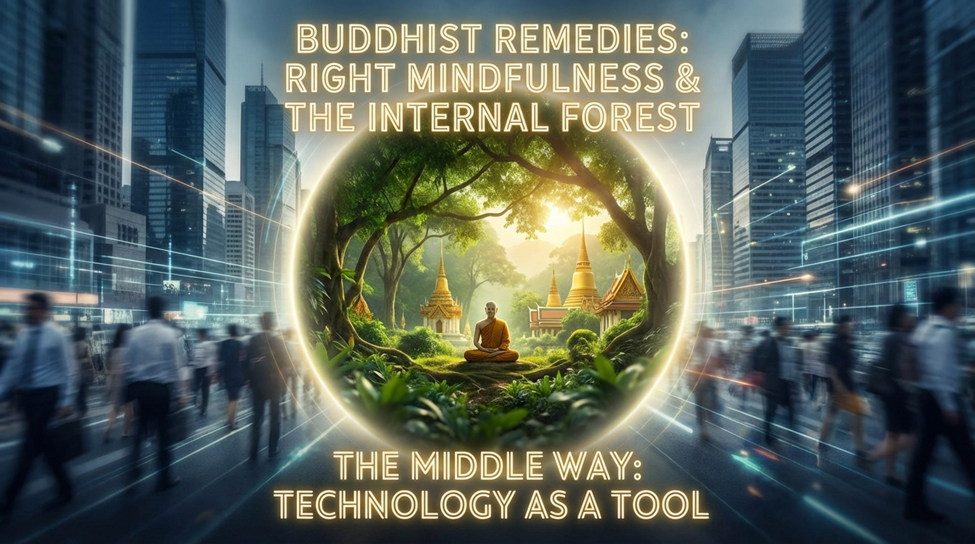
- Determination (Aditthana): Setting firm “Digital Precepts,” such as no devices during meals or after 8 PM.
- The Middle Way (Majjhima Pathipada): Technology is a tool, not a master. Using it with clear comprehension(Sampajanna) means knowing why we are picking up the device.
4. How to Practice: The Architecture of a Meditative Sitting
To effectively “switch off,” one must understand the mechanics of the practice. Scientific research by Amishi Jha (2017) indicates that as little as 12 minutes of focused mindfulness practice per day can protect the brain’s “attentional buffer” (the cognitive capacity to maintain focus on a task while resisting irrelevant distractions) from degradation.

The Protocol for Each Sitting:
- The Anchor (Posture & Breath): Sit with a straight back—a “dignified” posture that signals alert presence. Choose an anchor, usually the breath at the tip of the nose or the rise and fall of the abdomen.
- The Engagement: Close your eyes and focus entirely on the physical sensation of the air entering and leaving the body. Do not try to change the breath; simply witness it.
- The Neurological Cycle: Inevitably, the mind will wander—perhaps toward a work email or a digital worry. This “mind-wandering” is not a failure; it is the “heavy lifting” (the neural effort required to notice a distraction and consciously redirect focus back to the target) of the brain.
- The Return (The Moment of Power): The moment you realize your mind has wandered is the moment of Sati. Gently, without judgment, bring the attention back to the breath. Research shows that this specific act—the non-judgmental return—is what strengthens the prefrontal cortex (the brain’s executive hub responsible for decision-making, concentration, and emotional regulation) and weakens the “Always-On” reactivity of the amygdala(the brain’s “alarm system” that triggers the stress-induced fight-or-flight response).
5. Psychological and Neurological Antidotes: The Science of Detachment
Modern neuroscience provides the “hardware evidence” that supports these ancient practices, revealing the transformative benefits of consistent mindfulness.
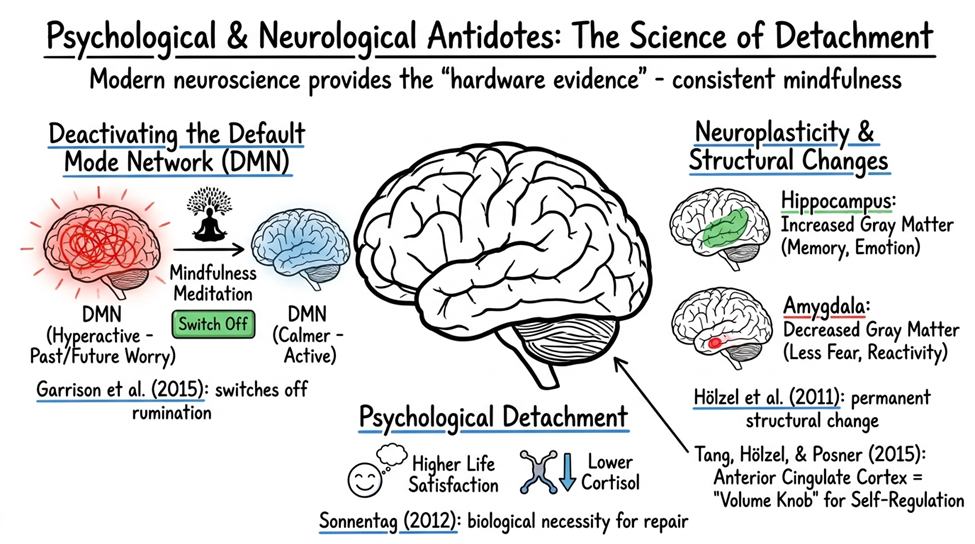
Deactivating the Default Mode Network (DMN): When we are “Always-On,” a part of our brain called the Default Mode Network (DMN) becomes hyperactive. The DMN is responsible for “self-referential” thought—worrying about the past or future. A landmark study by Garrison et al. (2015) showed that mindfulness meditation effectively deactivates the DMN. By practicing even a few minutes of meditation, we are “switching off” the brain’s tendency to ruminate on work stress.
Neuroplasticity and Structural Changes: The benefits extend beyond temporary relaxation to permanent structural change. Research by Hölzel et al. (2011) at Harvard found that eight weeks of mindfulness meditation led to:
- Increased Gray Matter Density in the Hippocampus: Improving memory and emotional regulation.
- Decreased Gray Matter in the Amygdala: Reducing the brain’s baseline “fear” response, making us less reactive to digital pings.
Psychological Detachment: Psychologists use the term “Psychological Detachment” to describe the ability to mentally disconnect from work. Research by Sonnentag (2012) found that workers who practice mental detachment have higher life satisfaction and lower levels of cortisol. This detachment is not a “luxury”; it is a biological necessity for neural repair. Furthermore, Tang, Hölzel, and Posner (2015) indicate that regular mindfulness practice increases the density of the Anterior Cingulate Cortex, which acts as the brain’s “volume knob” for self-regulation.
6. Conclusion: Finding the “Off” Switch
The “Always-On” reality is the modern-day version of the “lute string” being tuned too tight. As we explored in The QuietBurnout, when the string is too tight, it snaps. The digital world is designed to keep the string tight forever.

To survive this era, we must recognize that our “Always-On” status is a choice, not a mandate. The “remedy” lies in the courage to be “unreachable.” By integrating the psychological need for detachment with the Buddhist practice of mindfulness, we can move from being “Always-On” to being “Always-Present.” True resilience is the ability to walk through a hyper-connected world with a mind that is, in the end, “stainless and secure”—not because we have escaped technology, but because we have mastered our own attention.
7. References
- GARRISON, K. A., et al. (2015). Meditation leads to reduced default mode network activity beyond a self-referential control task. Cognitive, Affective, & Behavioral Neuroscience, 15(3), 712-720. Available from: https://doi.org/10.3758/s13415-015-0358-y
- HÖLZEL, B. K., et al. (2011). Mindfulness practice leads to increases in regional brain gray matter density. Psychiatry Research: Neuroimaging, 191(1), 36-43. Available from: https://doi.org/10.1016/j.pscychresns.2010.08.006
- JHA, A. P., et al. (2017). Practice is protective: Mindfulness training promotes cognitive resilience in high-stress cohorts. Scientific Reports, 7(1), 3873. Available from: https://doi.org/10.1038/s41598-017-03873-w
- PAYUTTO, P. A. (Bhikkhu). Buddhadhamma: The Laws of Nature and Their Benefits to Life. Translated by Robin Philip Moore. Bangkok: Buddhadhamma Foundation, 2021. Available from: https://buddhadhamma.github.io/
- SONNENTAG, S. (2012). Psychological detachment from work during leisure time: The benefits of mentally disconnecting. Current Directions in Psychological Science, 21(2), 114-118. Available from: https://doi.org/10.1177/0963721411432638
- TANG, Y. Y., HÖLZEL, B. K., & POSNER, M. I. (2015). The neuroscience of mindfulness meditation. Nature Reviews Neuroscience, 16(4), 213-225. Available from: https://doi.org/10.1038/nrn3916
- WORLD HEALTH ORGANIZATION (WHO). (2019). Burn-out an “occupational phenomenon”: International Classification of Diseases (ICD-11). Available from: http://www.who.int/classifications/icd/en/
🎥 Watch Full Video:
[EN Version] https://youtu.be/xbOnqeK0HQM
[TH Version] https://youtu.be/YDSzKSLodPw

Author: Paitoon Songkaeo, Ph.D.
Transitioning from a Buddhist monk to a diplomat, Paitoon Songkaeo is the Administrative Director of the Thailand Foundation. With a background of 16 years as a Buddhist monk, he later joined the Ministry of Foreign Affairs and retired as the Consul-General of Kota Bahru, Malaysia, in 2017.