


1. Introduction

In the relentless theatre of modern work, where “busyness” is often mistaken for virtue, a pervasive and insidious form of workplace suffering is taking hold: Quiet Burnout. Unlike its dramatic cousin, which announces itself with public collapse, quiet burnout creeps in, disguised as ordinary fatigue or a persistent “bad mood.” It is the slow, silent depletion of the human spirit, experienced by those who often maintain a façade of high performance while their internal resources—emotional, mental, and physical—are running on fumes. This article defines the nature of this silent epidemic, identifies its deep-seated causes, explores medical strategies for avoidance, and, more importantly, offers a profound path toward inner peace and sustainable resilience. Rooted in the timeless spiritual wisdom and meditative practices of the Buddha’s teachings, this exploration is offered not as a medical prescription, but as a source of deep inspiration and practical guidance.
2. Definition and Nature of Work Stress, and Its Detrimental Effects
The World Health Organization (WHO), in its International Classification of Diseases (ICD-11), defines burnout as an “occupational phenomenon” resulting from chronic workplace stress that has not been successfully managed. Quiet burnout is distinguished by its subtle, internalized progression. Sufferers, often people-pleasers or those whose personal values conflict with their organization’s culture, suppress their symptoms, striving to uphold the image of a fulfilled, top-performing individual.
While classic burnout manifests as noticeable detachment and visible fatigue, quiet exhaustion hides beneath a surface of forced composure. The symptoms are primarily psychological and somatic:
- Persistent Cynicism: A growing sense of negativity towards one’s job, colleagues, or life in general, where chronic exhaustion makes optimism impossible.
- Emotional Numbness: Feeling detached or indifferent to things that once sparked joy or concern.
- Physical Manifestations: Frequent headaches, digestive issues, persistent muscle tension, and unexplained aches.
- Heightened Sensitivity: Increased irritability toward minor stimuli like loud noises, bright lights, or even physical contact.
The Bad Things as a Result of Work Stress

When this chronic stress remains unmanaged, the consequences escalate from psychological discomfort to severe health crises. Prolonged exposure to high levels of stress hormones (like cortisol) makes quiet burnout a significant risk factor for major health issues, including clinical depression, severe anxiety disorders, and cardiovascular disease. Furthermore, the persistent struggle to concentrate and the erosion of emotional reserves can strain personal relationships, leading to social withdrawal and isolation, trapping the individual in a self-perpetuating cycle of depletion.
3. The Root Causes of Work Stress
Quiet burnout is rarely the fault of a single challenging project; it is the product of systemic failure and deep-seated personal conflict. The root causes can be categorized into structural and internal drivers:
Structural and Organizational Drivers:
- Value Dissonance: The most common trigger for quiet burnout, where an individual’s core values (e.g., integrity, service, quality) clash fundamentally with the organization’s demands (e.g., speed, metrics, short-term profit).
- Lack of Control and Clarity: Not having a say in one’s schedule, workload, or priorities, coupled with unclear expectations from management.
- The Culture of Urgency: Working in systems that reward constant visibility and rapid results over depth and reflection, creating a pressure cooker where slowing down is perceived as failure.
Internal and Psychological Drivers:
- People-Pleasing: A tendency to consistently neglect one’s own needs, finding it impossible to say “no” to requests, leading to a feeling of being exploited and overwhelmed.
- Unresolved Conflict: Chronic internal and external tensions that are suppressed rather than addressed, slowly corroding mental energy.
- Disappointment and Boredom: The insidious realization that one’s high commitment is not matched by impact or fulfillment, leading to a loss of efficacy and self-doubt.
4. Work Stress Can Medically Be Avoided and How to Avoid
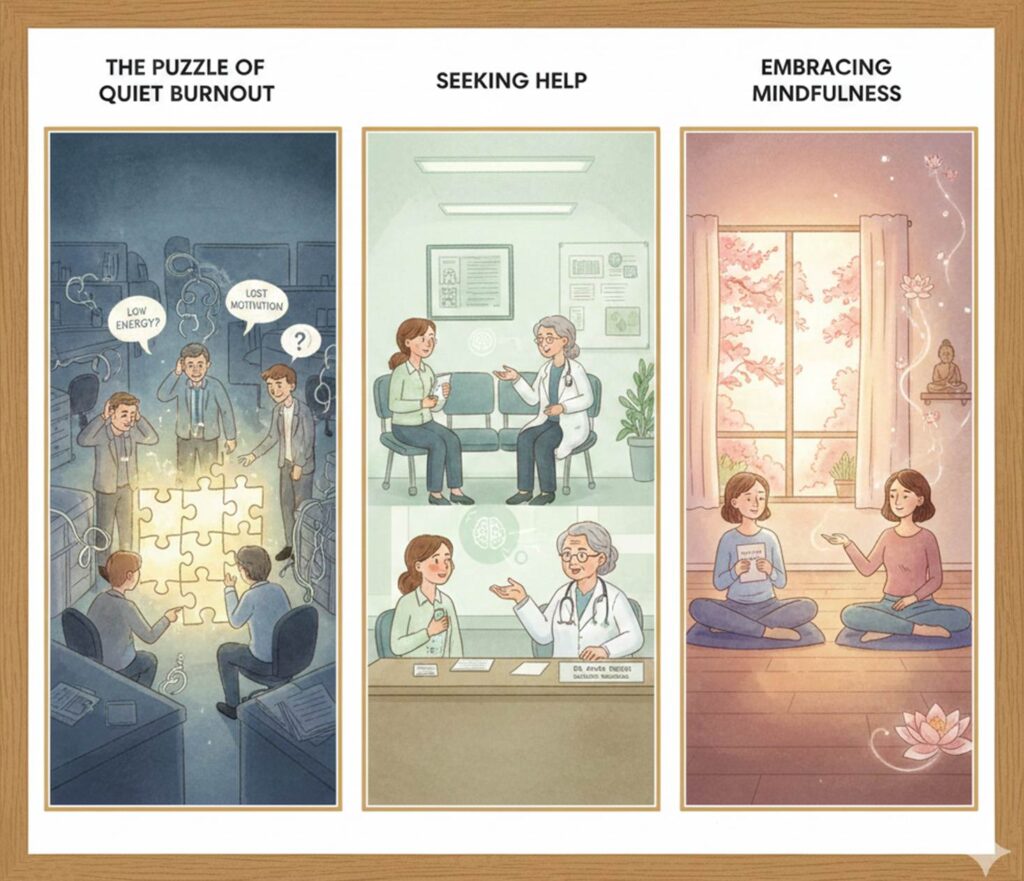
While the structural drivers often require organizational change, individuals can employ medically-backed strategies to build resilience and fortify themselves against collapse. The core of prevention involves intentional self-care and cognitive restructuring.
Non-Negotiable Self-Care:
- Establish Hard Boundaries: Clearly define work hours and adhere to them. Resist the urge to check emails outside of these times, effectively creating mental and physical detachment from work.
- Prioritize Sleep Hygiene: Aim for a consistent 7–9 hours of quality rest. A consistent bedtime is as important as total hours. Avoid screens and anxiety-provoking thoughts for at least an hour before bed, opting for relaxing activities like reading or deep breathing.
- Movement and Nutrition: Regular physical activity (even a daily 20-minute walk or 5,000 steps) reduces stress hormones and boosts mood. Maintain a balanced diet of proteins, fiber, and healthy fats to stabilize energy levels and prevent the irritability caused by sugar crashes.
- Scheduled Breaks: Take genuine breaks away from the desk. Eating lunch away from the workstation and short walks help reset cognitive function, increasing overall productivity.
Cognitive and Emotional Reframing:
- Practice Reframing (CBT): Actively challenge negative thought patterns, such as catastrophic thinking (“maximizing problems”) or minimizing successes. Reframe burdens as opportunities for growth, focusing energy only on what is within one’s control.
- Seek Support: Do not suffer in silence. Talk to trusted friends, family, or a mental health professional. Organizations often provide Employee Assistance Programs (EAPs) for free counseling, which is a critical resource for interrupting the cycle of self-blame and isolation.

5. Role of Buddha’s Teachings: Relevant Teachings and Meditation
The suffering inherent in quiet burnout finds its ancient diagnosis in the Buddha’s first Noble Truth: Dukkha, or the reality of suffering, stress, and dissatisfaction. The Buddhist path offers not just temporary relief but a fundamental paradigm shift for engaging with effort and expectation. These teachings on moderation and inner peace resonate deeply with the national cultural ideals of harmony, a time-tested approach to modern stress. The practice of Vipassanā (insight meditation), a cornerstone of Theravada Buddhism widely practiced across Thailand, is the direct spiritual tool for achieving this inner resilience.
The Middle Path and Right Effort (Samma Vayama): Burnout is the inevitable result of effort tuned too tight—the lute string snapped from excessive tension. The Buddha’s teaching of the Middle Path advises against extremes of asceticism and indulgence, and, in a workplace context, against both workaholism (too taut) and chronic idleness (too slack). This principle is crystallized in the factor of Right Effort (part of the Noble Eightfold Path), which is defined by four conscious strivings:
- Preventing unwholesome states (like cynicism, anxiety, or resentment) from arising.
- Abandoning unwholesome states that have already arisen.
- Cultivating wholesome states (like gratitude, calm, and kindness) that have not yet arisen.
- Maintaining and Enhancing wholesome states that are already present. This framework provides a practical daily guide: energy is directed not at achieving impossible output metrics, but at the quality of one’s mind. When this effort is wise, it is sustainable.
Right Mindfulness (Samma Sati) and Meditation: The foundational antidote to stress is Mindfulness (Sati), the practice of paying attention to the present moment, without judgment. Research confirms that mindfulness achieves its burnout-reducing effect primarily by strengthening positive reappraisal—the ability to find constructive meaning in stressors—a mechanism found to be more significant than reducing catastrophic thinking [LIU & WONG, 2024]. Furthermore, its effectiveness is statistically proven even in high-stakes roles like Intensive Care nursing, where interventions running 8–12 weeks significantly alleviate symptoms [KIM et al., 2024]. Critically, even ultra-short practices—such as a 3-minute mindfulness breathing exercise—have shown promise in boosting overall well-being in psychiatric nurses, addressing the high attrition rates associated with longer programs and demonstrating the value of accessible, brief moments of reflection [GIANELLA et al., 2024]. Through mindfulness meditation, we gain the capacity to observe the arising of frustration, exhaustion, or anger before it spirals into reactive burnout. Vipassana (insight meditation) is particularly powerful, as it teaches one to respond calmly to stressors rather than impulsively, purifying the mind of the habitual clinging to outcomes or expectations. By integrating mindfulness into daily work—whether through deep breathing before a difficult meeting or simply focusing on the sensation of walking during a break—the individual reclaims agency over their internal experience, transforming performance from a struggle into a sustained, resilient flow.
6. Conclusion

The phenomenon of Quiet Burnout is a stark reminder that resilience is not measured by sheer endurance alone, but by the wisdom of knowing when and how to rest, and where to place our effort. By recognizing the subtle, often-ignored signs of depletion—the cynicism, the numbness, the constant physical aches—we gain the power to halt the invisible drain before it leads to collapse. Overcoming this exhaustion demands more than just a temporary break; it requires the conscious setting of structural boundaries and the deep internal work of mindfulness. The teachings of the Buddha, particularly the principle of Right Effort, offer a profound and enduring roadmap: an unwavering focus on the quality of our consciousness, rather than the impossible quantity of our output. By committing to this balanced path, we move from being silent victims of chronic stress to conscious architects of sustainable well-being, transforming our struggle for survival into an engaged, spiritually resonant, and peacefully enduring existence.
7. References
- BODHI, Bhikkhu, ed. The Middle Length Discourses of the Buddha: A Translation of the Majjhima Nikāya. 4th ed. Somerville: Wisdom Publications, 2009. Available from: https://www.wisdompubs.org/book/middle-length-discourses-buddha. [Accessed 2025-12-16].
- GIANELLA, Elizabeth, OWENS, Rebecca A., QUINN GRIFFIN, Mary T. and FITZPATRICK, Joyce J. A Mindfulness-Based Intervention: Effects on Psychiatric Nurses Well-being and Burnout. Journal of the American Psychiatric Nurses Association. 2024, vol. 18, no. 2, p. 115-120. Available from: https://journals.sagepub.com/doi/abs/10.1177/10783903241240455. [Accessed 2025-12-16].
- KIM, S. H. et al. Effectiveness of Mindfulness Intervention to Reduce Burnout in Intensive Care Nurses: A Systematic Review. International Journal of Nursing Studies. 2024, vol. 148, p. 103598. Available from: https://doi.org/10.1016/j.ijnurstu.2023.103598. [Accessed 2025-12-16].
- LIU, Yijun and WONG, Kennis. Positive reappraisal and catastrophizing mediate the relationship between mindfulness and job burnout. Journal of Occupational Health Psychology. 2024, vol. 29, no. 1, p. 50-61. Available from: https://psycnet.apa.org/doi/10.1037/ocp0000373. [Accessed 2025-12-16].
- MAYO CLINIC. Burnout: Prevention and Treatment. Rochester, Minnesota: Mayo Clinic. Available from: https://www.mayoclinic.org/healthy-lifestyle/adult-health/in-depth/burnout/art-20046642. [Accessed 2025-12-16].
- PAYUTTO, P. A. (Bhikkhu). Buddhadhamma: The Laws of Nature and Their Benefits to Life. Translated by Robin Philip Moore. Bangkok: Buddhadhamma Foundation, 2021. Available from: https://buddhadhamma.github.io/. [Accessed 2025-12-17].
- PSYCHIATRY.ORG. Work and Mental Health. Washington, D.C.: American Psychiatric Association. Available from: https://www.psychiatry.org/patients-families/work-and-mental-health. [Accessed 2025-12-16].
- WORLD HEALTH ORGANIZATION (WHO). International Classification of Diseases, 11th Revision (ICD-11). Geneva: World Health Organization. Available from: http://www.who.int/classifications/icd/en/. [Accessed 2025-12-16].

Author: Paitoon Songkaeo, Ph.D.
Transitioning from a Buddhist monk to a diplomat, Paitoon Songkaeo is the Administrative Director of the Thailand Foundation. With a background of 16 years as a Buddhist monk, he later joined the Ministry of Foreign Affairs and retired as the Consul-General of Kota Bahru, Malaysia, in 2017.