


บทนำ: ทำไม สังสารวัฏ และ กรรม ยังคงสำคัญในปัจจุบัน
For many, the concepts of samsara (the cycle of birth and death) และ kamma (the law of moral causation) seem abstract or confined to ancient Buddhist doctrine. Yet, a closer look reveals their profound relevance for modern life.
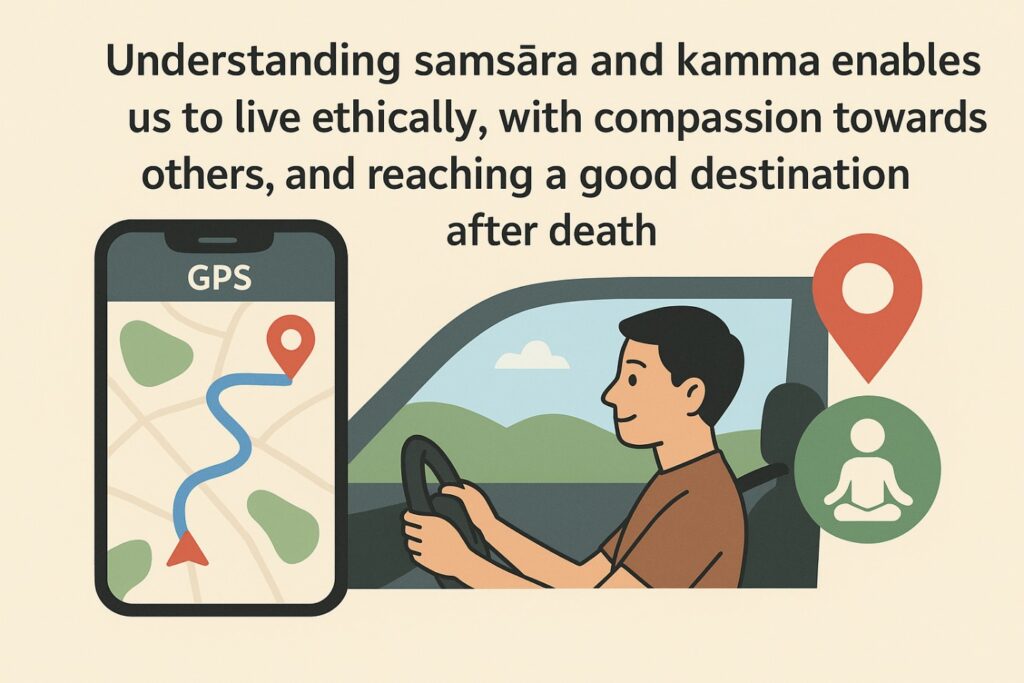
Understanding samsara and kamma provide us with a framework for existence: they explain why life is marked by constant change, and why our choices shape not only this life but also those to come. The law of kamma operates as a spiritual compass, showing us how our intentions and actions determine our destiny.
The Buddha’s vision of samsara was not a matter of speculation, but of direct experience attained through deep meditative insight. Today, his insights find resonance not only in Buddhist tradition but also in modern science and psychology. As we will see, understanding samsara is not just a matter of belief — it is a practical guide for living with clarity, responsibility, and compassion.
Part I: Seeing Beyond the Ordinary — The Buddha’s Vision
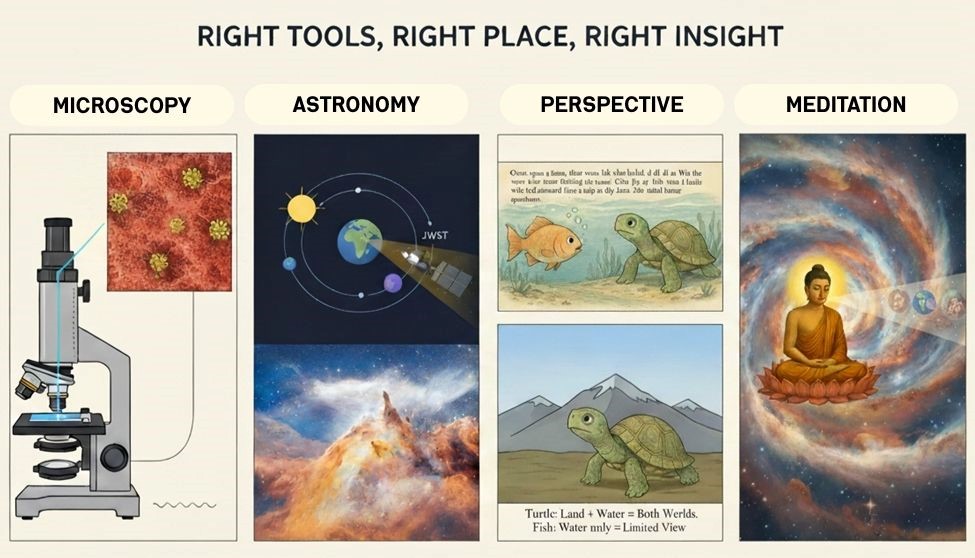
To appreciate the Buddha’s discovery of samsara, we must first recognize the limits of ordinary perception. Human senses, like scientific instruments, are bounded by their range. Just as a light microscope cannot reveal viruses because they are smaller than the wavelength of visible light, so too our everyday perception cannot detect the hidden truths of existence.
Modern science overcomes these limits with advanced tools:
- อริยสัจ 4 (Four Noble Truths) Electron Microscope reveals the structure of viruses such as SARS-CoV-2.
- อริยสัจ 4 (Four Noble Truths) James Webb Space Telescope (JWST) captures galaxies from the dawn of the universe by seeing in infrared light, invisible to the naked eye.
In Buddhist tradition, this idea is illustrated in the story of the turtle and the fish. The turtle, who has seen both land and water, tries to explain the experience of walking on land to the fish. But the fish, knowing only the water, dismisses the claim as impossible. Similarly, ordinary perception cannot grasp the realities beyond its own domain.
อริยสัจ 4 (Four Noble Truths) Buddha, however, developed the “instruments” needed to perceive the unseen. Through deep meditative absorption (jhana), he purified his mind and cultivated higher knowledge (naṇa). This allowed him to directly perceive past lives and the workings of rebirth. Two specific faculties were central:
- Pubbenivasanussatinaṇa — the knowledge of remembering past lives, through which he recalled his own former existences in detail.
- Cutupapatanaṇa — the knowledge of seeing beings pass away and reappear, observing how kamma determines the cycle of rebirth.
Like the telescope or microscope in science, these meditative faculties opened a hidden dimension of reality. The Buddha’s vision of samsara thus emerged not from speculation but from systematic training and direct experience.
Part II: กรรม — The Law That Guides Our Lives
The cycle of samsara is not random or chaotic. It is governed by kamma: the principle of cause and effect rooted in our intentions, words, and deeds. This law extends beyond the present, shaping both this life and future lives.
Two analogies help us understand how kamma operates: as a GPS for life’s journey and as a universal legal framework.
Kamma as a Spiritual GPS
A GPS system guides drivers by processing real-time and historical data to suggest the best route. If one strays from the path, it recalculates to bring the traveler back on course.
กรรม functions in much the same way:
- Data input: Our thoughts, intentions, and actions form the “kammic data.” Skillful actions (kindness, generosity) are like open highways, while unskillful actions (greed, hatred) are like roadblocks.
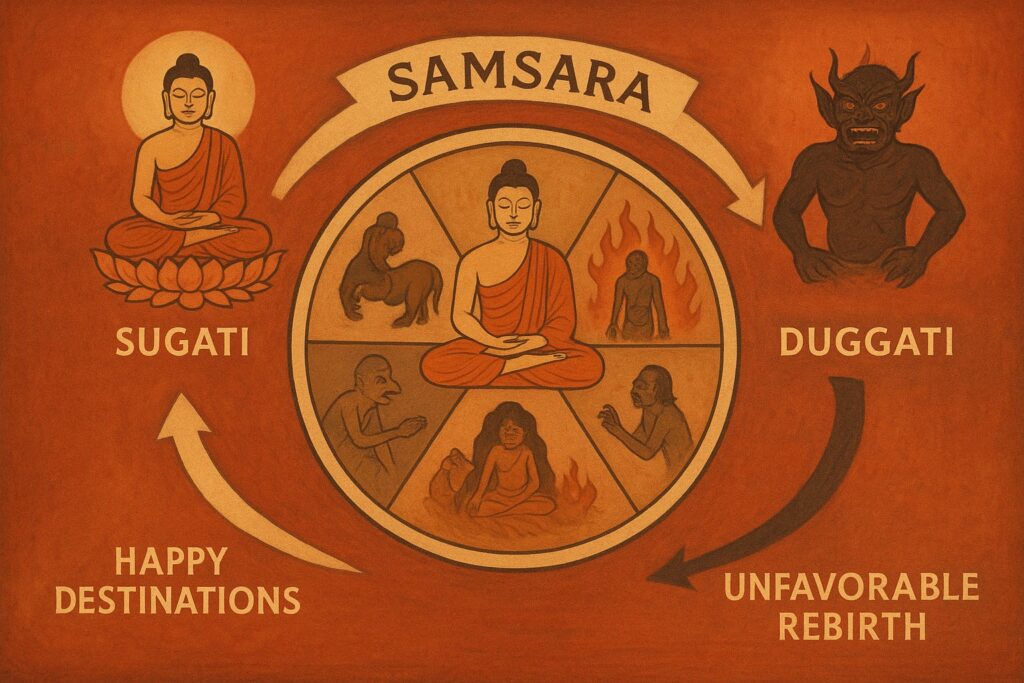
- Destination: The “destination” is our next rebirth. Wholesome kamma leads to favorable destinations (Sugati), while unwholesome kamma leads to unfavorable ones (Duggati).
- Feedback: Just as GPS provides turn-by-turn corrections, the consequences of kamma — suffering or happiness — guide us to adjust our course.
his analogy emphasizes personal responsibility: each decision shapes the path we travel in samsara.
กรรม as a Universal Law of Justice
กรรม also works as a self-enforcing legal system. Unlike human courts, which require judges and police, the law of kamma operates automatically:
Cause and effect: Every intentional act plants a seed that ripens into a result. Compassion creates happiness; hatred creates suffering.
Impartial and universal: No one escapes the results of kamma, which follow us across lifetimes. Our present circumstances — wealth, health, character — are shaped by past actions.
Role of intention: What matters most is not just the deed but the motive (cetana) behind it. An act done with malice differs kammically from the same act done with pure intent.
Through this lens, life is seen not as unfair, but as profoundly just. The diversity of human conditions reflects the working of this moral law.
While Buddhist tradition explains kamma as both a guiding system and a universal law of justice, modern research and psychology provide echoes of these truths in a scientific language.
Part III: Modern Echoes — Evidence from Research and Psychology
Although the Buddha’s realization of samsara was experiential, modern research provides empirical echoes of these truths.
Insights from Past-Life Studies
The most well-known work comes from Dr. Ian Stevenson and colleagues at the University of Virginia, who studied over 2,500 cases of children claiming to remember past lives.
ตารางที่ 1: การค้นพบที่สำคัญจากงานวิจัยเรื่องการจดจำอดีตชาติ
| ปรากฏการณ์ | คำอธิบาย |
| การระลึกชาติได้เอง | Children, typically between the ages of 2 and 7, spontaneously speak about a previous life without hypnotic regression. The memories often cease by age 6 or 7. |
| ความสัมพันธ์ทางกายภาพ | A number of children presented with birthmarks or birth defects that corresponded to the fatal wounds suffered by the deceased individual whose life they claimed to remember. |
| ลักษณะทางพฤติกรรม | Many children displayed emotional longing for their previous family, as well as phobias or other behaviors that appeared to be connected to the manner of death in the previous life. Over 35% of children with memories of a violent death showed phobias related to that death. |
| รายละเอียดที่ตรวจสอบได้ | In a significant number of cases, the children provided enough accurate details—including names of places, people, and events—that researchers were able to locate the deceased person whose life matched the details provided by the child. |
These studies found that claims of past-life memories were not purely a cultural phenomenon and occurred in Western countries and families without a belief in reincarnation or rebirth. The consistency of the findings across diverse cultures, combined with the presence of physical and behavioral correlates, presents a compelling body of evidence that supports the assertion that rebirth is a verifiable aspect of reality.
Table 2: Key Benefits of Understanding Samsara and Kamma
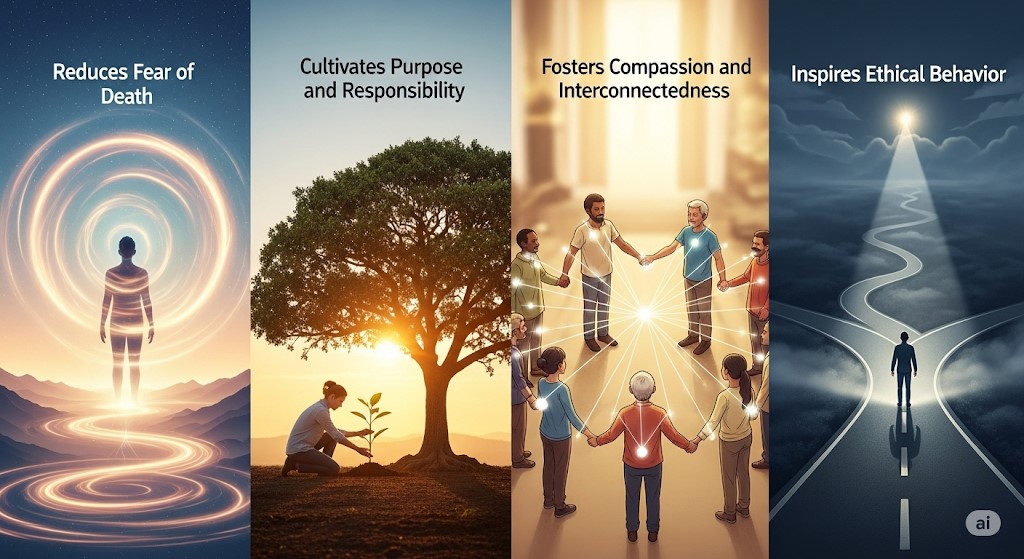
| Benefit | Explanation |
| Reduces Fear of Death | The concept of samsara views death as a transition to a new existence, countering the fear of annihilation and allowing for a more accepting attitude toward mortality. |
| Cultivates Purpose and Responsibility | By suggesting that life is part of a larger cycle and that actions have consequences beyond this lifetime, samsara imbues existence with a deeper significance and a sense of purpose. |
| Fosters Compassion and Interconnectedness | The understanding that all beings are part of the same cyclical process of existence cultivates a sense of interconnectedness and fosters virtues such as compassion, empathy, and kindness towards others. |
| สร้างแรงบันาลใจสู่พฤติกรรมทางจริยธรรม | The law of kamma provides a direct motivation for ethical behavior, as individuals are encouraged to act in ways that generate positive kamma, thereby ensuring a more favorable future existence. |
These benefits resonate with both Buddhist teachings and modern psychology, providing a foundation for resilience, compassion, and meaning in life.
The Wisdom of Knowing, Not Merely Believing
For the Buddha’s followers, the teachings on samsara and kamma are familiar, but for newcomers they can seem unfamiliar or even abstract. The Buddha himself, however, never asked people to accept these truths on faith alone. In the Kalama Sutta, he advised against blind belief—whether based on tradition, repetition, or respect for a teacher. Instead, he urged people to examine teachings for themselves, to test whether they lead to beneficial outcomes and wholesome results, are commended by the wise, and foster compassion and clarity. If they do, then one should practice them because they bring benefit; if they do not, then they should be set aside, for to follow them would bring only harm.
The truths of samsara and kamma are to be known through reflection, practice, and lived results. In this way, the path becomes one of self-reliance and wisdom, where each person discovers truth not by believing, but by knowing.
Conclusion: Living Without Fear of Death, With Mindful Living
Understanding samsara and kamma offers more than a theoretical framework — it is a practical GPS for existence. Like a steering wheel that lets us turn left or right, it enables us to make wise choices in the journey of life. It helps us:
- Live without fear of death, seeing death not as an end but as a natural transition within samsara.
- Practice mindfulness at all times, so that each thought, word, and action becomes a conscious “turn” that shapes our direction.
- Navigate life’s uncertainties with wisdom, as the law of kamma provides constant feedback that helps us adjust our course.
- Cultivate compassion and ethical living, knowing that wholesome actions lead to happiness and harmony while unwholesome actions cause suffering and create obstacles.
In this way, samsara and kamma become not abstract beliefs but living tools — a compass and GPS that guide us moment by moment. By embracing mindful living and freedom from fear, we discover a path of clarity, responsibility, and peace that leads us forward, turn by turn, toward the highest good.
เช่นเดียวกับที่ GPS ช่วยให้นักเดินทางไปถึงจุดหมายที่ถูกต้อง การเข้าใจสังสารวัฏและกรรม—ด้วยความมีสติ—จะช่วยนำทางเราให้ก้าวพ้นความกลัวและความสับสน ไปสู่สันติภาพและการตื่นรู้
Watch full video : https://youtu.be/jxMplocVTz8
References
- Access to Insight. “The Truth of Rebirth.” By Thanissaro Bhikkhu. Accessed August 18, 2025. https://www.accesstoinsight.org/lib/authors/thanissaro/truth_of_rebirth.html.
- Access to Insight. “Jhana.” Accessed August 17, 2025. https://www.accesstoinsight.org/ptf/dhamma/sacca/sacca4/samma-samadhi/jhana.html#:~:text=Jhana%20is%20a%20meditative%20state,the%20development%20of%20Right%20Concentration.
- BuddhaNet. “Buddhist Studies on Rebirth and Karma.” Accessed August 18, 2025. https://www.buddhanet.net/e-learning/buddhism/bs-s07c/.
- Buddha Vacana. “Pubbenivasanussatinana.” Accessed August 17, 2025. http://www.buddha-vacana.org/formulae/pubbe.html.
- Buddhism Stack Exchange. “How do we know that the suttas talk about past lives?” Accessed August 17, 2025. https://buddhism.stackexchange.com/questions/15555/how-do-we-know-that-the-suttas-talk-about-past-lives.
- EBSCO. “Samsara.” Research Starters. Accessed August 17, 2025. https://www.ebsco.com/research-starters/religion-and-philosophy/samsara.
- Fox Weather. “Jewels of discovery by NASA’s Webb Space Telescope in its first 3 years.” Accessed August 17, 2025. https://www.foxweather.com/earth-space/nasa-webb-space-telescope-3-years.
- Fundação BIAL. “Academic studies on claimed past-life memories.” Accessed August 17, 2025. https://bialfoundation.com/com/science-stories/posts/academic-studies-on-claimed-past-life-memories/.
- Lamayeshe.com. “Meditation on Lower Realms and Karma.” Accessed August 18, 2025. https://www.lamayeshe.com/article/chapter/meditation-two-three-lower-realms-refuge-and-karma.
- NASA Scientific Visualization Studio. “James Webb Space Telescope Orbit.” Accessed August 17, 2025. https://svs.gsfc.nasa.gov/13553/.
- Number Analytics. “The Philosophical Underpinnings of Samsara.” Accessed August 17, 2025. https://www.numberanalytics.com/blog/philosophical-underpinnings-of-samsara.
- Pāli Dictionary. “cutūpapāta-ñāṇa.” Accessed August 17, 2025. https://dictionary.sutta.org/browse/c/cut%C5%ABpap%C4%81ta-%C3%B1%C4%81%E1%B9%87a/.
- ResearchGate. “The Composition of Ian Stevenson’s Twenty Cases Suggestive of Reincarnation.” Accessed August 17, 2025. https://www.researchgate.net/publication/384905191_The_Composition_of_Ian_Stevenson’s_Twenty_Cases_Suggestive_of_Reincarnation.
- Thailand Foundation. “The Kalama Sutta: A Buddhist Timeless Guide to Critical Thinking and Ethical Living.” Accessed August 24, 2025. https://thailandfoundation.or.th/the-kalama-sutta-a-buddhist-timeless-guide-to-critical-thinking-and-ethical-living/
- University of Virginia School of Medicine. “Children Who Claim to Remember Previous Lives: Past, Present, and Future.” Accessed August 17, 2025. https://med.virginia.edu/perceptual-studies/wp-content/uploads/sites/360/2015/11/REI35.pdf.
- University of Virginia School of Medicine. “Ian Stevenson and Cases of the Reincarnation Type.” Accessed August 17, 2025. https://med.virginia.edu/perceptual-studies/wp-content/uploads/sites/360/2016/12/REI36Tucker-1.pdf.
- Webb Telescope. “Webb’s Orbit.” Accessed August 17, 2025. https://webbtelescope.org/contents/media/images/4201-Image.
- What the Buddha Taught. Accessed 24 August, 2025. https://www.theravada.gr/wp-content/uploads/2021/05/Dr_Walpola_Rahula_What_the_Buddha_Taught.pdf
- Wikipedia contributors. “Dhyana in Buddhism.” Wikipedia, The Free Encyclopedia. Accessed August 17, 2025. https://en.wikipedia.org/wiki/Dhyana_in_Buddhism.
- Wikipedia contributors. “Rebirth (Buddhism).” Wikipedia, The Free Encyclopedia. Accessed August 18, 2025. https://en.wikipedia.org/wiki/Rebirth_(Buddhism).
- Wisdom Library. “Sugati, Su-gati: 19 definitions.” Accessed August 17, 2025. https://www.wisdomlib.org/definition/sugati.
- Ottama. Message in Kamma, Rebirth, and Samsara. Buddhist Publication Society. PDF document. Accessed August 18, 2025. https://bps.lk/olib/wh/wh425_Ottama_Message-in-Kamma-Rebirth-Samsara.pdf.
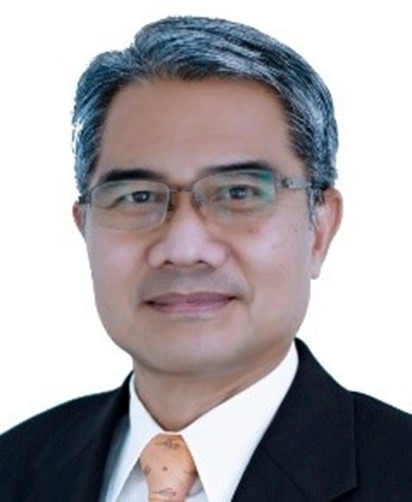
ผู้เขียน : ดร. ไพฑูรย์ สงค์แก้ว
ดร. ไพฑูรย์ สงแก้ว อดีตเป็นพระภิกษุ ก่อนเข้ารับราชการเป็นนักการทูตในเวลาต่อมา ปัจจุบันดำรงตำแหน่งผู้อำนวยการบริหารมูลนิธิไทย ท่านเคยบวชเรียนในบวรพุทธศาสนามายาวนานถึง 16 ปี ก่อนจะเข้ารับราชการที่กระทรวงการต่างประเทศ และเกษียณอายุราชการในตำแหน่งกงสุลใหญ่ ณ เมืองโกตาบารู ประเทศมาเลเซีย เมื่อปี พ.ศ. 2560 นอกจากนี้ เขายังเป็นผู้เขียนบทความประจำในด้าน สิ่งยึดเหนี่ยวทางจิตใจและการทำสมาธิ section.