


In the second part of this series, we explored the prehistoric roots and early-state traditions of Thai ceramics, from Ban Kao and Ban Chiang to the Dvaravati, Hariphunchai, Srivijaya, and Khmer periods. Now, in this third part of the series, we turn to the classical and early modern eras of Thai history, when ceramics reached new heights of innovation, artistry, and international recognition under the kingdoms of Sukhothai, Lanna, Ayutthaya, and Rattanakosin.
Credit: orientalceramic.com
Thai Ceramics during the Sukhothai Period: The Golden Age of Sangkhalok Ware
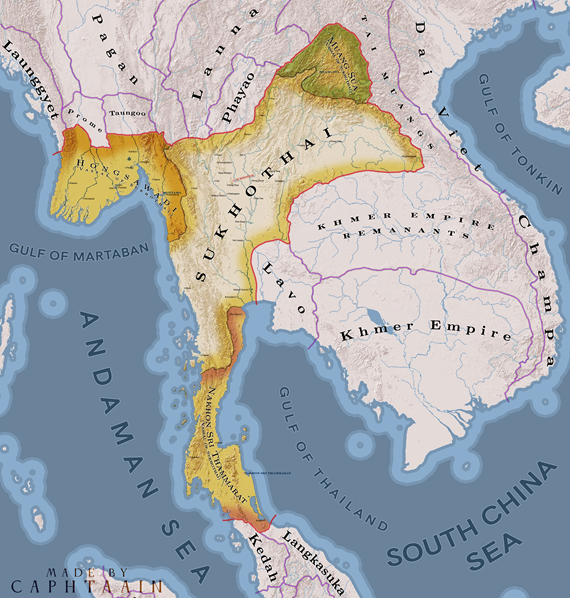
The Sukhothai period marks a defining chapter in the history of Thai ceramics, distinguished by technical innovation, artistic refinement, and flourishing international trade. Thriving between the 13th and 15th centuries CE, the Sukhothai Kingdom emerged as one of the first truly independent Thai polities following the decline of Khmer dominance in the region. This era is widely regarded as a cultural renaissance, during which arts, religion, and commerce flourished, with ceramics becoming one of the most significant forms of material culture.
Credit: wikimedia.org
Credit : finearts.go.th
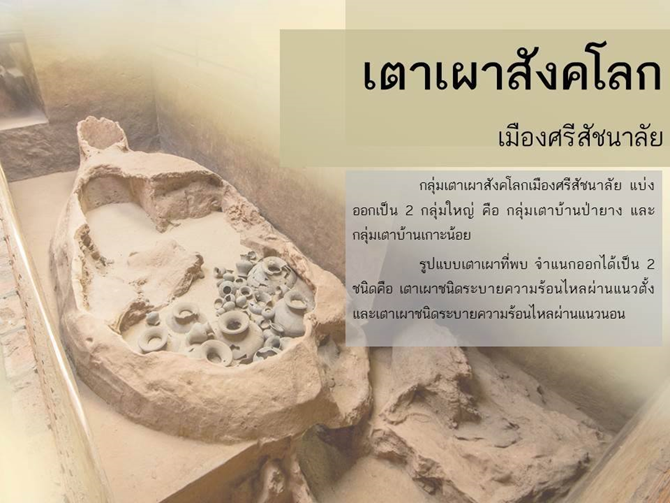
Ceramic production during this period was primarily centered in the Northern central region of Thailand, with the most prominent kiln complexes located in Si Satchanalai, present-day Sukhothai Province, which served as the principal center of Sangkhalok production, and Sawankhalok in neighboring areas, another major ceramic hub often referenced interchangeably with Sangkhalok ware. Archaeological excavations have uncovered over 200 kiln sites in the Si Satchanalai area alone, indicating a robust and highly organized ceramic industry. These kilns employed advanced updraft designs capable of high-temperature firings, marking a significant advancement from earlier low-fired earthenware traditions.
Credit: finearts.go.th
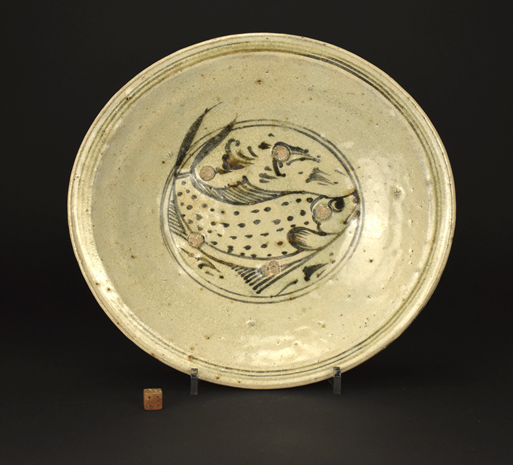
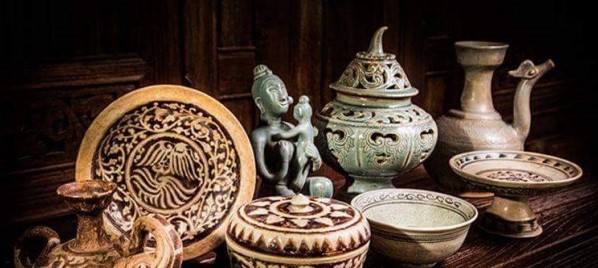
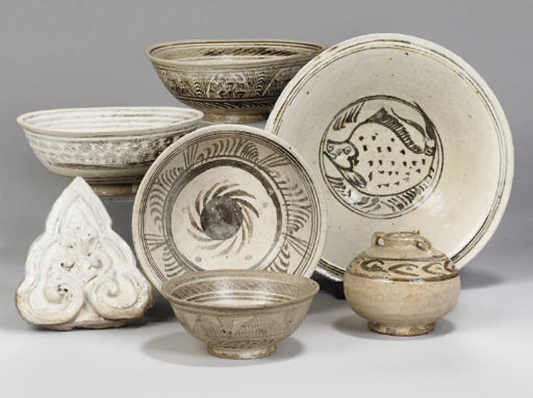
Sukhothai-period ceramics, particularly Sangkhalok ware, are notable for their refined stoneware bodies, high firing temperatures, and elegant glaze techniques, resulting in wares that were both utilitarian and decorative. While reflecting Chinese influences, especially from the Yuan and early Ming dynasties, Sukhothai ceramics developed a distinctive local flair in shape, design, and glaze tone. Key features of Sangkhalok ceramics include celadon glazes in greenish-blue tones produced through high-temperature reduction firing, underglaze black decoration featuring motifs such as lotus petals, fish and aquatic life, floral scrolls, and geometric patterns, and forms ranging from bowls, dishes, jars, kendis (pouring vessels), to covered boxes and figurines. The sgraffito technique, where patterns were incised into the clay body before glazing, was also commonly used to create detailed decorative surfaces.
Sangkhalok ware is undoubtedly the most renowned ceramic type from the Sukhothai period. The name “Sangkhalok,” sometimes spelled “Sawankhalok,” likely derives from the city of Sawankhalok and has come to encompass the broad range of glazed stoneware produced in the region during this era. These wares were not only used locally but were also extensively exported throughout Southeast Asia, Japan, and as far as the Middle East, testifying to their widespread appeal and the kingdom’s active participation in maritime trade networks.
Credit: christies.com
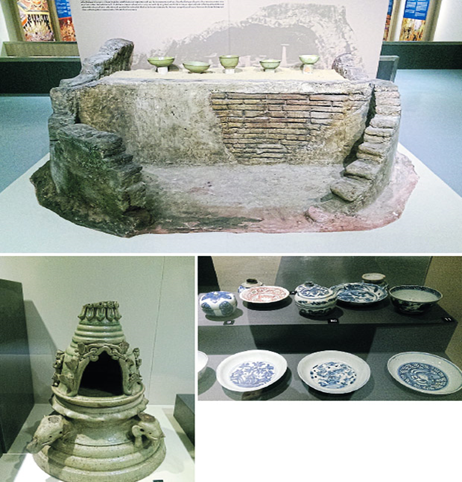
Exported Sangkhalok pieces have been recovered from numerous underwater shipwrecks and archaeological sites, highlighting their role as valuable trade commodities and underscoring their significance as cultural ambassadors of Sukhothai’s artistic legacy.
Overall, the ceramics of the Sukhothai period represent a pinnacle of Thai artistic achievement in the pre-modern era. With the advent of Sangkhalok ware, Thailand elevated its ceramic techniques to new heights and established itself as a vital player in regional trade and cultural exchange. Today, these artifacts continue to captivate collectors, scholars, and visitors, preserving the elegance, innovation, and cultural sophistication of a golden age in Thai ceramic history.
Credit: visitworldheritage.com
Thai Ceramics during the Lanna Period: Northern Craft and Cultural Identity
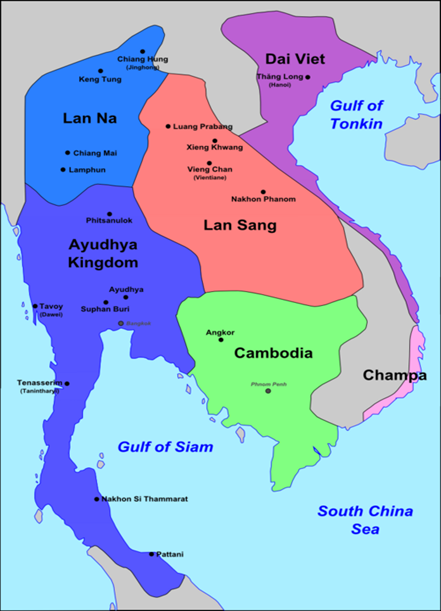
The Lanna Kingdom, which flourished in the mountainous north of Thailand, developed a rich and distinctive ceramic tradition that both reflected and supported its unique cultural identity. Thriving between the 13th and 18th centuries CE, with its peak during the 14th to 16th centuries, the Lanna Kingdom was centered in Chiang Mai and maintained political autonomy and cultural vibrancy even as it absorbed influences from neighboring kingdoms such as Sukhothai and Ayutthaya.
Credit: wikipedia.org
The ceramics of Lanna evolved alongside the region’s growing wealth, religious institutions, and domestic needs, creating a legacy that offers invaluable insights into regional craftsmanship, trade, and artistic expression. Ceramic production was concentrated in the upper Northern provinces of Thailand, particularly in areas rich in natural clay and water sources, with key kiln sites including San Kamphaeng in Chiang Mai Province, Wiang Kalong in Chiang Rai Province, Wang Nuea in Lampang Province, and Tao Pan and Tao Phayao in Phayao Province. These sites reflect a decentralized yet vibrant network of ceramic production centers that served both local consumption and regional trade, as evidenced by archaeological studies uncovering kiln remains, ceramic shards, and finished vessels illuminating the extent of Lanna’s ceramic culture.
Credit: bangkokpost.com
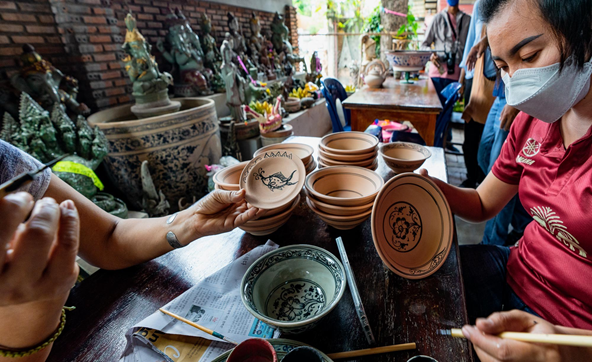
Lanna ceramics were predominantly low-fired earthenware and stoneware made using both hand-forming and wheel-throwing techniques, displaying a wide variety of forms and decorative approaches suited to daily use and religious practice. Key stylistic features include functional forms such as cooking pots, water jars, offering trays, lamps, and burial urns; decorative techniques like incising, stamping, cord-marking, and mold-pressing; glazes in muted green, brown, or gray tones, sometimes uneven due to rudimentary kiln controls; and figurines and ritual objects including animal figures, guardian statues, and votive tablets. Lanna ceramics are characterized by simple yet elegant shapes reflecting highland utilitarian needs and aesthetic sensibilities, emphasizing rustic charm and regional uniqueness distinct from the refined celadon and underglaze wares of Sukhothai and Ayutthaya.
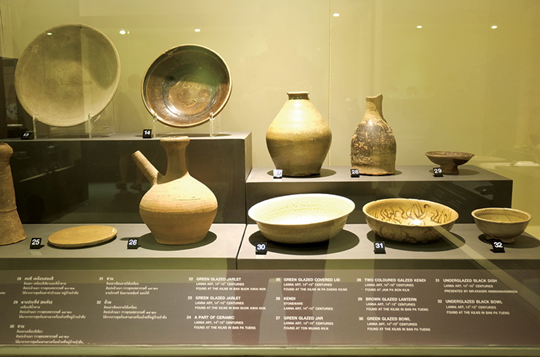
Credit: changpuakmagazine.com
Each production center in Lanna developed its own stylistic identity. San Kamphaeng was a major kiln center known for producing glazed earthenware pots, bowls, and small ritual vessels, many featuring greenish glazes and molded designs. Wiang Kalong ceramics are notable for their thin walls and decorative finesse, often employing sgraffito and impressed designs on reddish-brown bodies with dark glazes. Wang Nuea produced large storage jars and domestic wares characterized by thick walls and utilitarian forms with minimal decoration. The Tao Pan and Tao Phayao kilns specialized in glazed stoneware with refined shapes, often showing technical influence from Sangkhalok ceramics while retaining a distinctly Northern style in form and function.
Overall, Lanna-period ceramics offer a compelling portrait of Northern Thailand’s cultural and material history. Their diversity in form and decoration illustrates the region’s artisanal richness, while their distribution points to vibrant networks of production and exchange. Though perhaps more understated than their central Thai counterparts, Lanna ceramics remain vital to understanding the full scope of Thailand’s ceramic heritage, where local identity, craftsmanship, and function blend into enduring works of art.
Thai Ceramics during the Ayutthaya and Rattanakosin Periods: The Elegance of Benjarong Tradition
Thai ceramics underwent significant transformation during the Ayutthaya and Rattanakosin periods, reflecting the evolving aesthetics of Thai society as well as its diplomatic and cultural connections with the wider world. The Ayutthaya period, spanning from 1350 to 1767 CE, marked the rise of a powerful and cosmopolitan Thai kingdom engaged in extensive trade with China, Japan, Persia, and European powers. This era witnessed the continuation of local ceramic traditions alongside the adaptation of imported techniques, particularly from China. Following the fall of Ayutthaya in 1767, the Rattanakosin period began with the establishment of Bangkok as the capital in 1782. The early to mid-Rattanakosin era, from the late 18th to 19th centuries, continued many artistic and court traditions from Ayutthaya while also fostering a strong sense of national identity through the refinement of royal arts, including ceramics.
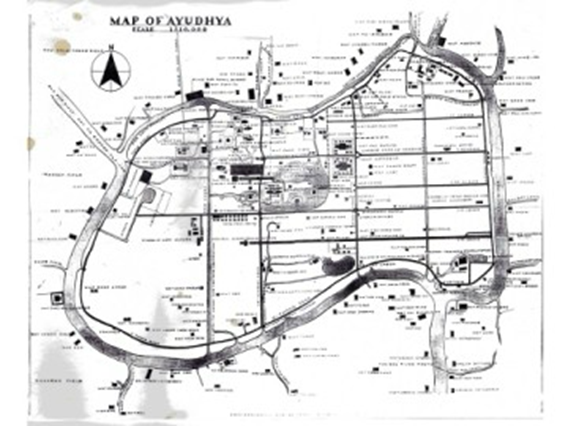
Credit: ayutthaya-history.com
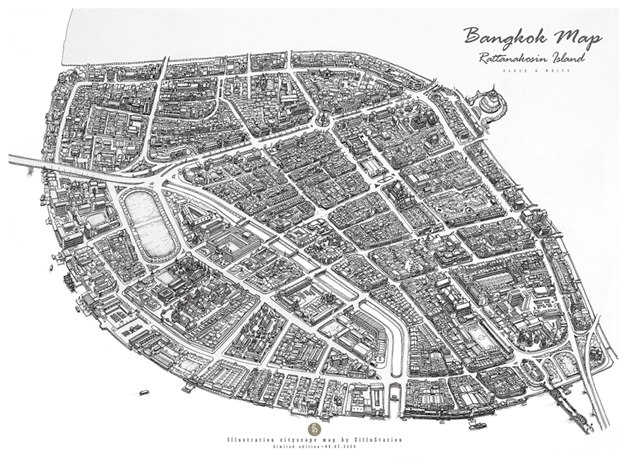
Credit: behance.net
During the Ayutthaya period, the influx of Chinese porcelain and the expansion of international maritime trade deeply influenced Thai ceramic production. Local kilns began shifting their focus from producing everyday earthenware to creating more refined decorative ceramics suited to
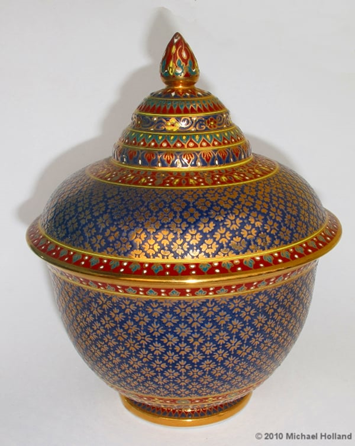
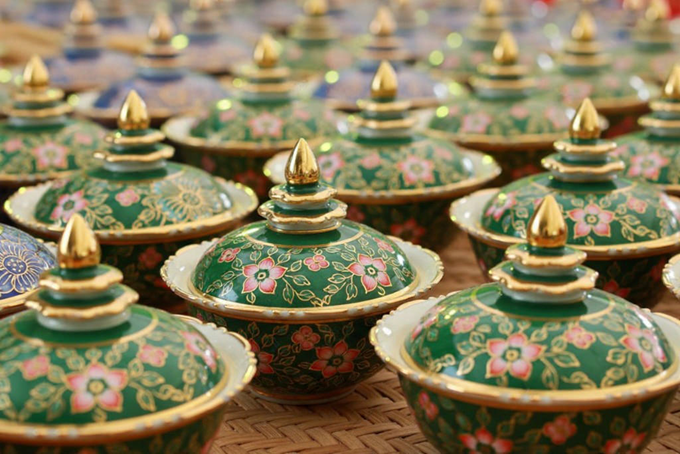
and ritual functions. As trade routes expanded, imported Chinese blanc-de-chine and blue-and-white porcelain became fashionable among the Thai court and nobility. In response, Thai artisans developed Benjarong ware, an adaptation of Chinese porcelain that evolved into a uniquely Thai art form in style, meaning, and use. Benjarong, derived from the Sanskrit pancha rang meaning “five colors,” became the most distinguished ceramic style of the Ayutthaya and Rattanakosin periods. Historically, Thai Benjarong porcelain was commissioned by Thai consumers to be produced in China, based on designs and motifs drawn by Thai artist. Later, Thai artisans would travel to oversee the production, ensuring a distinctively Thai aesthetic. By the Rattanakosin period, Thai craftsmen had mastered both painting and firing techniques at home. Benjarong ware featured a traditional five-color scheme of red, green, yellow, black, and white, with other colors being added in later ages. Its motifs included complex symmetrical patterns with floral designs, mythical beings, flame motifs (kranok), and mythological creatures such as garuda, naga, and kinaree. Common forms included covered bowls, water vessels, tea sets, spittoons, and decorative lidded jars, often used in royal households or Buddhist ceremonies.
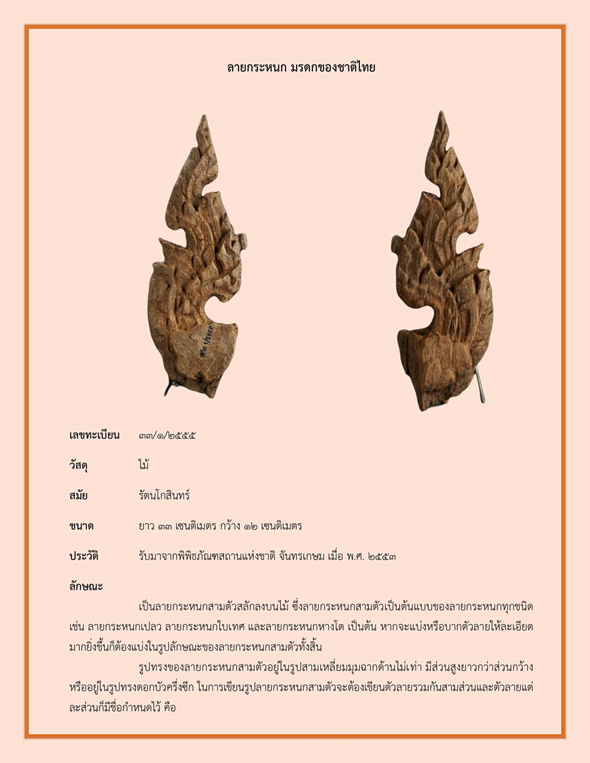
Credit: finearts.go.th
Credit: bangkokforvisitors.com
During the early Rattanakosin period, Benjarong reached new levels of sophistication under royal patronage. Production became centralized and formalized, often carried out in workshops serving the palace. This era saw the development of Lai Nam Thong ware, a luxurious variation of Benjarong that added real gold gilding over the enamel designs to emphasize prestige and grandeur.
Today, though no longer restricted to royal use, Benjarong remains a symbol of Thai heritage and refined artistry. Modern artisans continue to produce Benjarong ware for ceremonial use, diplomatic gifts, and collectors, ensuring the continuation of a tradition that blends international influences with uniquely Thai aesthetics. From the globalized courts of Ayutthaya to the grandeur of early Rattanakosin, Thai ceramics evolved from utilitarian wares into objects of royal art and national pride. Benjarong ware, in particular, bridges centuries of craftsmanship, religious symbolism, and political identity, remaining one of Thailand’s most enduring contributions to the global history of ceramics.
Credit: sabaihome.store
Conclusion
From the Sangkhalok kilns of Sukhothai to the rustic charm of Lanna, and from the cosmopolitan courts of Ayutthaya to the gilded splendor of Rattanakosin Benjarong, Thai ceramics reveal a story of technical innovation, cultural identity, and international exchange. Each era contributed distinctively to the evolution of Thai ceramic traditions, shaping a legacy that endures today.
Now that we’ve seen how Thai ceramics developed through the great kingdoms, join us in the final of this series as we explore modern Thai ceramics—how traditional techniques, regional styles, and global influences converge in contemporary artistry and craft.
Sources
- Khreuang Pan Dinphao [Pottery]. 2011. Bangkok: Khati Publishing.
- https://www.youtube.com/watch?v=4eZWYMOylk4&pp=ygUx4LmA4Lia4LiN4LiI4Lij4LiH4LiE4LmMIOC4lOC4reC4meC5hOC4geC5iOC4lOC4tQ%3D%3D
- https://www.youtube.com/watch?v=4eZWYMOylk4&pp=ygUx4LmA4Lia4LiN4LiI4Lij4LiH4LiE4LmMIOC4lOC4reC4meC5hOC4geC5iOC4lOC4tQ%3D%3D
- https://www.youtube.com/watch?v=Fp-GZ-Br15Q
- https://www.thailandfoundation.or.th/en/culture_heritage/dragon-jars-of-ratchaburi-province/
- https://www.thailandfoundation.or.th/en/culture_heritage/ban-chiang-pottery/
- https://www.thailandfoundation.or.th/en/culture_heritage/wiang-kalong-earthenware-from-the-city-of-lost-crows/
Author: Viphawan Benniman
Editor: Tayud Mongkolrat