


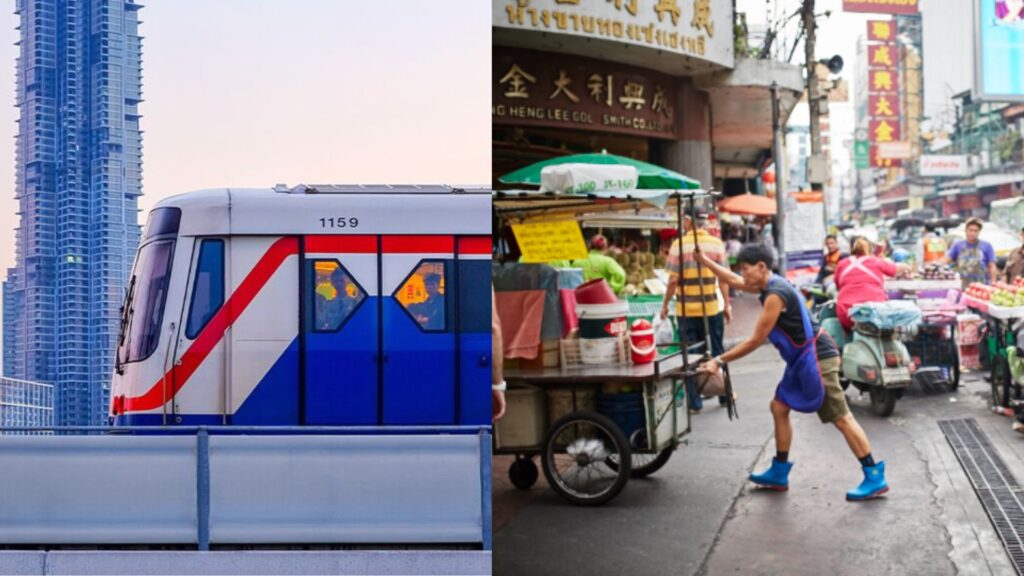
(Left) The elevated flow of the BTS Skytrain; (Right) The grounded agility of a street vendor’s cart. Two sides of Bangkok’s modern mobility and retail landscape.
Cr. (Left) The Bear Travel; (Right) ironchefshellie
Claudio Sopranzetti provides a fascinating ethnographic comparison of two iconic vehicles in Bangkok’s commercial landscape: the Skytrain car and the street vendor’s cart. Instead of viewing them as opposing forces of modernity versus tradition, the article argues that both represent aggressive marketing strategies that emerged forcefully after the 1997 economic crisis. Sopranzetti analyzes how carts create a centrifugal force, turning sidewalks into interactive social spaces, while the Skytrain exerts a centripetal force, channeling isolated consumers directly into air-conditioned shopping malls, creating a vertical separation in the city’s social fabric.
The Thailand Foundation invites you to explore this unique perspective on Bangkok’s urban flux. This article challenges the assumption that street vending is a fading relic, proposing instead that the lumpy mobility of the cart is just as modern as the smooth flow of the Skytrain. It offers a deep reflection on how we move, consume, and relate to one another in the city, reminding us that true modernity in Bangkok is defined by the coexistence of these contrasting rhythms.
Author: Claudio Sopranzetti
This article was published in the Rian Thai International Journal of Thai Studies and is being shared by the Thailand Foundation with permission from the Thai Studies Center, Chulalongkorn University, all rights reserved to the owner of the material.