


Video Versions of the Article
For those who prefer to watch and listen, this article is also available in video format.
The videos are presented in both Thai and English, offering the same core insights through spoken reflection and guided explanation.
Introduction
Every year on February 14th, the world turns its collective attention toward the heart. From the bustling streets of Bangkok to the plazas of Rome and New York, cities become adorned with symbols of romantic affection. Valentine’s Day has become a global phenomenon, celebrating the “coupled” experience—the “I” and the “Thou” in a dance of mutual attraction. While celebrating human connection is undoubtedly valuable, the intense cultural focus on romantic love often obscures a deeper, more enduring truth.

In a world frequently fractured by geopolitical division, social isolation, and self-interest, the kind of love we most desperately need is not merely an emotion dependent on another’s reciprocation. It is a spiritual capacity—a disciplined, intentional stance toward life itself. True spiritual love is the profound realization that our own well-being is inextricably linked to the well-being of others. It is the ultimate antidote to egoism and the psychological foundation of ethical living.
When we look past the surface differences of the world’s major religious traditions and civilizations, we find that the cultivation of this expansive, unconditional love is a universal imperative. From the Theravada forest traditions of Thailand to the Vedantic halls of India, the philosophical gardens of China, and the prophetic voices of the Abrahamic faiths, the highest teaching remains consistent: to transcend the narrow boundaries of the self and embrace the “other” with active compassion.
The Buddhist Perspective: From Self-Cherishing to Universal Compassion

In the landscape of Thai spirituality, Buddhism provides a sophisticated psychological roadmap for transforming love from a source of suffering into a limitless resource. The Buddha made a clear distinction between different types of love. Worldly love, or pema, is often intertwined with attachment (upādāna). Because this love is rooted in possession and the desire for things to remain as we like them, it inevitably leads to dissatisfaction (dukkha) when circumstances change or the beloved is lost.
However, the Buddha offered a higher path through the Brahmavihāras, known as the “Divine Abodes” or the “Four Immeasurable States.” The foundation of these is Mettā (loving-kindness)—a boundless, non-discriminating benevolence that desires the welfare of all beings, friend and foe alike. This is not a passive feeling but an active mental cultivation. In the Buddhist tradition, practitioners develop this through meditation, starting with a wish for their own happiness and gradually radiating that wish outward in concentric circles until it encompasses the entire cosmos.
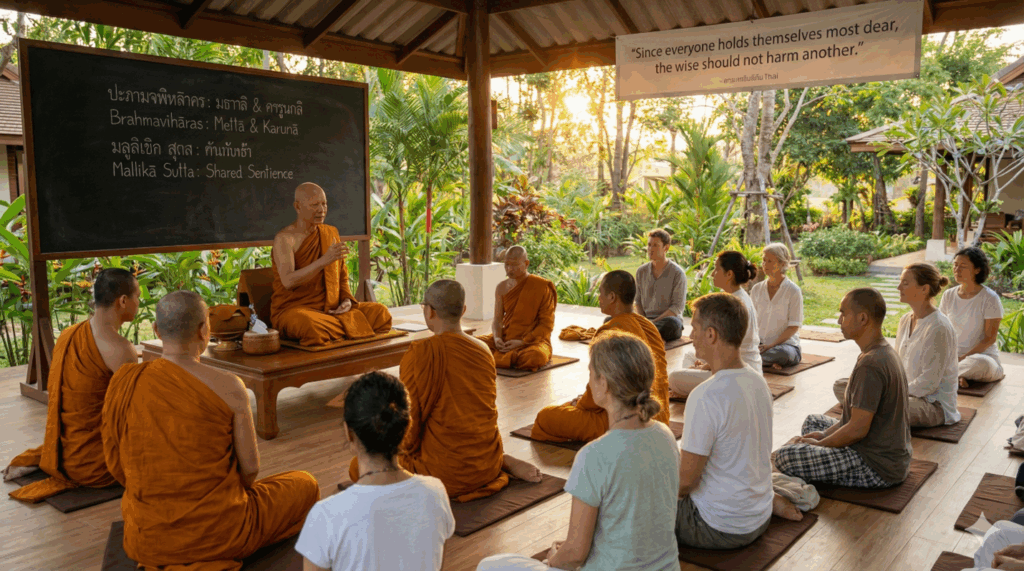
Crucially, Buddhist teaching grounds this high ideal in psychological reality. In the Mallikā Sutta, Queen Mallikā truthfully admits to King Pasenadi that there is no one dearer to her than herself. Rather than condemning this as narcissism, the Buddha uses it as the bridge to empathy. He states that since every being holds themselves most dear, one who truly loves themselves should not harm another. Here, the Golden Rule is not a divine command but a logical deduction based on shared sentience. By understanding our own desire for happiness and our aversion to pain, we unlock the capacity for Karunā (compassion)—the “quivering of the heart” in response to another’s suffering. In the Thai tradition, this recognition of oneself in the other is the bedrock of social harmony.
Hinduism: The Cosmic Embrace
Across the Indian subcontinent, the diverse traditions of Hinduism offer a metaphysical basis for universal love that resonates deeply with these Buddhist insights. At the heart of Vedantic Hindu philosophy is the concept that the true self (Atman) is ultimately identical to the universal reality (Brahman). Therefore, the separation between “self” and “other” is considered a veil of illusion (maya). To harm another is, quite literally, to harm oneself; to love another is to recognize the same divine spark residing within them that resides within you.

The Bhagavad Gita, a central pillar of Hindu scripture, speaks of the Yogi who “sees the Self present in all beings, and all beings present in the Self” (6:29). This realization leads naturally to Ahimsa (non-violence in thought, word, and deed), which is the highest expression of love in action. Furthermore, the path of Bhakti Yoga focuses on intense, devotional love for the Divine. This devotion is intended to purify the heart of egoism, allowing the devotee to see the Divine in everyone they meet, effectively transforming every human interaction into an act of worship and selfless love.
The Chinese Synthesis: Love as Harmony and the Way
In Chinese civilization, the concept of love is woven into the very fabric of social order and cosmic balance through the dual lenses of Confucianism and Taoism. Confucianism introduces the foundational virtue of Ren (humaneness or benevolence). Confucius taught that Ren begins with the family but must eventually expand to encompass all of humanity. This is practiced via the “Silver Rule”: “Do not do to others what you would not want others to do to you” (Analects 15:24). For the Confucian, love is a disciplined practice of ritual and respect that maintains the harmony of the “Great Family” of mankind.

Complementing this is the Taoist perspective, which views love as an alignment with the Tao (the Way). Lao Tzu taught that the universe operates on a principle of selfless giving. In the Tao Te Ching, he writes that the Sage “takes the heart of the people as his own,” expressing Ci (compassion)—a “quiet love” that seeks no control or possession but allows others to flourish according to their own nature. Together, these traditions suggest that love is the harmonious glue that binds the individual to the family, the society, and the cosmos.
The Abrahamic Chord: Love as Divine Imperative
The major monotheistic traditions—Judaism, Christianity, and Islam—frame love not just as a human virtue, but as a reflection of the Divine nature itself.
In Judaism, the Torah provides one of the earliest articulations of the ethics of reciprocity: “You shall love your neighbor as yourself” (Leviticus 19:18). The great sage Hillel famously summarized the entire Torah while standing on one foot by stating: “That which is hateful to you, do not do to your fellow.” Furthermore, the Jewish concept of Chesed translates to loving-kindness or unearned benevolence, emphasizing that the world is sustained by acts of love that mirror God’s own grace.

Christianity builds directly upon this foundation. Jesus of Nazareth elevated the “love command” to the highest status, asserting that all religious law depends on loving God and neighbor. Christian theology introduces the concept of Agape—unconditional, sacrificial love that does not depend on the merit of the recipient. It is a love that seeks the highest good of the other, even at a cost to oneself. As the New Testament states, “God is love,” making the practice of love the primary way humans participate in the Divine.
Islam, too, places mercy and love at the core of the relationship between the Creator and creation. One of the ninety-nine names of Allah is Al-Wadud, “The Most Loving One.” The Quran repeatedly emphasizes God as the Most Gracious and Most Merciful. This divine mercy demands a human response. The Prophet Muhammad is recorded in the Hadith tradition stating: “None of you [truly] believes until he loves for his brother that which he loves for himself.” In the Islamic worldview, true faith is inseparable from a heart oriented toward the well-being of the Ummah (community) and all of humanity.
Conclusion: Love as a Spiritual Practice
When we synthesize these diverse views, a powerful convergence emerges. Whether it is the Buddhist insight of shared sentience, the Hindu realization of cosmic unity, the Chinese ideal of Ren, or the Abrahamic command to reflect Divine mercy, the message is clear: true love is a movement away from the self-referential ego and toward an embrace of the whole.

Romantic love, while beautiful, is often exclusive—it draws a circle around “us” that can inadvertently exclude “them.” Spiritual love is inclusive; it constantly widens the circle. It is not merely a feeling that happens to us, but a deliberate practice of generosity, patience, and understanding. It is a “higher love” that does not require the other to be like us, to like us, or even to know us.
On this Valentine’s Day, perhaps the most profound spiritual act we can undertake is to look beyond the commercialized romance and commit to the harder work of universal love. In a world hungry for genuine connection, this ancient, shared wisdom is the nourishment we need most. By treating every person we encounter with the same care we give ourselves, we transform a simple holiday into a global movement of peace.
References (APA Style)
- The Bhagavad Gita (E. Easwaran, Trans.). (2007). Nilgiri Press.
- The Connected Discourses of the Buddha: A Translation of the Samyutta Nikaya (B. Bodhi, Trans.). (2000). Wisdom Publications.
- The Analects of Confucius (S. Leys, Trans.). (1997). W.W. Norton & Co.
- The Holy Bible: New Revised Standard Version (1989). Oxford University Press.
- Tao Te Ching (Laozi; S. Mitchell, Trans.). (1993). Harper Perennial.
- An-Nawawi’s Forty Hadith (E. Ibrahim & D. Johnson-Davies, Trans.). The Holy Koran Publishing House.
- Lovingkindness: The Revolutionary Art of Happiness Salzberg, S. (1995). Shambhala Publications.
- The Torah: The Five Books of Moses (2000). The Jewish Publication Society. (Original work published 1962).

Author: Paitoon Songkaeo, Ph.D.
Transitioning from a Buddhist monk to a diplomat, Paitoon Songkaeo is the Administrative Director of the Thailand Foundation. With a background of 16 years as a Buddhist monk, he later joined the Ministry of Foreign Affairs and retired as the Consul-General of Kota Bharu, Malaysia, in 2017. He may be reached at [email protected].