

Last time in our third part of this series, we traced the development of Thai ceramics through the classical kingdoms of Sukhothai, Lanna, Ayutthaya, and Rattanakosin; eras that produced iconic traditions such as Sangkhalok celadon and Benjarong porcelain. Finally, we are looking at the contemporary era, where Thai ceramics have become a dynamic field of innovation, cultural expression, and global recognition.
A Dialogue Between Tradition and Innovation
According to research by Phiphat Chit-arirak, Phoradee Phanthupakorn, and Sermsak Nakbua, published in 2013 in the Journal of Fine and Applied Arts, Burapha University, contemporary ceramics in Thailand took shape in the mid-twentieth century, when traditional pottery, long valued for its utility, was reimagined within the framework of modern art education. The founding of Silpakorn University in 1943 under Professor Silpa Bhirasri was pivotal, as ceramics began to be taught alongside painting and sculpture, bridging craft and fine art. By the 1950s and 1960s, ceramic works appeared in the National Art Exhibitions, signaling a transformation from everyday objects into vehicles of artistic expression. This shift laid the foundation for a new era in which Thai ceramics came to embody both cultural heritage and modern creativity, establishing the medium as an integral part of Thailand’s contemporary art movement.
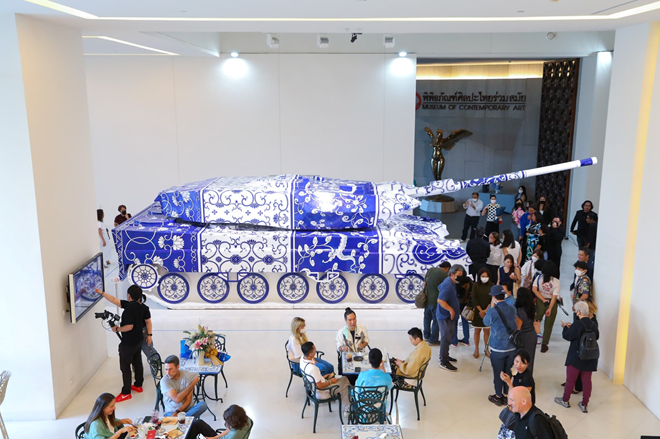
Credit: holidaytourstravel.com
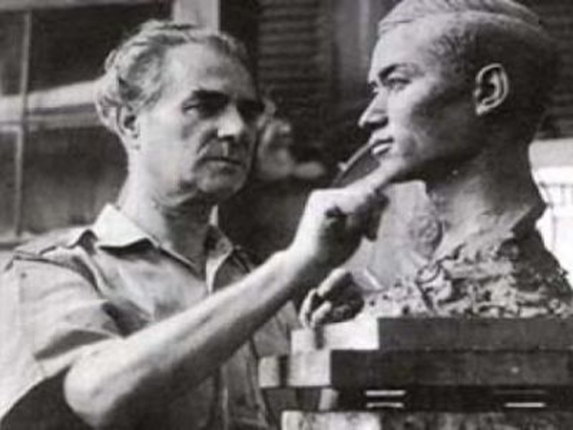
Credit: gpsmycity.com
Contemporary Thai ceramicists draw on a wide range of influences, blending local materials and motifs with global visual languages. Stylistically, the field is marked by aesthetic hybridity and technical versatility: hand-building and wheel-throwing are practiced alongside industrial methods and experimental glazing; narrative content ranges from Buddhist cosmology and folklore to ecological themes and personal identity; and the boundary between form and function is frequently challenged. Some artists remain rooted in vessel-making traditions, while others pursue non-functional sculpture, installation, or performance, pushing the conceptual limits of the medium.
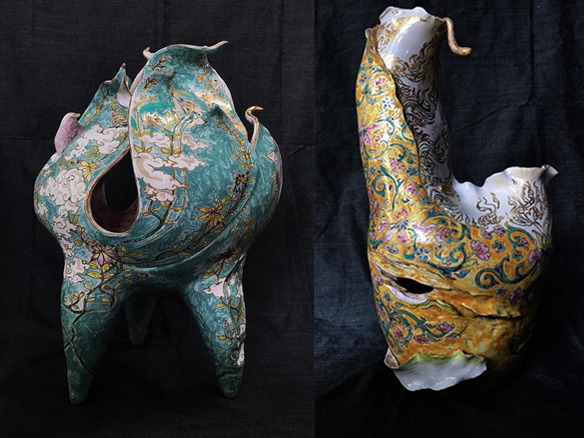
Credit: thaijo.org
This contemporary landscape operates across two primary spheres: traditional craft villages and studio-based or conceptual art practices. Villages such as Dan Kwian in Nakhon Ratchasima, known for its iron-rich red clay, and Koh Kret in Nonthaburi, famous for Mon-style terracotta, continue to preserve ancestral knowledge while adapting to modern demands. These communities now cater to tourist markets, collaborate with designers, and participate in cultural events, blending heritage with economic sustainability. Simultaneously, university-trained ceramicists and independent artists are reshaping the perception of Thai ceramics, presenting works in galleries, biennials, and design fairs that engage with issues such as cultural memory, urbanization, and postcolonial identity. Many of these artists blur the line between craft and contemporary art, creating minimalist or symbolic forms that reflect both local and global contexts.
In essence, contemporary Thai ceramics embody a vibrant continuum between past and present, craft and art, function and concept. Whether emerging from rural kilns or urban studios, these works articulate a Thai cultural identity in flux—rooted in tradition yet unafraid to innovate. As the field continues to grow, Thai ceramicists remain at the forefront of preserving heritage while boldly exploring new artistic frontiers, ensuring that ceramics remain a vital and evolving medium in Thailand’s cultural landscape.
Current Styles and Movements of Thai Ceramics: A Living Tradition in Diverse Forms
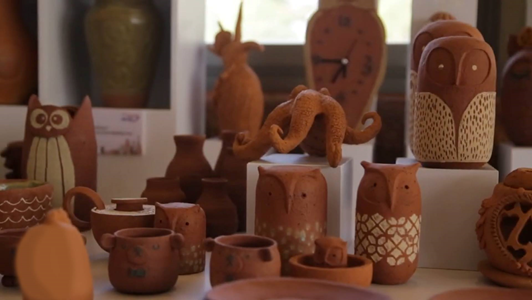
Contemporary Thai ceramic art is as diverse and vibrant as Thailand’s cultural heritage itself. Today, ceramics are far more than utilitarian or decorative objects; they are expressive forms of identity, storytelling, and innovation that blend the past with the present. Among the most regal styles is Benjarong, meaning “five colors,” characterized by intricate floral and geometric motifs in red, green, yellow, blue, and black painted over white porcelain, with Lai Nam Thong as a luxurious variant adding gold gilding. Historically reserved for royalty and nobility, Benjarong remains a prestigious cultural product used in ceremonies, diplomacy, and high-end décor. Sangkhalok ware, revived from Sukhothai’s golden era, features celadon and underglaze black designs depicting fish, flowers, and spirals, with its rich greenish glaze produced in Si Satchanalai, Sukhothai, and revival studios around Chiang Mai. Koh Kret ceramics from Nonthaburi Province, crafted by the Mon community, are renowned for their finely carved, unglazed terracotta pottery, especially elegant patterned water jars, preserving ancestral techniques in what feels like a living museum.
In Nakhon Ratchasima, Dan Kwian ceramics is distinctive for its reddish iron-rich clay shaped into robust, rustic forms such as planters, garden sculptures, and water jars, combining folk utility with bold artistic flair. Meanwhile, Ratchaburi dragon jars, with their wheel-thrown forms and slip-painted dragon motifs under salt glaze, once used for water storage, are now valued as nostalgic art pieces. The Ban Chiang revival in Udon Thani recreates prehistoric red spiral and wave motifs on buff clay, preserving and celebrating Thailand’s earliest ceramic identity.
Credit: discoverythailand.com
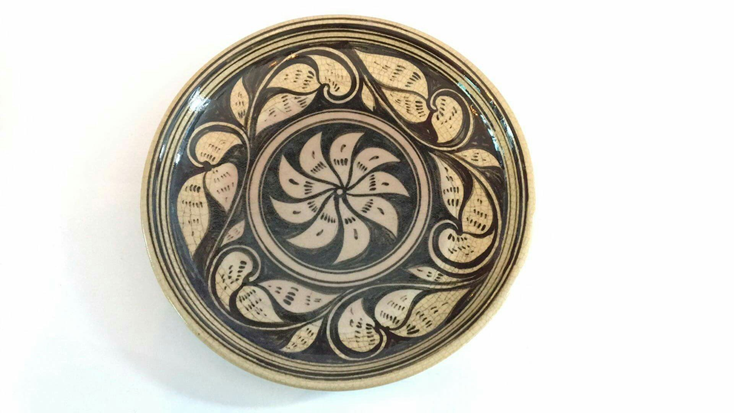
Northern styles include Wiang Kalong earthenware from Chiang Rai, recognized for its red clay body with black or dark-brown glaze incorporating incised designs, reflecting ancient Lanna aesthetics. In Hang Dong District, Chiang Mai, Ban Mueang Kung pottery continues Lanna-inspired pottery traditions, producing pots, and jars using wood-fired kilns while engaging tourists and students in local culture.
Credit: pickacraft.com
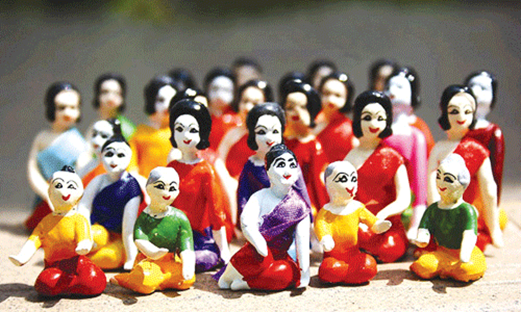
Royal Court Dolls (Tukata Chao Wang), hand-sculpted and painted clay dolls depicting traditional Thai costumes and folklore remain treasured cultural collectibles and educational tools. A major site of production is Baan Bang Sadet in Ang Thong Province.
Credit: thaitechno.net
From the south, Ko Yo ceramic tiles in Songkhla feature roof and floor tiles crafted through ancient methods, enhancing architecture and modern design with their bold palettes.
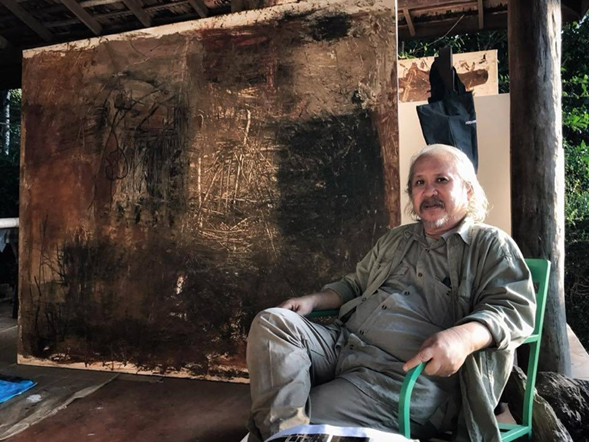
Modern Thai ceramics are a vibrant reflection of the country’s evolving culture, encompassing elegant tableware, collectible figurines, faith-based guardian statues, and lifestyle products that merge tradition with contemporary living. Studios such as Lamunlamai Craftstudio create pastel-hued playful ceramics with a soft minimalist touch; while WK Studio produces faith-based figurines with modern collectible flare. Renowned artisans such as National Artist Somlak Pantiboon, a pioneering Chiang Rai–based ceramicist, blends Northern Thai traditions with international influences, known for wood-fired works and experimental forms that challenge the boundary between craft and contemporary art.These are but a few examples of the countless Thai ceramicists innovating across the country.
Credit: xspace.gallery
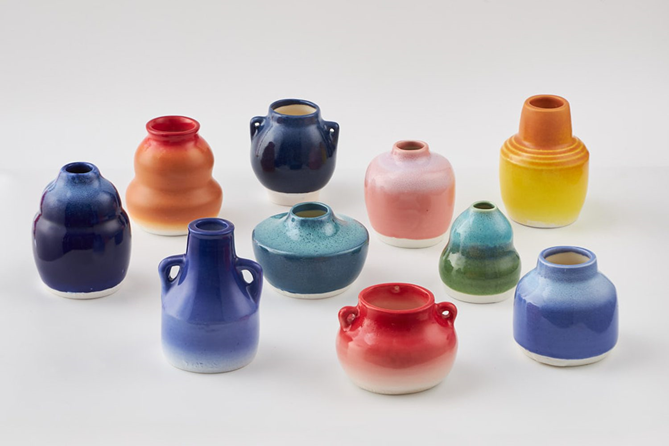
Credit: art4d
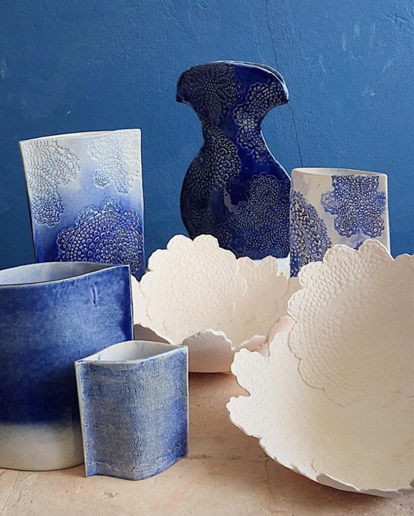
Credit: kooper.co
Today, Thai ceramic art is not one thing but many things: the quiet rhythm of hands shaping clay in Koh Kret, the roar of a Bangkok kiln firing gold-laced Benjarong, and the bold reinvention of ancient forms in galleries and design fairs. Whether rooted in tradition or modernity, local practice or global appeal, Thailand’s ceramic styles continue to invite exploration and admiration in equal measure.
Conclusion: An invitation to discover the living heritage of Thai ceramics
The heritage of Thai ceramics stands as a testament to the country’s enduring artistry, cultural depth, and profound connection to the natural world. Each piece—whether a delicately glazed bowl, a hand-carved figurine, or a bold modern sculpture—embodies the refined craftsmanship of Thai artisans. From precise contours and intricate patterns to rich textures and subtle hues, Thai ceramics reveal a level of detail and care that arises only through the human hand.
The value of handmade creation lies not only in its uniqueness, since no two pieces are ever the same, but also in the stories told through each form. Every object captures a moment of artistic expression shaped by local knowledge, cultural influences, and a dedication to beauty and function.
Within Thailand’s ceramic landscape thrives a remarkable diversity. Styles range from the regal elegance of Benjarong and the rustic charm of Dan Kwian to the revival of prehistoric Ban Chiang motifs and the innovative works emerging from contemporary design studios. This fusion of traditions with openness to new ideas reflects a uniquely Thai spirit: adaptable, inventive, and deeply rooted in cultural heritage.
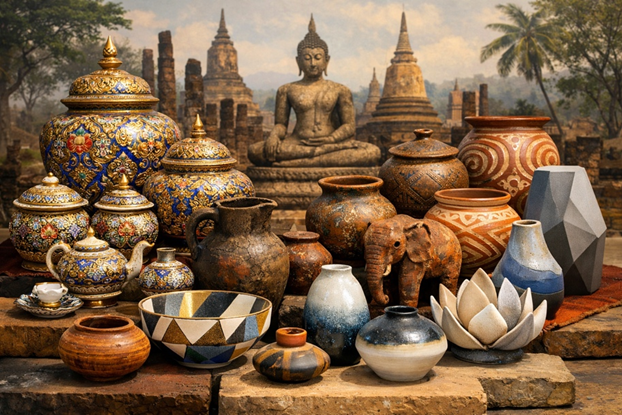
Credit: Visualized by Artificial Intelligence
Embedded within each ceramic tradition is a wisdom that honors nature. Local clays and minerals are used sustainably, shaped through techniques passed down for generations, turning raw earth into lasting works of art. Thai ceramics, spanning thousands of years, remain a living, evolving heritage, continually adapting to the times while preserving the gentle soul of traditional craftsmanship.
Those drawn to the beauty and depth of Thai ceramics will find endless inspiration. Visiting pottery villages, meeting artisans, witnessing creation processes, or bringing home a piece that resonates offers an intimate connection to this cultural legacy. The Sustainable Arts and Crafts Institute of Thailand (SACIT), a public organization under the Ministry of Commerce, also provides information on ceramic art and artisans. The organization hosts two large craftwork conventions annually, Craft Bangkok and Identity of Siam, where interested buyers can meet with and purchase works directly from artisans.
May Thai ceramics inspire us not only through their forms, but through the timeless values they carry.
The story of Thai ceramics is a beautiful and fascinating aspect of Thai culture and heritage. Thai ceramics art reflects history, creativity, and the skills of Thai artisans throughout the ages. Join us in exploring more stories of Thailand and the Thai people as we take you on a journey to discover the essence of Thainess.
Sources
- Khreuang Pan Dinphao [Pottery]. 2011. Bangkok: Khati Publishing.
- https://journal.lib.buu.ac.th/index.php/art/article/view/6043/3218
- https://www.youtube.com/watch?v=4eZWYMOylk4&pp=ygUx4LmA4Lia4LiN4LiI4Lij4LiH4LiE4LmMIOC4lOC4reC4meC5hOC4geC5iOC4lOC4tQ%3D%3D
- https://www.youtube.com/watch?v=4eZWYMOylk4&pp=ygUx4LmA4Lia4LiN4LiI4Lij4LiH4LiE4LmMIOC4lOC4reC4meC5hOC4geC5iOC4lOC4tQ%3D%3Dราชบุรี
- https://www.youtube.com/watch?v=Fp-GZ-Br15Q
- https://www.thailandfoundation.or.th/en/culture_heritage/dragon-jars-of-ratchaburi-province/
- https://www.thailandfoundation.or.th/en/culture_heritage/ban-chiang-pottery/
- https://www.thailandfoundation.or.th/en/culture_heritage/wiang-kalong-earthenware-from-the-city-of-lost-crows/
- https://mgronline.com/china/detail/9670000075827
- https://www.amarintv.com/news/social/228185
- https://www.youtube.com/watch?v=9p7qbGQ-Dn8&pp=ygUUcm95YWwgdGhhaSBmaWd1cmluZXM%3D
- https://www.youtube.com/watch?v=QNkEe3QWcuM&pp=ygUt4LiB4Lij4Liw4LmA4Lia4Li34LmJ4Lit4LiH4LmA4LiB4Liy4Liw4Lii4Lit
- https://art4d.com/2024/03/lamunlamai-craftstudio
- https://adaymagazine.com/wk-studio/
- https://archive.sacit.or.th/creator/109
- https://www.google.com/url?sa=i&url=https%3A%2F%2Fmgronline.com%2Fsmes%2Fdetail%2F9510000039503&psig=AOvVaw0eARBITAGa2PxJD9CMWiUn&ust=1738065599239000&source=images&cd=vfe&opi=89978449&ved=0CBcQjhxqFwoTCODnkIftlYsDFQAAAAAdAAAAABAJ
- https://thekindcraft.com/doy-din-dang-pottery/
- OpenAI. (2023). ChatGPT (Mar 14 version) [Large language model]. https://chat.openai.com/chat
Author: Viphawan Benniman
Editor: Tayud Mongkolrat