


Video Versions of the Article
For those who prefer to watch and listen, this article is also available in video format.
The videos are presented in both Thai and English, offering the same core insights through spoken reflection and guided explanation.
1. Introduction
The human mind possesses a paradoxical capacity: it can serve as its own greatest source of comfort or its cruelest tormentor. While we instinctively treat friends with kindness during their failures, many of us subject ourselves to a harshness we would never inflict upon an enemy. This internal hostility—often dismissed simply as “being hard on oneself”—is a significant driver of modern mental illness and physical disease. Conversely, cultivating a supportive relationship with oneself is not merely a luxury; it is a biological necessity for resilience.
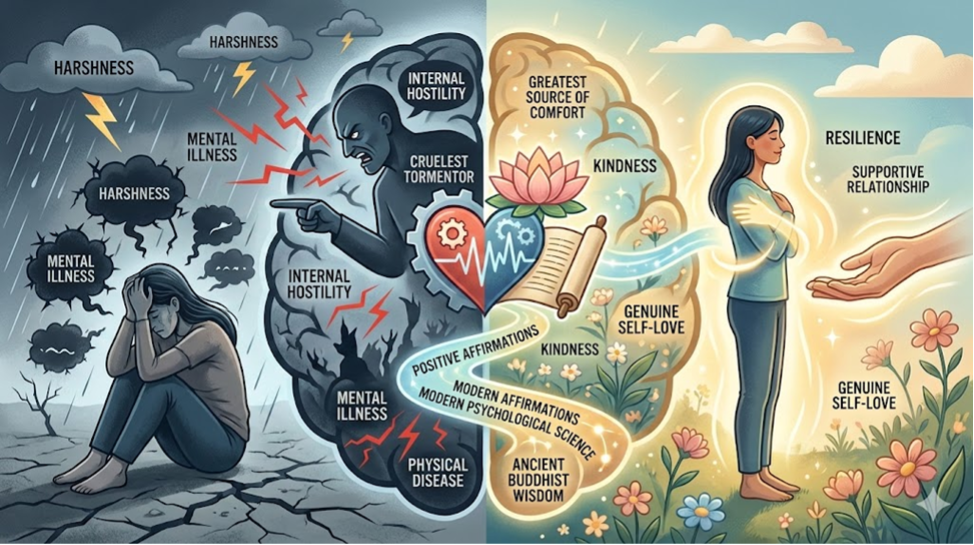
We often seek complex solutions to this problem, yet the remedy may lie in the simplicity of language itself. As highlighted by recent mental health resources, such as those from Verywell Mind, using positive affirmations to assert one’s worthiness is a practical tool to counter negative self-talk. This article explores the definitions, origins, and remedies for self-hatred, examining both modern psychological science and ancient Buddhist wisdom to chart a path toward genuine self-love.
2. Defining the Terms: Self-Love vs. Self-Hatred
To address these concepts effectively, we must first strip them of their cultural baggage.
Self-Love (The Healthy Construct): In this context, “self-love” does not refer to narcissism or ego inflation. Psychologists like Dr. Kristin Neff define it as Self-Compassion. It is a grounded stance composed of three elements:
- Self-Kindness: Being warm rather than judgmental toward oneself.
- Common Humanity: Recognizing that suffering is a shared human experience, not a sign of brokenness.
- Mindfulness: Observing negative emotions without being consumed by them. It is the internal environment where one can say, “I am enough,” without needing to prove superiority over others.
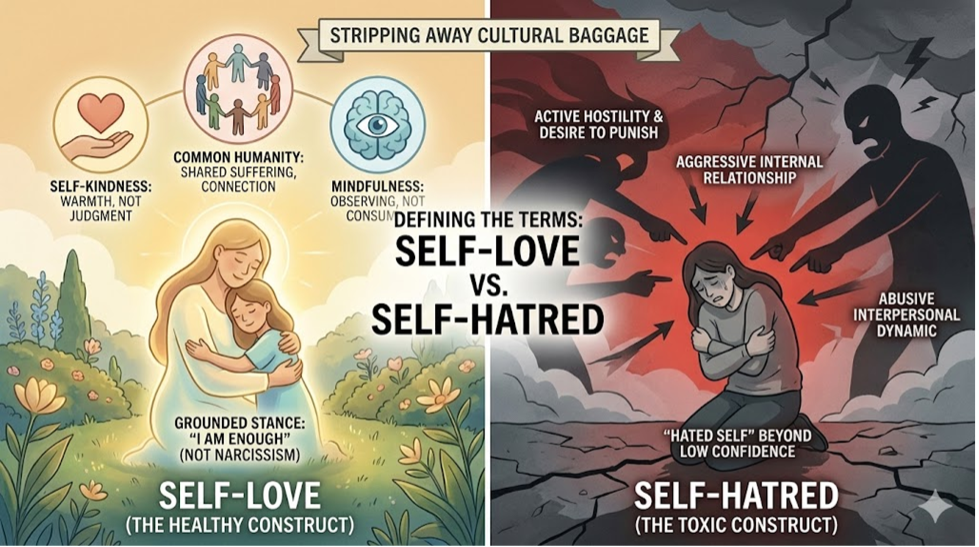
Self-Hatred (The Toxic Construct): This goes beyond low confidence. Clinical researcher Paul Gilbert distinguishes the “Inadequate Self” (feeling disappointed) from the “Hated Self”. The latter is characterized by active hostility and a desire to punish the self. We use the term “self-hatred” to accurately describe this aggressive internal relationship, which functions similarly to an abusive interpersonal relationship.
3. The Origins: How We Learn to Love or Hate Ourselves
Neither self-love nor self-hatred is innate; they are learned responses with deep roots.
- Evolutionary Roots: Evolutionary psychology suggests that shame and self-criticism evolved as survival mechanisms to ensure social conformity and prevent rejection by the tribe. Self-hatred is often this ancient warning system in overdrive.
- Developmental Roots: Psychologically, we often treat ourselves as we were treated by early caregivers. According to Object Relations Theory, a child absorbs the voice of the parent. If a child is soothed during distress, they internalize a “Self-Soothing” voice; if punished or neglected, they internalize a “Self-Attacking” voice.
The consequences are profound. Self-hatred leads to chronic inflammation—indicated by high cortisol and Interleukin-6—and is a primary predictor of suicidal ideation. Conversely, self-love fosters a “Growth” mindset and enhances immune function.
4. Can Self-Love Be Cultivated? (The Science of Change)
A common myth is that self-hatred is a permanent character trait. Modern neuroscience refutes this through the concept of neuroplasticity—the brain’s ability to reorganize itself by forming new neural connections.
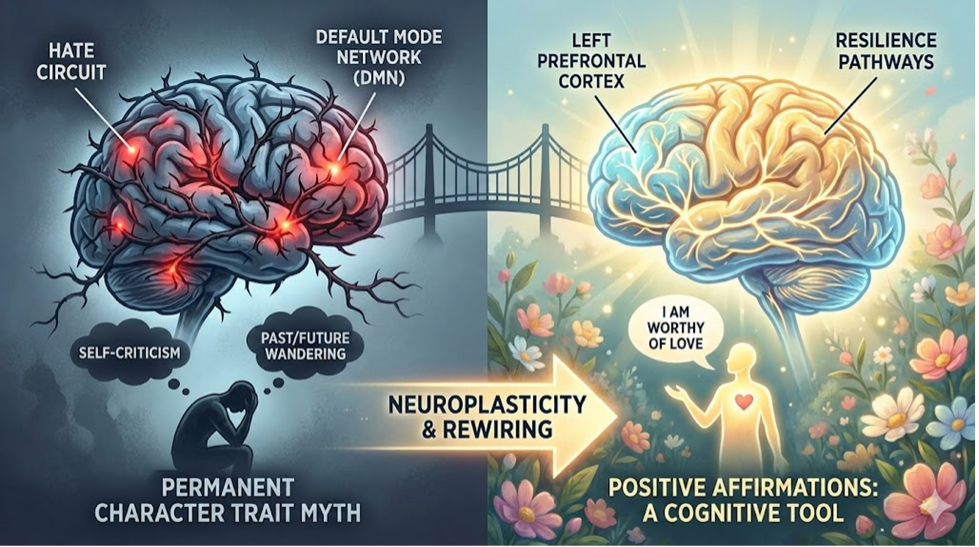
Research indicates that self-hatred relies on specific neural pathways, often linked to the Default Mode Network and a so-called “Hate Circuit”. Every act of self-criticism strengthens these pathways. However, we can “rewire” the brain through consistent practice.
This is where positive affirmations and proactive strategies become scientifically relevant. Research highlighted by Psychology Today suggests that self-love is an actionable skill. By focusing on strengths, practicing self-forgiveness, and prioritizing well-being, we interrupt the automatic firing of the “Hate Circuit”. By consciously choosing new language and behaviors, we weaken old connections and strengthen pathways in the Left Prefrontal Cortex, associated with resilience and positive affect.
5. Psychological Paths: Traditional vs. Modern Approaches
Psychology offers distinct methods for handling the “inner critic”.
- Traditional Path (CBT): Cognitive Behavioral Therapy treats self-hatred as a “cognitive distortion,” using logic to challenge the accuracy of thoughts like “I am worthless.”
- Modern Paths (CFT, ACT, IFS): Newer therapies focus on the relationship with thoughts.
- Compassion-Focused Therapy (CFT): Targets the body’s physiological “soothing system” via the Vagus Nerve.
- Internal Family Systems (IFS): Views the self-hating part as a misguided “Protector.”
- Acceptance and Commitment Therapy (ACT): Uses “defusion” to observe thoughts merely as words passing through the mind.
6. The Buddhist Path: Mettā and Karuṇā
While psychology offers the map, Buddhist practice offers the vehicle. As described in Buddhist Meditation in Theory and Practice by Paravahera Vajirañāṇa Mahāthera, cultivating the “Divine Abodes” (Brahmavihāra) is the direct antidote to mental toxins.
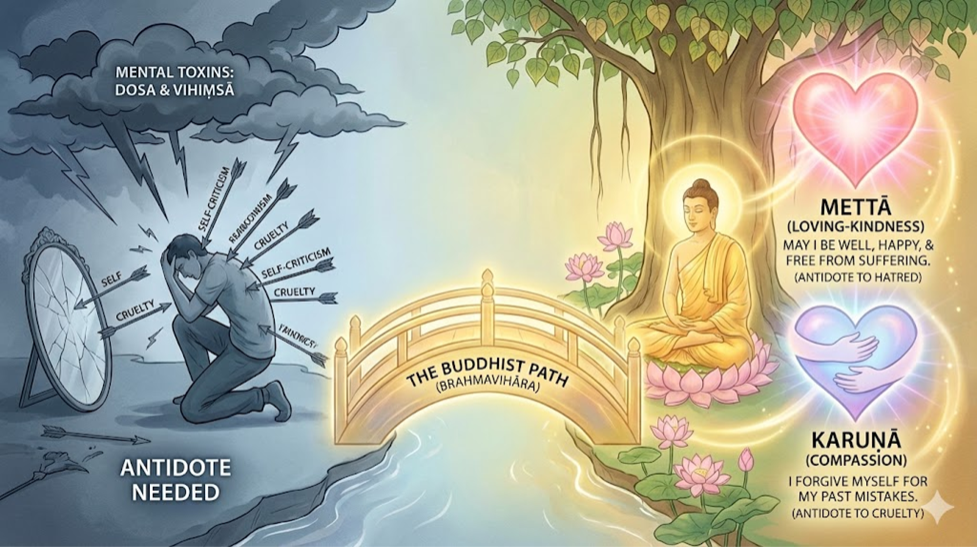
Mettā (Loving-Kindness): Defined as pure friendliness, Mettā is the specific antidote to Dosa (Hatred). The practice begins by suffusing oneself with the thought, “May I be well, happy, and free from suffering.” This mirrors modern affirmations for worthiness and is the necessary foundation required to extend love to others.
Karuṇā (Compassion): This is the heart’s response to pain and the antidote to Vihiṁsā (Cruelty). When we direct Karuṇā inward, we cease the cruel bombardment of self-criticism. A practitioner might use the affirmation, “I forgive myself for my past mistakes.“
The Path of Transformation: In the Buddhist view, self-love is not a feeling to be found, but a mental quality to be systematically trained. By shifting our internal gaze from judgment to gentle awareness, we transform the very structure of our consciousness from a site of conflict into a sanctuary of peace.
Scientific Convergence: Modern research validates these ancient practices. Evidence synthesized by Psychology Today confirms that self-compassion meditation serves as a powerful shield against depression and anxiety by fostering emotional regulation and reducing the impact of negative self-judgment. Furthermore, Fredrickson et al. (2008) found that the more one practices loving-kindness, the greater their personal resources and health.
7. Conclusion
The Buddha famously stated in the Dhammapada, which can be paraphrased as: our thoughts are the blueprint for everything we experience. The mind is the architect; our reality is built from our thinking. If we approach life with a clear and kind intention, joy will follow us as naturally and reliably as our own shadow.
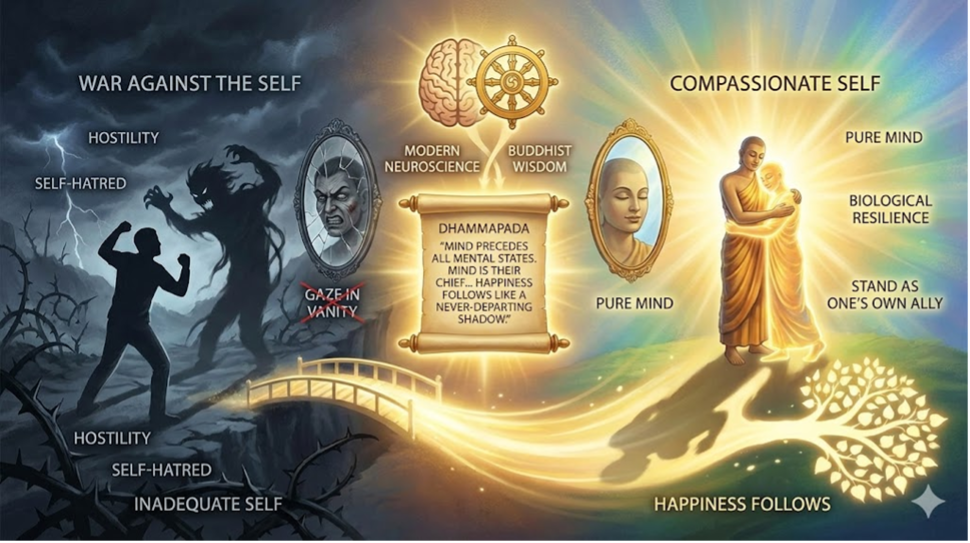
This ancient wisdom aligns with the modern understanding that the war against the self is a battle of the mind—one that cannot be won through hostility. If we try to conquer ourselves with hatred, we become both the victor and the vanquished. The convergence of modern neuroscience and Buddhist wisdom confirms that self-hatred is an outdated survival mechanism that no longer serves us. By shifting from the “Inadequate Self” to the “Compassionate Self”—whether through therapy, affirmations, or Mettā—we do not become narcissistic. Instead, we cultivate the “pure mind” necessary for biological resilience and growth. To love oneself is not to gaze in the mirror with vanity, but to stand as one’s own ally when the mirror cracks.
8. References
- Baumeister, R. F. (1990). Suicide as escape from self. Psychological Review, 97(1), 90–113.
- Breines, J. G., & Chen, S. (2012). Self-compassion increases self-improvement motivation. Personality and Social Psychology Bulletin, 38(9), 1133–1143.
- Cooks-Campbell, A. (2024). 25 Self-Love Affirmations to Remind You of Your Worth. Verywell Mind.
- Davis, T. (2020). Self-Love Tips: Science-Based Strategies. Psychology Today.
- Davidson, R. J., et al. (2003). Alterations in brain and immune function produced by mindfulness meditation. Psychomatic Medicine, 65(4), 564-570.
- Dhammapada: The Buddha’s Path of Wisdom. (1985). (A. Buddharakkhita, Trans.). Buddhist Publication Society.
- Dickerson, S. S., & Kemeny, M. E. (2004). Acute stressors and cortisol responses. Psychological Bulletin, 130(3), 355–391.
- Fredrickson, B. L., et al. (2008). Open hearts build lives: Positive emotions and loving-kindness. Journal of Personality and Social Psychology, 95(5), 1045–1062.
- Gilbert, P., et al. (2004). Criticizing and reassuring oneself. British Journal of Clinical Psychology, 43(1), 31–50.
- Gilbert, P., & Procter, S. (2006). Compassionate mind training. Clinical Psychology & Psychotherapy, 13(6), 353–379.
- Gordon, S. (2015). Self-Compassion and Meditation Can Yield Better Mental Health. Psychology Today.
- Neff, K. D. (2003). Self-compassion: An alternative conceptualization of a healthy attitude. Self and Identity, 2(2), 85–101.
- Pace, T. W., et al. (2009). Effect of compassion meditation on neuroendocrine responses. Psychoneuroendocrinology, 34(1), 87–98.
- Vajirañāṇa, P. (2010). Buddhist meditation in theory and practice (A. R. Bomhard, Ed.). Charleston Buddhist Fellowship. (Original work published 1962).

Author: Paitoon Songkaeo, Ph.D.
Transitioning from a Buddhist monk to a diplomat, Paitoon Songkaeo is the Administrative Director of the Thailand Foundation. With a background of 16 years as a Buddhist monk, he later joined the Ministry of Foreign Affairs and retired as the Consul-General of Kota Bharu, Malaysia.