


Royal palaces in Thailand are far more than residences for royalty. They are physical expressions of how Thai civilization understands authority, spirituality, and harmony. From ceremonial halls to sacred precincts, Thai palaces embody a worldview in which kingship is inseparable from duty, religious devotion, and refined craftsmanship.
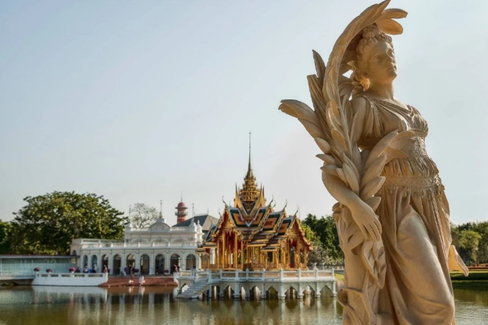
Photo Credit : travelphotographyguru.com
As documented in The Royal Palaces by H.H. Prince Dhaninivat, Thai royal architecture reflects centuries of continuity and adaptation. Each palace was conceived not only to serve practical and administrative needs, but also to express cosmic order, reverence for Buddhism, and the dignity of the monarchy. Together, these palaces stand as living records of Thailand’s cultural identity and historical resilience.
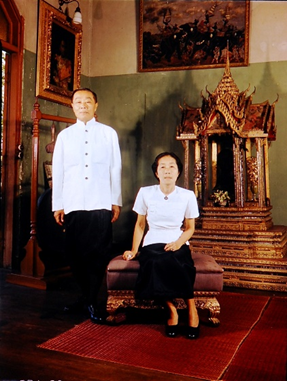
Photo Credit : LIFE Photo Collection, United States
Today, the Thailand Foundation invites you to explore these royal spaces and discover how architecture reveals the values and beliefs of the Thai civilization.
The Evolution of Royal Architecture
Ayutthaya
The Ayutthaya Kingdom (1351–1767 CE) marked a golden age in which the architectural, ceremonial, and ideological foundations of the Thai monarchy were firmly established. During this period, the royal palace functioned as both the political center of the kingdom and a powerful symbolic landscape, where kingship, religion, and cosmic order were expressed through carefully planned spaces and monumental architecture. Although only foundations and ruins of the Ayutthaya Royal Palace remain today, historical records reveal a complex palace city that shaped the monarchy’s identity for centuries to come.
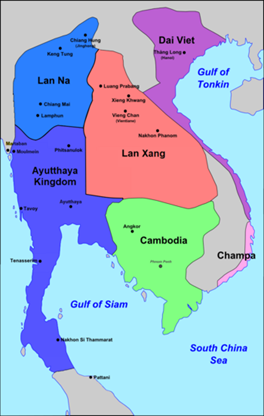
(1351 – 1767 CE.)
Photo Credit : kids.kiddle.co
The Ayutthaya palace complex featured a clear hierarchy of throne halls and pavilions designed for state ceremonies, royal audiences, military displays, and ritual life. Among the most prominent were Wihan Somdet Throne Hall, a prang-roofed structure commissioned by King Prasat Thong in 1643 CE to replace an earlier coronation hall destroyed by fire, and Sanphet Prasat Throne Hall, located at the center of the palace and distinguished by its five-tiered roof and projecting portico for receiving foreign envoys, flanked by royal white-elephant stables symbolizing divine authority. These halls represent only some of the many ceremonial structures that once formed the heart of the Ayutthaya royal palace.
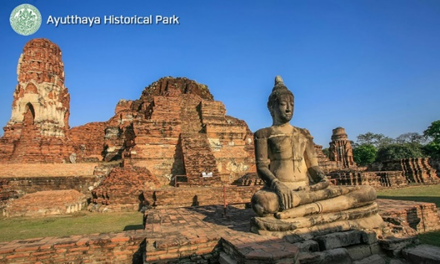
Photo Credit : virtualhistoricalpark.finearts.go.th
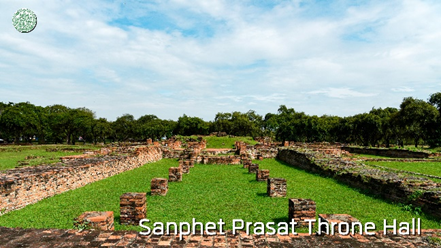
Photo Credit : virtualhistoricalpark.finearts.go.th
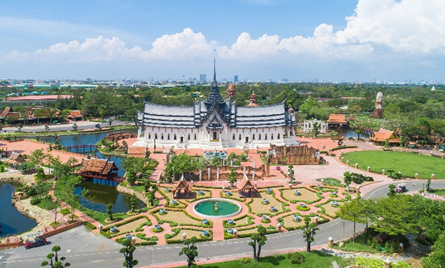
Photo Credit : muangboranmuseum.com
Other important buildings included Suriyatamarin Throne Hall, a cruciform laterite structure beside the river wall used for viewing royal water processions and later as a funerary hall, and Chakkrawat Phaichayon Throne Hall, built in 1632 CE atop the inner-city wall to oversee military drills and royal processions. Together with numerous additional pavilions, residences, and service buildings now lost to time, these structures reveal how Ayutthaya palace architecture articulated kingship through ritual, spectacle, and spatial hierarchy; principles that would later be consciously revived in the royal architecture of Bangkok.
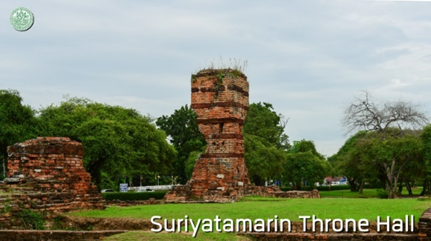
Photo Credit : virtualhistoricalpark.finearts.go.th
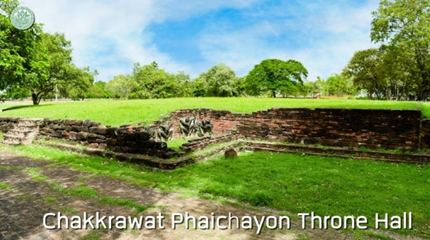
Photo Credit : virtualhistoricalpark.finearts.go.th
Bangkok
When King Rama I founded Bangkok and established the Chakri dynasty in 1782, he built the Grand Palace following the model of the royal palace of Ayutthaya. This continuity was deliberate: the new capital was intended to inherit the spiritual authority and political legitimacy of the former kingdom. Constructed simultaneously with the founding of the city, the Grand Palace functioned not only as the royal residence but also as the administrative and ceremonial heart of the kingdom.
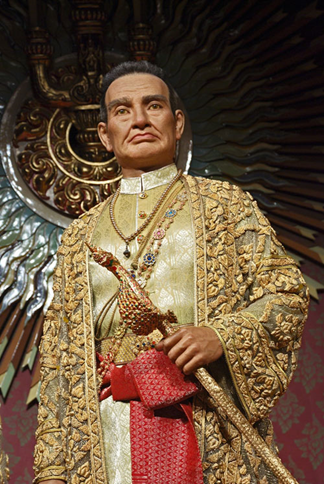
Photo Credit : rattanakosinblog.wordpress.com
Successive kings of the Chakri dynasty expanded and reshaped royal architecture in response to changing historical contexts. Kings Rama I to Rama III focused on establishing and restoring traditional palace forms, reinforcing Siamese aesthetics rooted in Buddhist and Brahmanical symbolism. During the reigns of Rama IV and Rama V, selective Western influences were introduced, particularly in spatial planning, construction techniques, and materials, while preserving Thai rooflines and ceremonial symbolism, most notably exemplified by the Chakri Maha Prasat Throne Hall. From Rama VI onward, modern palaces and royal villas such as Dusit, Phya Thai, Sanam Chan, and Klai Kangwon reflected evolving royal lifestyles while maintaining a distinctly Thai architectural identity. Throughout these transformations, Thai palace architecture demonstrates an enduring openness to external influences without abandoning its cultural core.
The Grand Palace: A City within a City
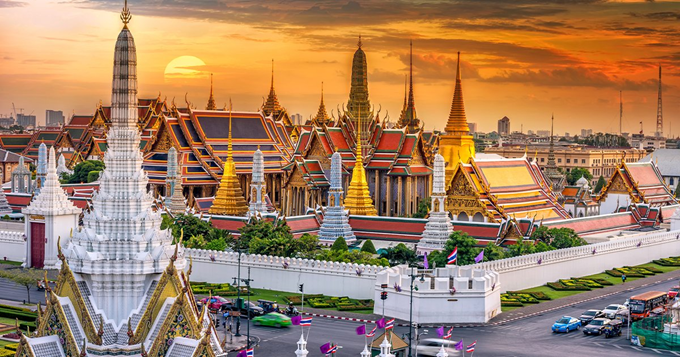
Photo Credit : bangkokforvisitors.com
The Grand Palace in Bangkok represents the most complete and enduring expression of Thai royal architecture. Rather than a single building, it was conceived as an enclosed royal city, constructed simultaneously with the founding of Bangkok in 1782. Designed to house the monarch, key government offices, and the royal chapel, the palace functioned as both the political and ceremonial heart of the kingdom, consciously modeled on the royal palace of Ayutthaya to affirm continuity of kingship and legitimacy.
The palace is organized into four principal precincts: the Front Court, the Inner Court, the residential and ceremonial complexes, and the sacred precinct of the Temple of the Emerald Buddha. This spatial hierarchy reflects a symbolic progression from worldly administration toward spiritual sanctity, mirroring traditional Thai cosmological order. Within this setting stand some of the most important monuments of Thai royal architecture, including Dusit Maha Prasat Throne Hall, built in the reign of King Rama I in pure traditional Siamese style, characterized by its spired roof and restrained dignity; and Chakri Maha Prasat Throne Hall, constructed under King Rama V, which combines a European-style structural body with traditional Thai roofs, symbolizing Siam’s engagement with the modern world while preserving royal identity.
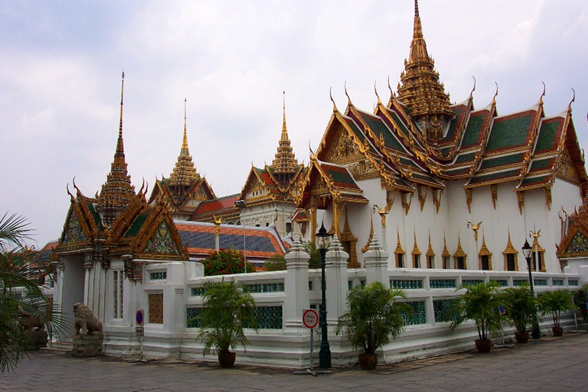
Photo Credit : bangkokforvisitors.com
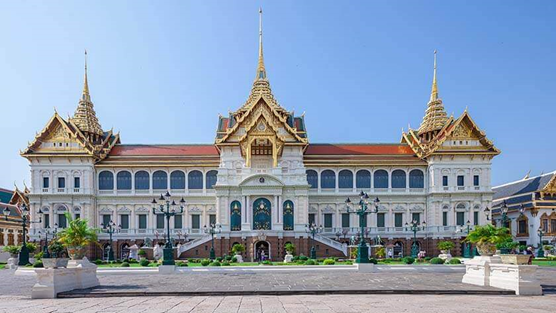
Photo Credit : yourthaiguide.com
Nearby, Phaisal Taksin and Amarindra Audience Halls serve as the setting for coronations and major state ceremonies, reinforcing the sacred nature of kingship. At the spiritual core of the palace stands Wat Phra Si Rattana Satsadaram (the Temple of the Emerald Buddha), the royal chapel and palladium of the Siamese monarchy, embodying the inseparable relationship between kingship, Buddhism, and moral authority, as detailed in “The Royal Palaces” published by the Fine Arts Department.
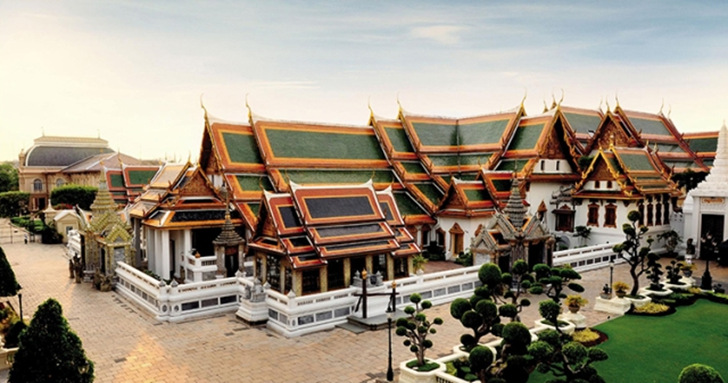
Photo Credit : stanglibrary.wordpress.com
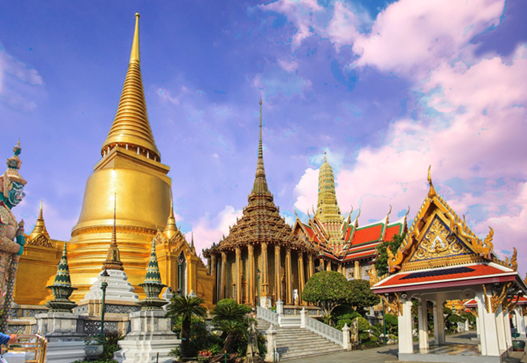
Photo Credit : siambangkokmap.com
Regional and Modern Palaces
Beyond the Grand Palace, Thai royal palaces reflect the diversity of landscapes, climates, and evolving royal lifestyles across the kingdom. As the monarchy adapted to new social and environmental contexts, palace architecture expanded beyond the walled royal city into river plains, hills, and seaside settings, while continuing to express Thai values of harmony, refinement, and balance.
In the capital, Dusit Palace represents early modern urban planning, combining Western-inspired grandeur with Thai decorative sensibilities and ceremonial functions. Outside Bangkok, Bang Pa-In Palace, an Ayutthaya-era palace rebuilt during the reign of King Rama V, offers a tranquil riverside setting where Thai, Chinese, and European architectural styles coexist within a carefully landscaped environment. Further South, Phra Nakhon Khiri, commonly known as Khao Wang, exemplifies harmony with nature, its hilltop layout integrating royal residences, religious structures, and ceremonial spaces into a single symbolic landscape.
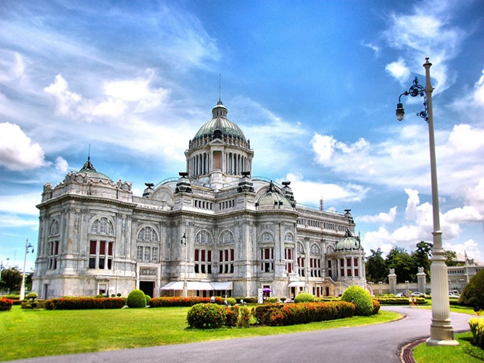
Photo Credit : excursionmania.com
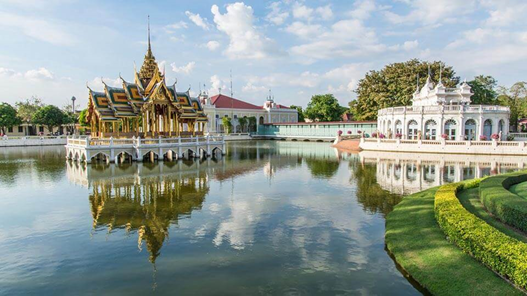
Photo Credit : yourthaiguide.com
Later palaces such as Sanam Chan Palace and Klai Kangwon Palace reflect a shift toward refined simplicity and comfort, responding to modern royal life without abandoning traditional architectural principles. Together, these regional and modern palaces demonstrate how Thai palace architecture has continually adapted to geography, climate, and social change while preserving its cultural meaning.
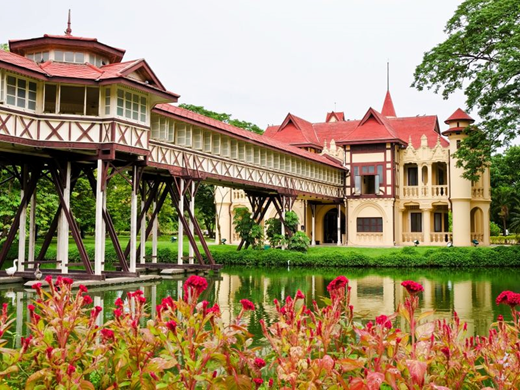
Photo Credit : takemetour.com
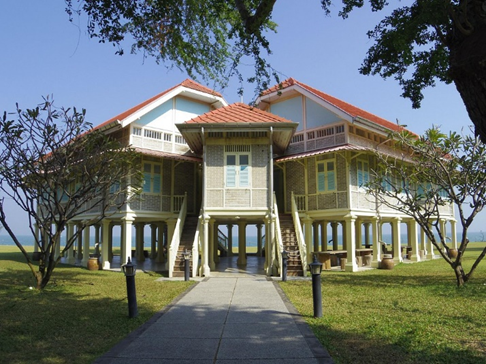
Photo Credit : tripadvisor.com
Art and Architecture in Harmony
Thai palace architecture is inseparable from the decorative arts that give it visual richness and symbolic depth. Architectural forms are enlivened by layered and spired roofs, gilded surfaces, finely detailed murals, lacquer work, and mother-of-pearl inlays, all crafted by royal artisans to communicate sacred meaning as much as aesthetic beauty. Every decorative element is carefully placed, transforming palace buildings into visual expressions of moral order, kingship, and religious devotion. Recurring motifs carry clear symbolic significance. Lotus patterns evoke purity and spiritual awakening; naga serpents function as guardians, protecting sacred spaces from malevolent forces; and the dominant use of white and gold conveys holiness, virtue, and royal authority. These elements reflect a belief system shaped by Buddhism, Brahmanical traditions, and older animist ideas, woven seamlessly into architectural design.
A prominent example is the mural gallery encircling the Temple of the Emerald Buddha, which depicts the entire epic of the Ramakien. Although not a Buddhist scripture, the epic is presented as a moral and artistic companion to Buddhist teachings, visually uniting mythology, kingship, and ethical values into a continuous narrative. This harmony between art and architecture lies at the heart of Thai royal aesthetics.
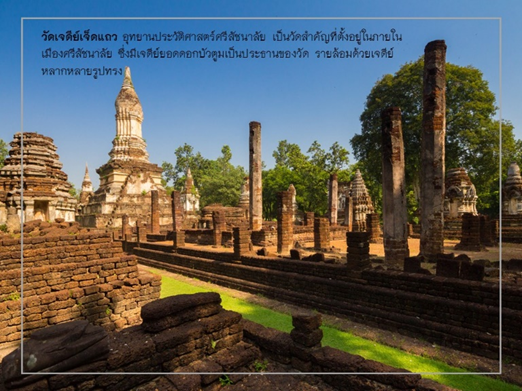
Photo Credit : finearts.go.th
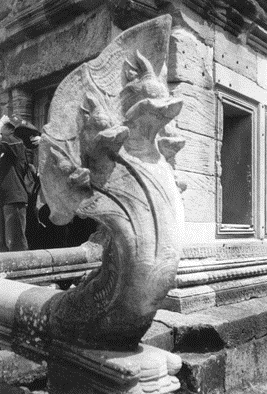
Photo Credit : silpa-mag.com
Values Reflected in Thai Palace Architecture
Thai royal palaces are more than architectural achievements; they are physical expressions of deeply held cultural values. Through their layout, form, and ornamentation, palace architecture communicates how Thai society understands authority, morality, and the relationship between humans, nature, and the sacred.
Respect and hierarchy are embedded in spatial organization, where clearly defined zones reflect reverence for the monarchy, seniority, and moral order. Harmony is achieved through a careful balance between natural surroundings, religious symbolism, and refined craftsmanship, ensuring that buildings coexist gracefully with their environment. At the same time, Thai palace architecture demonstrates openness and adaptability, absorbing foreign influences selectively while preserving a distinctly Thai identity. Finally, creativity and continuity are sustained through generations of artisans who reinterpret tradition in response to changing needs, allowing palace architecture to remain both relevant and enduring. Together, these values explain why Thai royal palaces feel at once timeless and alive.
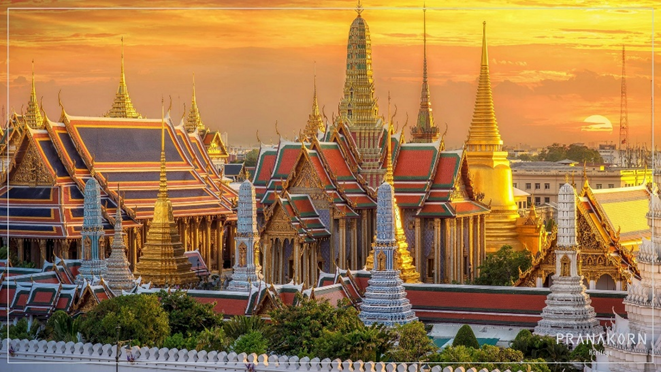
Photo Credit : pranakornheritagehotel.com
Conclusion
Thai royal palaces are not relics of the past. They are living museums of belief, artistry, and national identity. Through centuries of political change and cultural exchange, they continue to express the Thai pursuit of balance, between grandeur and grace, tradition and transformation.
To walk through these palaces is to encounter the spiritual and artistic heart of Thailand, where architecture becomes a language of values, history, and Thainess itself.
Thai palace architecture is a living reflection of Thai culture and heritage, embodying values of respect, harmony, and adaptability that have shaped the Thai worldview across centuries. Through the balance of authority and grace, tradition and change, these palaces reveal how Thai society understands leadership, spirituality, and cultural continuity. Join us as we explore more stories of Thailand and its people, and discover the essence of Thainess together.
Sources
- The Royal Palaces by H.H. Prince Dhaninivat https://www.finearts.go.th/storage/contents/2020/08/file/xQeunheawAVQlNzOgewvMBbIh04Ab08ahEaqy92k.pdf
- Ayutthaya Royal Palace: Ayutthaya Province
https://news.ayutthaya.go.th/travel/detail/51

Author: Tayud Mongkolrat
*This article is written with the help of AI.
Uploaded on February 2, 2026