



1. Introduction
Today, Friday, 16 January 2026, the Kingdom of Thailand marks a monumental milestone: the 70th anniversary of Wan Khru (วันครู), or National Teachers’ Day. Since its inception in 1957, this day has served as a temporal anchor for our nation, a moment when the machinery of the state pauses to honor the Mae Phim Khong Chat (แม่พิมพ์ของชาติ)—the Molds of the Nation.
This year, Wan Khru 2026 carries a special resonance. The Teachers’ Council of Thailand (Khurusapha คุรุสภา) has dedicated this 70th anniversary to honoring Her Majesty Queen Sirikit The Queen Mother, under the profound theme: “The One Who is the Mother and Teacher of the Land”. This theme invites us to reflect on the teacher not merely as an instructor of subjects, but as a nurturing, maternal force that sustains the spirit of the land.
However, as I write this from Bangkok, I am conscious that these words will reach far
beyond the borders of Thailand. Whether you are a dedicated Kru in a rural school in Chiang Mai, an ESL teacher navigating the bustle of Tokyo, or an educator in a classroom in London or New York, you share a common reality: Burnout. You are standing on the front lines of a changing world, often feeling less like a “Mold of the Nation” and more like a weary dam holding back a flood of administrative burdens, social expectations, and the emotional anxieties of the post-pandemic generation. The global crisis of teacher burnout is not just a career challenge; it is a spiritual crisis.
At the Thailand Foundation, within our section on “Spiritual Values and Meditation,” we
believe that the ancient wisdom of the East offers more than just rituals; it offers a survival kit for the modern soul. Today, I invite you to step away from the noise of the staff room and enter the “Sanctuary Within”—a proven path to healing your exhaustion and reclaiming your happiness.
2. The Spiritual Architecture of the Teacher
To understand how to find resilience in this profession, we must first rediscover what the profession actually is in the eyes of the Dhamma. In modern secular education, a teacher is often defined by metrics: test scores, graduation rates, and KPIs. But in the Buddhist worldview, the teacher occupies a sacred space in the sociological map of human relationships.
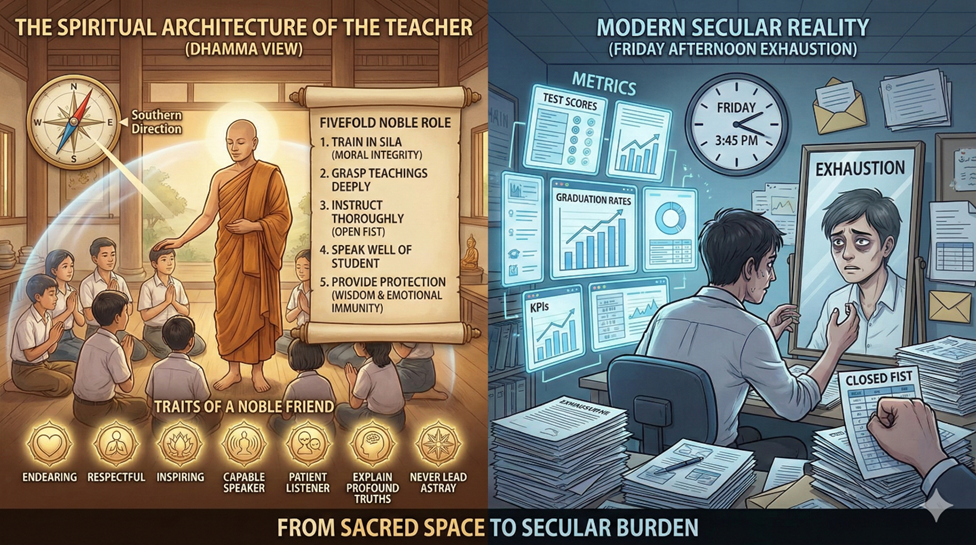
In the Sigalovada Sutta, the Buddha described the six directions that protect a human being. Parents are the East (the forefront), but teachers are the Southern Direction (the right-hand side), a position of immense honor and stability. The relationship is defined by reciprocal duties. The student ministers to the teacher through respect, service, and diligence. In return, the teacher’s noble role is fivefold:
- To train the student in the best discipline. This is not just classroom management, but the cultivation of Sila (moral integrity).
- To ensure the student grasps what is taught deeply, not superficially.
- To instruct thoroughly in all arts and sciences, holding nothing back (opening the “closed fist” of the teacher).
- To speak well of the student among friends and companions, acting as their advocate.
- To provide protection in all directions.
It is this fifth duty—providing protection—that elevates teaching to a spiritual practice. In 2026, “protection” does not mean shielding students from the world, but equipping them with the wisdom and emotional immunity to navigate it.
However, to provide this protection, the teacher must possess the qualities of a Noble Friend. The scriptures tell us that a Noble Friend has seven specific traits: they are endearing; they command respect; they are inspiring; they are capable speakers; they are patient listeners; they can explain profound truths; and they never lead the student astray.
When we look at this list, we see the ideal. But when we look in the mirror on a Friday afternoon, we often see something else: exhaustion.
3. The Storm Outside: The Crisis of Burnout
We must be honest about the suffering (Dukkha) inherent in our profession today. The gap between the “Noble Ideal” and the “Bureaucratic Reality” has become a chasm where burnout thrives.
Globally, teaching has become one of the most stressful professions, exacerbated by a worldwide shortage of 50 million educators. Recent surveys from 2025 reveal that in the United States, up to 60% of K-12 teachers report feeling burned out, with some studies indicating that over 90% have experienced it at some point. This struggle is equally severe internationally: 62% of teachers in the UK and 52% in Australia report significant stress, while in Canada, a staggering 77% suffer from emotional exhaustion. Across Asia, burnout rates hover between 50-70%, confirming that this is not merely a regional issue, but a global crisis hitting younger teachers particularly hard (Teacher Burnout Statistics, 2025).
In Thailand, this global trend mirrors our local reality. Recent research has highlighted a worrying phenomenon known as “Sickness Presenteeism”—where teachers continue to work despite being physically or mentally ill. Studies show that up to 35% of teachers report working while sick, driven by a deep sense of duty and financial necessity. This is not sustainable heroism; it is a slow-motion tragedy.
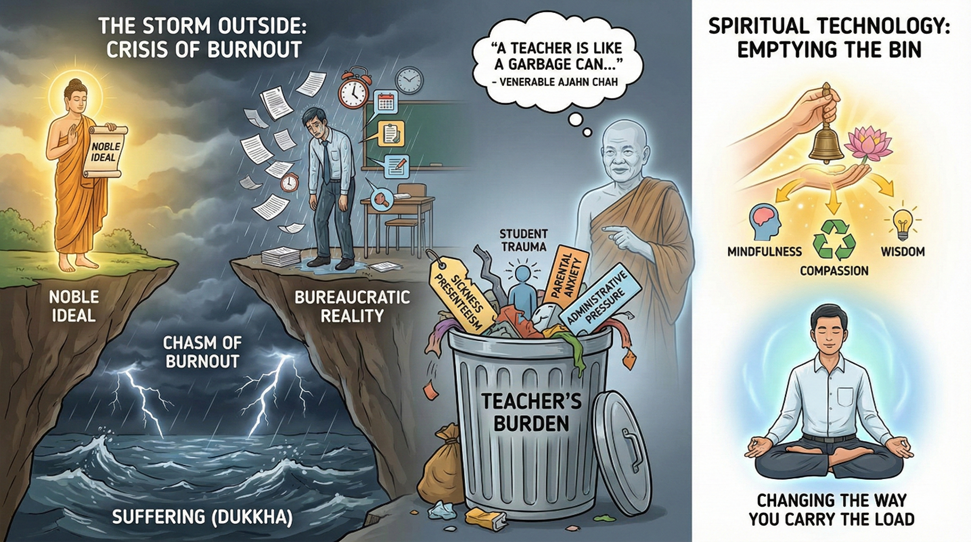
The Venerable Ajahn Chah, one of Thailand’s greatest meditation masters, once offered a visceral metaphor for the teacher’s burden. He said, “A teacher is like a garbage can that people throw their frustrations and problems into. The more people you teach, the bigger the garbage disposal problems.”
In the modern classroom, you absorb the “garbage” of student trauma, parental anxiety, and administrative pressure. If you do not have a way to empty the bin—to recycle that negative energy—you will inevitably decay. This is where the “Spiritual Technology” of Buddhism becomes essential. It is not about adding more to your to-do list; it is about changing the way you carry the load.
4. The Sanctuary Within: The Four Divine Keys
To transform the “Garbage Can” into a “Golden Vase,” we turn to the Brahmaviharas. In English, these are often called the “Sublime Attitudes,” but literally, they mean the “Divine Abodes” (Brahma = Divine, Vihara = Abode). They are meant to be a home for your mind—a sanctuary where you dwell, regardless of the chaos outside.
Here are the Four Divine Keys to overcoming burnout and unlocking a teacher’s happiness:
Key 1: Metta (Loving-Kindness) – The Shield of Safety Metta is the wish for the welfare and happiness of others. In the classroom, Metta is often misunderstood as “being nice” or “letting students get away with things.” It is neither. Metta is a specific mental attitude that protects you from the corrosive effects of anger (Dosa).
When a student is disruptive or rude, the natural reaction is irritation. This irritation burns your energy, not the student’s. To practice Metta is to flip the script. You look at the disruptive child and silently recite: “Just like me, this student wants to be happy. Just like me, they are confused about how to find happiness, and they are making mistakes.”
This simple cognitive reframing—the “Just Like Me” practice—dissolves the “Us vs. Them” dynamic. It transforms the student from an enemy into a fellow sufferer. It acts as a cool shield, preventing the fire of anger from scorching your heart.
(See also: the 18 Science-Based Reasons to Try Loving-Kindness Meditation)
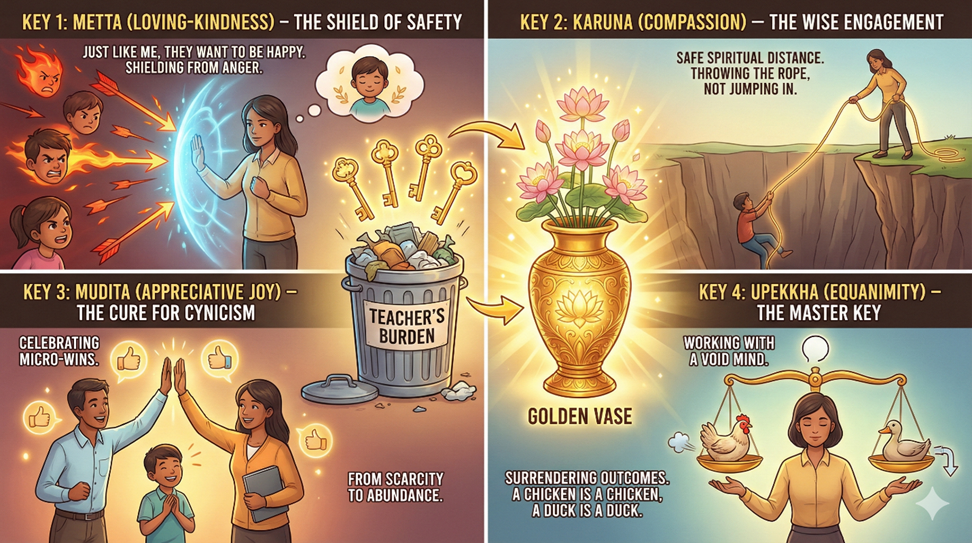
Key 2: Karuna (Compassion) – The Wise Engagement Karuna is the quivering of the heart in response to suffering. For teachers, who are naturally empathetic, this is often a trap. We suffer from “Compassion Fatigue” because we confuse compassion with pity.
Pity is heavy; it involves jumping into the hole with the student. Compassion is standing on the edge of the hole and throwing down a rope. Pity says, “I feel your pain.” Compassion says, “I see your pain, and I am here to help you out of it.”
The key to sustainable Karuna is wisdom. We must recognize that while we can offer the rope (education, advice, care), we cannot force the student to climb. This realization creates a “Safe Spiritual Distance.” It allows you to be fully present and helpful without drowning in the sorrows of those you serve. This is the difference between a lifeguard who saves a drowning swimmer and a lifeguard who drowns with them.
Key 3: Mudita (Appreciative Joy) – The Cure for Cynicism In the competitive world of education, where we are ranked, assessed, and compared, it is easy to fall into envy or cynicism. “Why did that teacher get the promotion?” “Why are these students so entitled?”
Mudita is the practice of taking joy in the success of others. It is the antidote to the “Scarcity Mindset.” When we practice Mudita, we actively scan our environment for “micro-wins.” We celebrate the colleague whose lesson went well. We feel genuine happiness for the student who finally grasped a difficult concept, even if they are still failing the subject overall.
By training the mind to spot goodness, we rewire our brain’s reticular activating system. We move from a mindset of deficit (“what’s wrong”) to a mindset of abundance (“what’s working”). This generates a renewable source of energy that burnout cannot touch.
Key 4: Upekkha (Equanimity) – The Master Key This is the crown jewel for the educator. Upekkha is often mistranslated as indifference, but it is actually a state of immense stability and balance. It is the deep understanding of the law that beings are the owners of their actions (Kammassakata).
As teachers, we often suffer because we are attached to outcomes. We want the student to pass. We want the class to be quiet. When reality doesn’t match our desire, we suffer.
Buddhadasa Bhikkhu, the renowned Thai reformer, taught the concept of “Working with a Void Mind” (Chit Wang-จิตว่าง). This means working with 100% effort but with 0% attachment to the “me” and “mine” of the result. We teach with all our skill, love, and energy, but we surrender the outcome to the laws of cause and effect.
Ajahn Chah offered a simple, humorous wisdom on this: “If you want a chicken to be a duck, and a duck to be a chicken, you will suffer.” Our job is to help the chicken be the best chicken it can be, not to cry because it cannot swim like a duck. Upekkha allows us to care deeply but hold the outcome loosely. It is the release valve that prevents the pressure from destroying the vessel.
5. Practical Steps: Building Your Spiritual Immune System
How do we bring these high concepts into a busy Tuesday morning? We start with micro-habits of mindfulness (Sati).
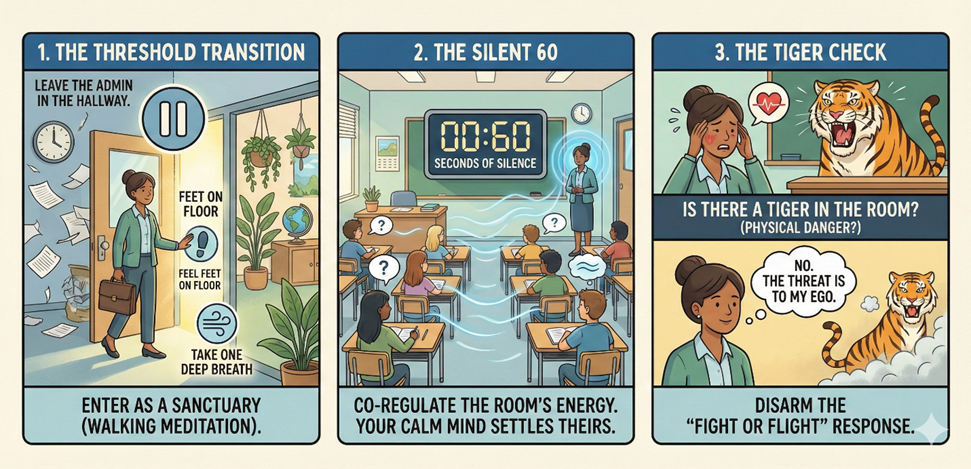
The Threshold Transition: Every time you walk through the door of your classroom, pause for one second. Feel your feet on the floor. Take one deep breath. Leave the administration in the hallway. Enter the room as a sanctuary. This is a form of walking meditation.
- The Silent 60: Begin your class with 60 seconds of silence. Tell the students it is a “focus challenge.” In reality, it is a moment for you to co-regulate the room’s energy. Your calm mind will settle their chaotic minds.
- The Tiger Check: When you feel your heart racing with stress, ask yourself: “Is there a tiger in the room?” (Am I in physical danger?). Almost always, the answer is no. The threat is to your ego, not your body. This realization disarms the “fight or flight” response.
6. Conclusion: Be the Cool Shade
On this 70th Teachers’ Day, as we honor the “One Who is the Mother and Teacher of the Land,” let us also honor ourselves by prioritizing our spiritual health.
To my fellow teachers in Thailand and across the world: You are often called Mae Phim (Molds of the Nation). But remember, a mold that is too rigid will crack under pressure. Be instead like the great Bodhi tree—providing Rom Pho Rom Sai (ร่มโพธิ์ร่มไทย-Cool Shade) for your students. But to provide shade, you must first be rooted and have a canopy of leaves that are healthy and green.
The “Sanctuary Within” is the ultimate cure for burnout. It is not a place you go to escape your job; it is the place from which you do your job. By cultivating Metta, Karuna, Mudita, and Upekkha, you unlock the happiness that is your birthright. You become a light in the dust, a compass in the storm, and a true Kalyanamitta to the world.
Happy Wan Khru 2026.
7. Reference
- Buddhadasa Bhikkhu. (n.d.). Quotes on Practice and Voidness. AZ Quotes. Retrieved December 28, 2025.
- Channuwong, S., & Ruksat, S. (2022). Buddhist Teachings for Improving Mental Health During the COVID-19 Pandemic. The Journal of Behavioral Science, 17(2), 29–41.
- Department of Mental Health, Thailand. (2022). Mental Health Situation Report. Ministry of Public Health.
- Edutopia. (2021). 8 Activities Students and Teachers Can Use to Create a Mindful Classroom.
- Jumpa Saelee, & Josephine E. Katenga. (2025). Teacher Burnout: Experiences of Thai Teachers Teaching English Language at a Faith-Based School in Thailand. Journal of Behavioral Science, 26(1).
- Khurusapha (The Teachers’ Council of Thailand). (2025, December 26). Wan Khru Year 69 Honors “The One Who is the Mother and Teacher of the Land”. Edunewssiam.
- Lindenwood University. (n.d.). Wai Khru: History and Significance.
- Mahachulalongkornrajavidyalaya University. (2015). The Seven Qualities of Kalyanamitta for Teachers. Journal of Buddhist Studies.
- Phra Brahmakunabhorn (P.A. Payutto). (2016). A Constitution for Living. Wat Nyanavesakavan.
- Thanissaro Bhikkhu. (Trans.). (1994). The Teachings of Ajahn Chah. Wat Pah Nanachat.
- Teacher Burnout Statistics in 2025: Causes, Effects, and Solutions. (2025). Wooclap.
- Thanissaro Bhikkhu. (Trans.). (2013). Sigalovada Sutta: The Buddha’s Advice to Sigalaka (DN 31). Access to Insight (BCBS Edition).
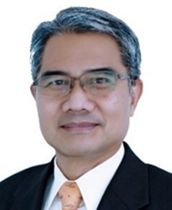
Author: Paitoon Songkaeo, Ph.D.
Transitioning from a Buddhist monk to a diplomat, Paitoon Songkaeo is the Administrative Director of the Thailand Foundation. With a background of 16 years as a Buddhist monk, he later joined the Ministry of Foreign Affairs and retired as the Consul-General of Kota Bharu, Malaysia, in 2017. He may be reached at [email protected].